
The National Archives guide to RG 12 describes 293 photographic prints in series HE showing home economics facilities and student activities in elementary and junior high schools, collected during 1925–1930. These are useful for reconstructing teaching spaces, equipment and period educational methods. They are not a list of all pupils at a school, a complete account of a curriculum or proof that a particular child was enrolled in the pictured class.
For family history, start with the actual photograph’s institution, location and date rather than a broad assumption about what American classrooms looked like in the 1920s. The HE images are historical materials assembled by the Office of Education’s Home Economics Section, not necessarily taken on the day they were collected. A photo labeled with a school name can support research into that building, while attendance and personal identity require records created for those purposes.
Identify the HE Print and Its Original Caption
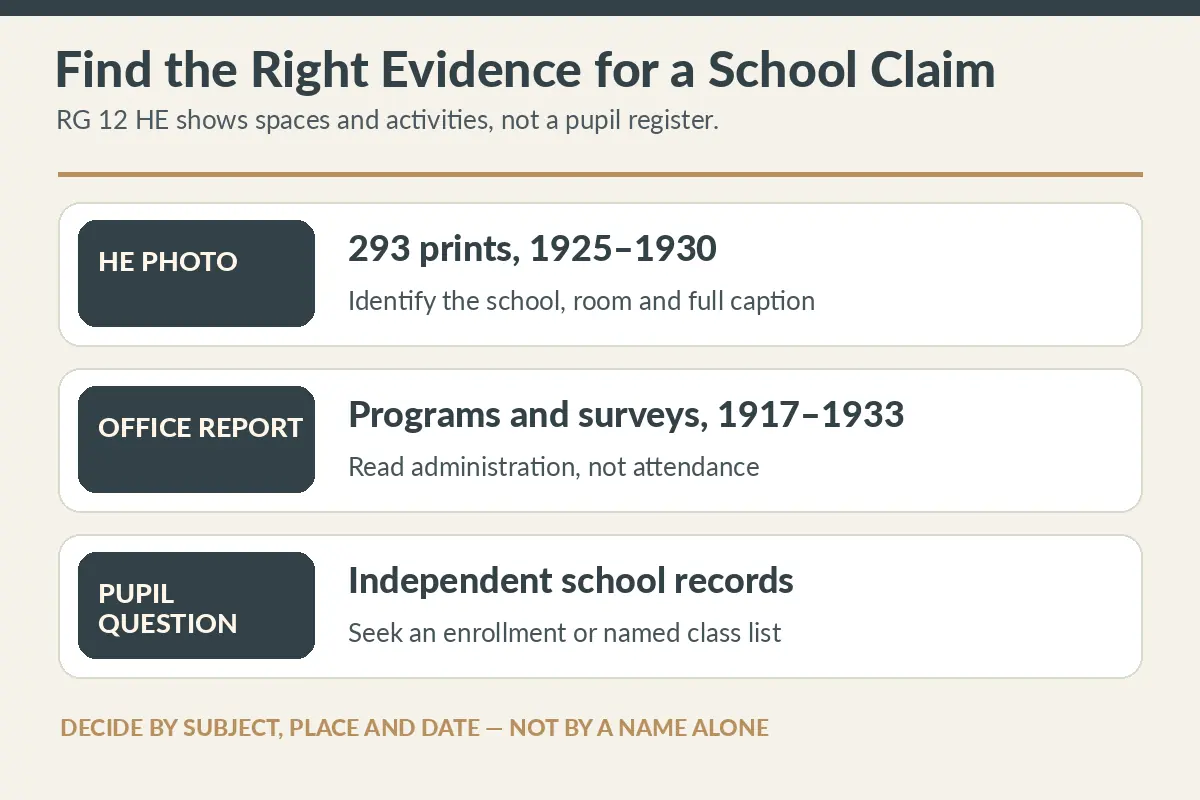
NARA identifies HE as photographic prints and gives a 293-image count. Search RG 12 with the series prefix and terms such as elementary school, junior high, classroom, kitchen or sewing room. Preserve the item identifier, full original caption, photographer if credited, repository citation and reported date. An online scan can leave out the reverse of a print, where provenance notes may be found. Do not treat a generic modern catalog title as a transcript of writing originally on the photograph.
A series count indicates a group of records, not a universally digitized set and not an equal sample of school districts. If only a series description appears, consult NARA’s catalog guidance or request item-level detail. Avoid naming a town from architectural resemblance alone. Similar teaching spaces and standard school equipment could appear in many states, and later building renovation can change the identifiable facade.
Decide What a Classroom Scene Can Prove
A photograph can document visible appliances, desks, demonstration tables, utensils, clothing, posters or students engaged in a lesson. It cannot prove what each child learned, which examination they passed, whether the pictured material was used throughout the school year, or whether a family was able to afford equivalent equipment at home. If the room looks unusually well supplied, consider whether it was selected to illustrate an exemplary program.
Keep caption text distinct from observation. “Sewing machines visible” is an observation; “the students learned a full commercial tailoring curriculum” would need a syllabus or administrative report. A pose may have been arranged for a photographer. That does not make the picture useless, but it weakens any claim about routine daily use of the equipment. Write a description that others can independently inspect.
Separate Collection Dates From Exposure Dates

The RG 12 HE date range of 1925–1930 is a collection description. It does not establish that every print was exposed in those years on a known day, nor that the building was built then. Preserve any more precise date attached to the individual photograph and say how it was determined. If the only source is the series, use a cautious phrase such as “in a collection dated 1925–1930.”
For a school chronology, compare date-stamped yearbooks, district annual reports, city directories, local newspaper school notices and dated building records. Distinguish school opening, classroom renovation and the date of a particular photograph. A building might appear in a later photo after adding a new wing or equipment. One photo cannot fill all those events, and an absent picture does not demonstrate that a class never existed.
Find the School Without Making Up Enrollment
Start with institution names in original captions, including historical spellings and district numbers. Search period county and city records for where the school operated. District boundaries can change and similarly named schools can coexist. Map the identified campus with sources from the same decade when possible rather than assuming a modern street address denotes the 1920s location.
If your ancestor was school-aged, establish residence, age and verified family relationships before searching school registers or board records. Even then, proximity to the school is not evidence of attendance. Family history may require enrollment ledgers, class lists, report cards, diplomas or a caption that actually names the student. If such records are closed, missing or never created, state the limitation rather than extracting a pupil identity from an anonymous face.
Read Office of Education Reports as Policy Context

RG 12 also describes correspondence of the home economics specialist, 1929–1933; reports of the Home Economics Division, 1917–1933; conferences, 1923–1928; and surveys of home economics education, 1923–1926. These administrative materials can explain instructional priorities and program organization, but they are not interchangeable with the HE print series. Use them to research what an agency studied or promoted, not as evidence that every pictured child belonged to a particular course.
When quoting a report, record the state, institution category, date and methodological limits. A national survey may aggregate school programs rather than describe the exact room in a photograph. Avoid turning an educational policy statement into a personal biography. It is possible to put a person’s documented school attendance beside evidence of the era’s educational practices without pretending the archive photographed that person.
Caption Historical Education Images With Care
Historical captions may use outdated terms or assumptions about gender, class, disability or appropriate work. A scholarly caption can preserve the source’s historical title while providing present-day neutral context. Do not repeat a demeaning label as if it were today’s editorial description, and do not claim to know what an anonymous child thought about the lesson. Treat the photograph as evidence of representation and material conditions, not private interior experience.
Before reproducing an image, check custodian information on access and rights as well as whether faces or personal details could involve privacy concerns. For a family album, cite the full NARA image description and explain whether the scene depicts a verified family school or only a comparable setting. Distinguish a modern educational diagram, which is interpretive, from the historical print it helps the reader analyze.
Worked Example: A Sewing Room and an Ancestor’s School
Suppose a 1928 city directory gives a family address near a school, and an HE print depicts a sewing room at a similarly named institution. Compare the exact school name and location first. A credible match would make the photo useful for describing classroom facilities, but the directory does not prove that a daughter in the household attended the lesson. This example is hypothetical and does not identify a real HE photograph.
Search for a dated attendance ledger, a named class portrait or an independently preserved report card. If none survives, caption the photograph as a documented room at a school relevant to the neighborhood, not the ancestor’s classroom. That modest distinction leaves room for future research and prevents an appealing image from becoming a false personal fact in online trees.
More Family Story and Preservation Guides
How We Research and Verify the Archive
We compared the RG 12, section 12.3.3 description with the NARA Still Picture Branch guide. Both support the HE series subject and 1925–1930 dating, while RG 12 separately identifies Home Economics Section administrative reports. Neither source supplies a list of pupils or guarantees that every school has an online item image.
Our evidence model separates the institution, the room and the student. We do not make face-based identifications from anonymous historical images. Illustrated charts are explanatory artwork, not scans of school records. The site’s editorial disclosures are available at affiliate disclosure; no paid genealogy route is required.
The RG 12 guide lists 293 photographic prints collected in 1925–1930.
No. The series describes photographs of facilities and activities, not comprehensive enrollment records.
Yes. It can guide place and institution research, subject to verifying the item and historical school location.
No. The guide separately describes administrative correspondence, conferences, surveys and reports.
No. Opening or building construction requires independent dated institutional records.