
Trace a Published Picture Back to Its Negative
The National Archives describes 690 photographic negatives used in the Agricultural Adjustment Administration’s Consumers’ Guide publication, dated 1937–1942, in Record Group 145. NARA identifies this group as photographic series CG and notes an item list for it. A home interior or farm family depicted in an educational publication can illustrate the publication’s message without being a documentary biography of the people shown. Start with the issue, page and caption if available; then ask which underlying photographic item supplied the image. Do not assume a familiar setting identifies an ancestor or a particular farm.
A print cut from an old publication may have been cropped, retouched or reproduced without its original credit. Preserve all text on the page, issue information and the relation between image and article. The photo’s appearance may date the clothing or equipment broadly, but that is not a substitute for the negative’s own creation metadata. The CG collection date span is a description of surviving negatives, not proof that every photograph was taken in the year it appeared in print. Keep the publication date and photographic date distinct.
Do Not Confuse CG Negatives With CC Photographs

Within RG 145, the Consumers’ Guide CG negatives and the Consumers’ Counsel CC negatives have different purposes and periods. Section 145.2 places the CG images in 1937–1942 and describes home, farm and consumer activities used in the publication. Section 145.3 identifies 450 negatives made for the Consumers’ Counsel during 1934–1939, covering growing, processing and merchandising products, consumer education and federal inspection. A similar kitchen or marketplace scene could belong to either. Use its actual series designation rather than grouping everything under a generic New Deal photo label.
When searching the Catalog or requesting reference help, specify whether you have a Consumers’ Guide citation, a photographic identifier or only a subject description. Ask for the item list for CG rather than assuming a full person-name index. Another group of images in the same record group concerns publicity and broader farm activities; matching an agricultural topic is not enough to prove which negative was used for an article. Record each candidate identifier, captions and production dates. An unrelated photograph can resemble a published picture without being its source.
Separate Visible Detail from Editorial Messaging
A photographed kitchen scene may accurately show a table, appliances, clothing or food preparation while providing no defensible account of who owns the house. The accompanying article could generalize about consumer budgets or household nutrition; its claims may reflect the sponsoring agency’s educational policy. Transcribe the caption literally and distinguish it from a modern interpretation. A sentence such as “efficient family kitchen” could describe an ideal presented to readers rather than an inspector’s finding about the household on that day.
Consider staging, demonstration work and repeated illustration as possibilities, without alleging staging in a particular picture unless the original evidence supports it. Cropping may remove a location marker or another person. An original negative might contain details not visible in the publication. If the photograph includes identifiable people, avoid assigning relationship terms from proximity or apparent age. “Three people at a table” is visible evidence; “a mother and her two children” is an inferred relationship unless the original caption or independent source names and establishes it.
Match the Negative, Issue and Caption Precisely
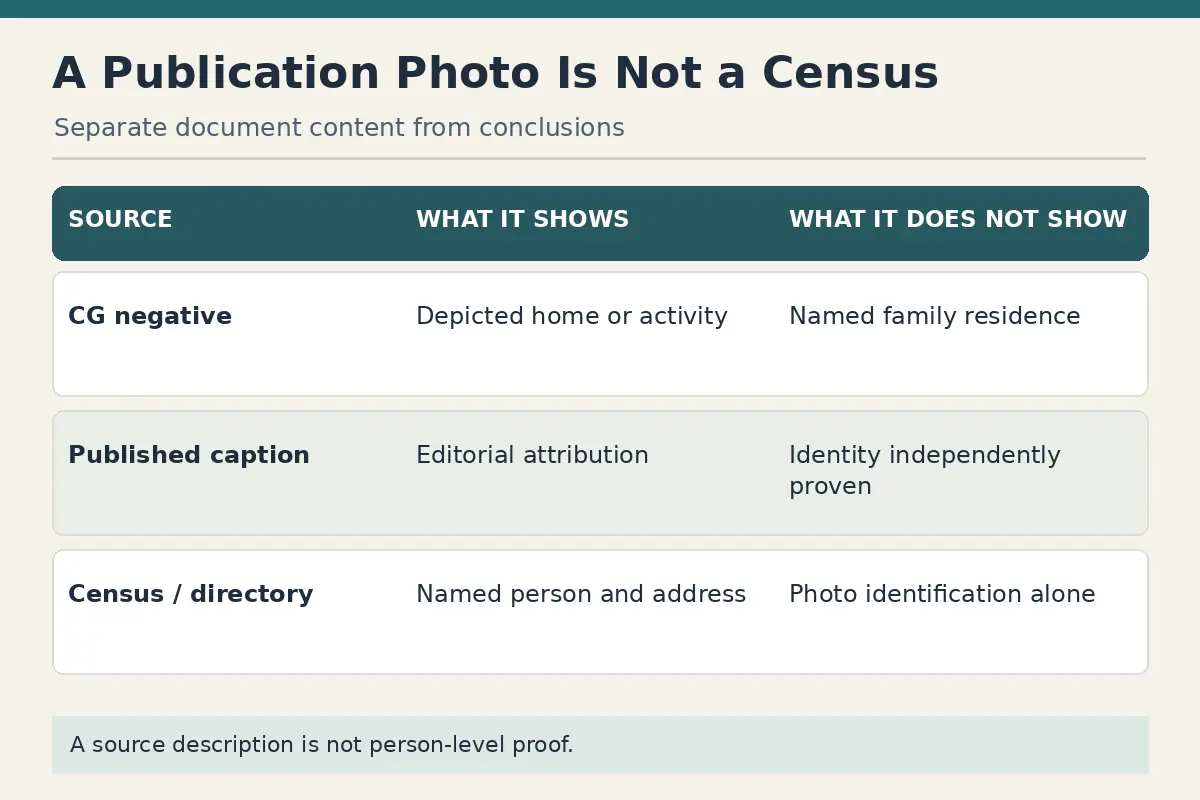
Use a comparison sheet with columns for CG image identifier, original negative title or caption, published issue and page, crop or orientation, date evidence and differences in wording. Identify the exact photograph, not merely a picture with similar subject matter. A mirrored or differently cropped version can still be the same underlying negative; record how you know. If the item list provides only a terse description, refrain from inventing a family name to match the publication. Provide NARA with the strongest identifier and ask how the negative is arranged.
NARA’s still-picture guidance recommends record group, series, applicable box or folder, and a unique item number when seeking a reproduction. A Catalog Local Identifier can help distinguish an image from other content under the same title. Include the National Archives Identifier when shown. Keep the digital filename as a retrieval aid rather than treating it as the archival citation. If a website reposts the photograph, trace it back to the NARA source or a clearly documented period publication before accepting user-added labels.
Test Family or Location Claims Outside the Photograph
A plausible family attribution may begin with an inscription on an inherited print or a relative’s recollection. Test it with an independent document naming the person in the claimed locality and date, such as a census return, directory, deed, employment record or family correspondence. These records can show residence or kinship but cannot, by themselves, prove that the individual appears in the CG image. A secure image-to-person identification needs something more specific: a contemporaneous named photo caption, a verified personal copy with attribution or a robust chain of provenance.
Suppose the publication shows a farmhouse and the family has long believed it depicts their grandparents. A matching county or farm type is supporting context, not a personal match. Compare buildings, land features and dated household documents, and retain all alternative identities. If the photo was deliberately selected as a generic example, the family claim may remain untestable. That is still a useful finding: the image documents the agency’s portrayal of domestic life, even where the subjects are unnamed.
Publish the Image Story With Transparent Limits

When writing a caption, identify the record group and CG series, the negative’s own archival reference, issue and page if matched, and the statements actually supplied by the original creator. Add an access or reproduction citation appropriate to the version used. Archive access and permission for republication are separate matters; check the repository’s guidance before reusing a digital image. Never redraw a modern illustration and imply it is a scan of a historic negative. Be equally cautious with uncertain names in public-facing family trees.
A carefully worded outcome might say that the Consumers’ Guide used a particular RG 145 CG image to illustrate home or farm practices between 1937 and 1942. It might separately note a family attribution remains unverified. Readers can then inspect the issue, negative and named local records independently. A strong historical narrative does not require inventing a complete household biography; explaining what the original educational photograph was meant to show is itself a valuable piece of social history.
More Family Story and Preservation Guides
How We Research This Archival Question
We checked the archival description for RG 145 and its relevant series, then distinguished what the official source explicitly documents from what a researcher might infer. The date spans on this page describe the listed holdings or survey, not a claim of complete digitization or coverage for every locality. We assessed each map, report, directory or inventory at the level of the individual item needed for the research question, rather than treating a series heading as a personal record.
We also compared this route with the relevant repository access guidance and use the National Archives Catalog guidance when a particular file unit or digitized image remains to be located. Evidence limits, alternative explanations and missing dates are named rather than silently filled. Our informational articles contain no confirmed affiliate offer; our affiliate disclosure explains the site policy.
NARA lists 690 CG-series negatives associated with Consumers’ Guide, dated 1937–1942.
No. CC images belong to the Consumers’ Counsel and are described separately for 1934–1939.
No. Relationships require captions with sound provenance or independent person-level records.
Not automatically. Publication, negative creation and later copying dates can differ.
Use RG 145, CG series, item identifier and Catalog identifiers when available, plus any known issue and page.