
A Design Photograph Is Not a Circulating Banknote
The National Archives describes a photographic group in RG 318 containing approximately 4,200 images of accepted and rejected designs for stamps and currency, along with other Bureau of Engraving and Printing subjects, dated 1924–1942. The group is identified as D in the Guide to Federal Records. This is a valuable collection for design history, but its subject line does not say that every pictured proposal was printed or issued. A handsome portrait or border reproduced in an archive image may be a proposal, a revised drawing or a rejected design rather than a security that ever reached the public.
First record the caption and identifier on the particular photograph, not only the title of the collection. If a photograph says “rejected,” retain that classification in your notes; do not relabel it after finding a visually similar issued object. If the descriptive entry says “accepted,” that still leaves separate questions about plates, production dates and quantities. The two words concern a design decision, not necessarily a full manufacturing history. Be equally cautious about public-building photographs or celebrity portraits within the same D grouping: NARA explicitly says the group contains subjects beyond banknote and stamp design.
Select the D-Series Photograph or a Production Record
The research route depends on what you wish to establish. To identify an old photograph of design artwork, begin with the D-series description and search the Catalog by object type, approximate date, subject and any design number. To establish whether engraving equipment was prepared, turn instead to the bureau’s records of dies and plates. NARA lists records of plates dated 1875–1966, die records spanning various periods and specific plate indexes for the early twentieth century. These are separate categories of evidence rather than stages every proposal necessarily passed through.
If the claim concerns the workforce instead of the object, the relevant records change again: RG 318 also includes lists of employees, employment applications and registers of personnel changes. A worker’s presence in an agency ledger does not identify the anonymous person in a photograph of a printing room. Do not treat the existence of all three record groups as an automatic connection among design, printer and circulating note. Name the exact question first—what was pictured, what was manufactured, or who worked there—and search the series that can answer it.

Read the Caption Before Judging the Artwork
Treat a photograph as a document with its own provenance. Note whether the item is a negative, a photographic print or a digital reproduction; capture the date assigned by the cataloger and the words used for acceptance status. Look for marks showing scale, crop, retouching or mounting. A web image can trim away critical marginal writing, while the original print may include a photographer’s notation or office number. Since the NARA description groups photographs by subject, a date range for the series cannot be equated with the creation date of every underlying design.
Build a side-by-side description using visible facts rather than imagined attribution: denomination or stamp topic if readable, border shape, portrait subject, lettering placement, orientation and any official item number. If a detail is not legible, write “not legible in the available copy.” Avoid reconstructing small lettering by guessing what a real banknote normally says. This restraint is especially important when publication illustrations crop or recolor the source. The objective is to locate a specific archival photograph that other researchers can verify, not to create a plausible replica of a currency design.
Separate Proposal, Engraving, and Issue Evidence
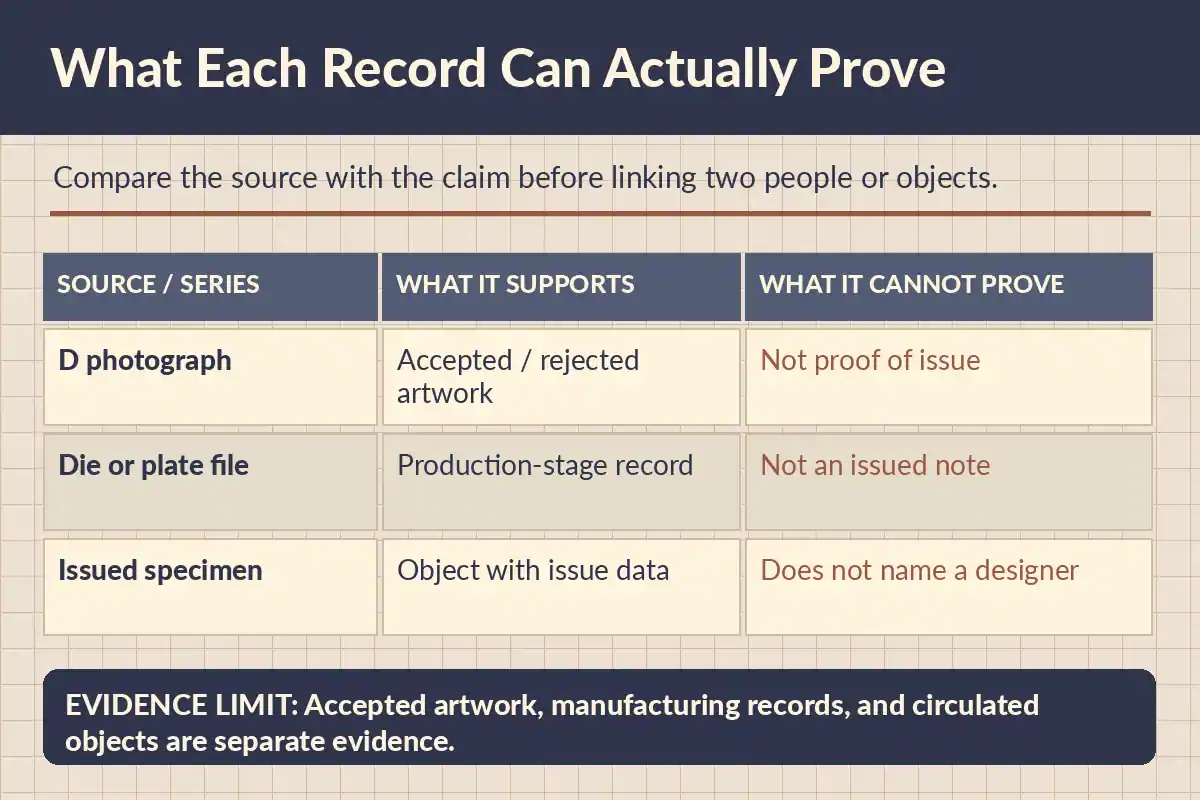
An accepted design is one evidence category; a manufactured die or plate is another; a note or stamp that was issued is a third. NARA’s RG 318 inventory documents separate records of dies, rolls and plates, so a design-to-production comparison can be asked as a concrete archival question. It does not follow that a matching image proves continuity through all stages. A plate record may belong to a different revision or denomination, and a later printed sample may share some motifs with a rejected draft. Write down which matching features are demonstrable and which are visual impressions.
Where possible, compare the proposed design to an independently identified issued item from a reputable museum or government collection. Record the issuing authority, series or issue date and the source of the comparison, not a guessed year based on artistic style. If you cannot establish that connection, the correct conclusion may simply be that RG 318 preserves an image of a design under consideration. That is a substantial historical fact. It may tell a story of the bureau’s selection process even when the design never reached circulation.
Avoid False Artist and Family Attribution
Historical engraving is collaborative. Designers, engravers, plate technicians, printers and office administrators could perform distinct work on the same production. A signature or note on an image may refer to an artist, a reviewer or a photograph caption rather than the person who cut the plate. If a family tradition claims that a named relative designed a famous stamp, locate a source that explicitly assigns the relevant role before joining the name to the design. Similar surnames in personnel lists are not enough to identify the creator of an image.
When tracing a named employee, use dates of employment and documented positions, and then look for independently dated correspondence connecting that individual to the object. Even an employee roster cannot establish authorship of a particular motif. The D-series photograph can ground the object side of the inquiry; the personnel and correspondence series may ground the person side. The link between them must be proved, not supplied by the researcher’s enthusiasm. Preserve uncertainty in captions so later family members can distinguish the verified object from an appealing narrative.

Request a Complete Image and Cite Its Status
For a request, provide “RG 318, D photographs, 1924–1942,” the design subject, any printed identifier and the Catalog entry or photographic item number. Ask for both sides of the object if the source is a physical print and for a scan that includes all marginal annotations. If you need production evidence, say so explicitly and ask which die or plate series may be relevant. Do not request an “original banknote” when the located record is only a photograph of artwork. That distinction makes the request more efficient and improves the final citation.
A responsible publication caption should say “design photograph,” “proposal,” or “accepted design” only where supported by the item’s description. Include a repository, RG, series, item title and identifier, plus a description of the copy used. Because Catalog descriptions may exist without digitized objects, note whether the image was personally inspected or merely located in an inventory. If you find contradictory dates or statuses, report both and investigate the underlying records rather than silently resolving the conflict. Historical design research benefits from accurate uncertainty just as much as genealogical research does.
More Family Story and Preservation Guides
How We Research This Archival Question
We reviewed the official RG 318 archival series description and checked the date spans and record types in the source against every decision shown in the accompanying explanations. We also used a second institutional source for the historical or collection-specific distinction. These are descriptions of archival holdings and practices; they are not evidence that a particular person, building, design, or vessel was present. We did not infer complete series survival or universal digitization from a collection heading. The evidence table marks what remains to be verified in an individual record.
For the research and citation workflow, we checked NARA’s Catalog guidance, which distinguishes record groups, series, file units, and individual items. Researchers should use current Catalog entries and repository staff to confirm custody, availability, exact date coverage, and restrictions because the printed Guide to Federal Records is a historical overview rather than a constantly updated item inventory. All reader-facing images on this page are original explanatory illustrations, not scans of original archival objects. We have not confirmed any paid partner referral; the site’s affiliate disclosure states the general policy.
The Guide to Federal Records describes about 4,200 D-series photographs, including accepted and rejected stamp and currency designs, dated 1924–1942.
No. A design decision and later production or public issuance are distinct claims.
No. The photographs and textual records of dies or plates are separate RG 318 material types.
Usually not; use a documented role and independent correspondence or personnel evidence.
Supply RG 318, the D-series context, subject, catalog or item number and a request for full annotations.