
The National Archives guide for Record Group 48 describes 81 photographic prints identified as EXS and documenting U.S. Department of the Interior exhibits at an international exposition in Seville, Spain, dated 1928–1929. The collection is a route into the history of displays, government publicity and exhibition design. It is not a ticket register, a guest book or a list of everyone who worked at the fair.
Begin with a visible exhibit panel, object, label or room layout, then ask who assembled it and what the historical caption actually identifies. An exhibit may represent a place or community without showing a person from that place. Similarly, the presence of a national or departmental symbol in a photograph does not demonstrate that a particular family member traveled to Spain.
Recognize EXS as a Specific Interior Department Picture Group

The NARA guide places EXS within the still-picture holdings of the Office of the Secretary of the Interior, Record Group 48. That provenance matters: it tells you why a federal agency retained the pictures, not the identity of every figure in them. Nearby in the guide is RST, a broad 517-image group of parks, industries, towns and other subjects from different dates and origins. Treat EXS and RST as different research paths.
When searching the Catalog, pair EXS with Seville and the agency name. A generic query for “Seville exposition” can retrieve programs, tourist postcards and photographs from other participants. Preserve the original archival group and the exact caption; do not blend images of different national displays or later reproduction albums into a single purported Interior Department exhibit.
Read Captions, Labels and Objects in Three Separate Passes
First describe only the visible features: cases, models, photographs, maps, textiles, artwork, printed signs and the arrangement of the room. Second transcribe any visible wording carefully, distinguishing fully legible letters from uncertain readings. Third read the repository caption and identify whether it names the exhibit, the subject of an exhibit, or the person who photographed it.
An image of a model mine or national park is evidence of representation at the exposition; it is not evidence that the scene depicted was physically located in Spain. A photograph within a display is itself a second image with a potentially separate maker, original date and location. If you intend to publish an illustration, record those nested layers rather than assigning the exhibition date to everything pictured.
Distinguish Agency Participation From Personal Attendance

A photograph of an Interior Department exhibit shows that a display was photographed under federal custody. It does not show who transported objects, installed panels or staffed the room unless a caption or associated document says so. Even a visible person may be a visitor, a technician or another agency representative. Avoid identifying them on the basis of a badge-like shape or formal clothing.
To research a named delegate or worker, seek contemporary exhibition directories, published programs, travel orders, personnel correspondence, shipping manifests or period newspapers. Each might establish a different link: assignment, travel, presence or public mention. A printed program could list an intended speaker who later did not attend, so compare promised participation with evidence of what happened.
Place the 1928–1929 Dates on the Correct Evidence
The 1928–1929 dates describe the EXS images as presented in NARA’s guide. Do not assume every photographed object was made during those years or that a particular exposure happened on opening day. Archive date ranges commonly encompass preparation, exhibition and later documentation; the precise event sequence requires dated item-level evidence.
When a caption identifies a project that existed years before the exhibition, record both times. A map on the wall might be historical, a model newly prepared, and a photograph a later reproduction. Make a three-column timeline: date represented, date of the physical display, and date of photographic recording. This prevents inaccurate captions such as saying that a historical park was established in the year a display about it was photographed.
Trace Who Made and Supplied an Exhibit Piece
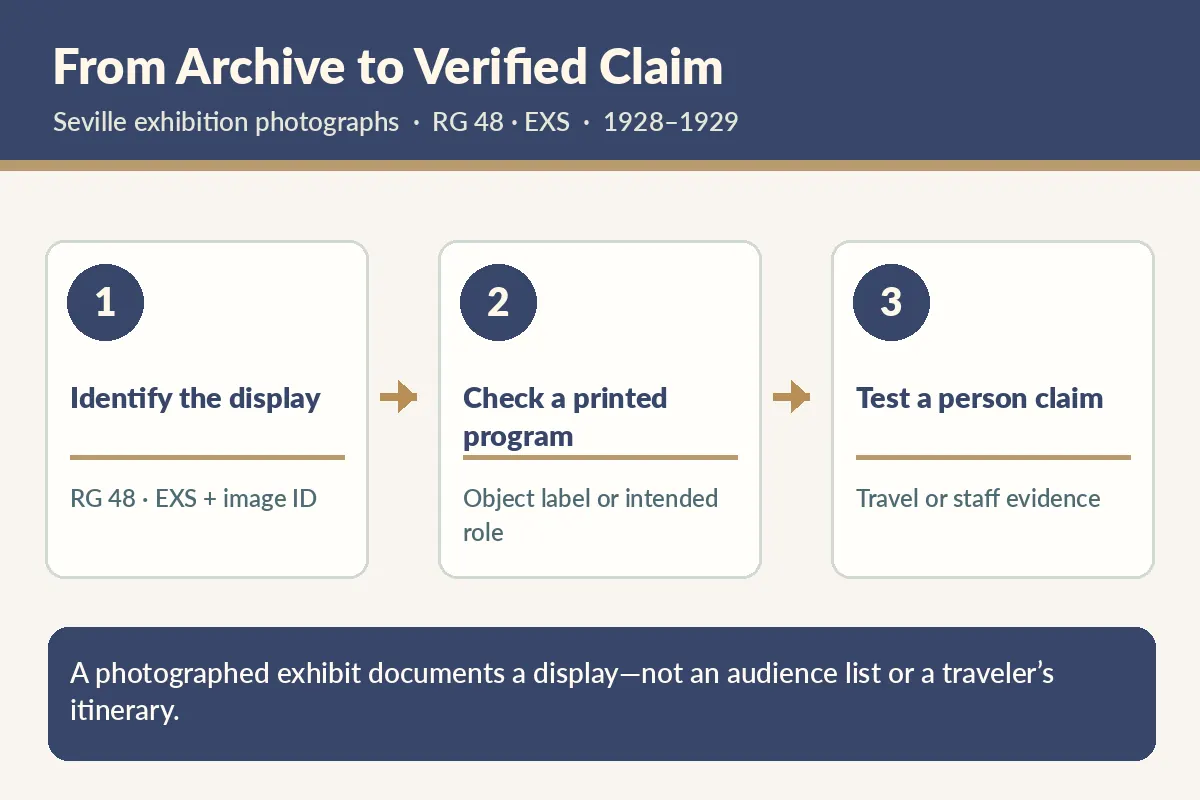
Look for departmental annual reports, acquisition files, shipment correspondence, invoices and contemporaneous exhibition catalogs that document a particular object. A departmental photograph can be an excellent visual checklist for matching the dimensions or title of an exhibit item; it rarely establishes legal ownership or an artifact’s entire chain of custody. Physical objects may have been borrowed or later returned.
If a label displays a location, an organization or a commercial name, distinguish the place represented from the creator and from the depositor. Verify proper names against contemporary spelling, especially where a translated exhibit title differs from an English record. Do not invent a sponsor or a partnership because two symbols occupy the same exhibition wall.
Handle Photographic Reproductions and Rights Carefully
Locate the specific EXS image in the Catalog and inspect the provided metadata for medium, creator, reproduction history and access. The record-group guide establishes an archival lead, not that each of the 81 prints is digitized or free from third-party rights. A privately produced object depicted inside a federal exhibit may have a different rights history from the archival print.
When you create an editorial diagram explaining the exhibit, label it as an interpretation rather than a facsimile of the 1929 display. Preserve uncertainty about colors in black-and-white pictures. If you share an actual archival image, cite the holding and image identifier and review the repository’s use guidance rather than relying on the broad fact that the record is federal.
Write a Source-Transparent Exhibit History
A defensible account links three records: the EXS print, an independent contemporary catalog or government file about the exhibit, and a separate record supporting the proposed person or object. Record the original label wording and any transliteration variants. If only the print survives, write about the visible display, not an imagined visitor biography.
This method is also useful for family collections containing fair souvenirs. A postcard or family anecdote may suggest interest in an exposition but does not prove attendance. Compare an independently dated travel document, residence record or diary before concluding someone visited Seville. When evidence remains sparse, state that the exposure documents a federal exhibit and leave the family claim open.
More Family Story and Preservation Guides
How We Research the Archival Trail and Its Limits
Our method begins with the NARA record-group description and records the exact subject, group code, medium, year span, and stated holdings before interpreting a particular item. We distinguish what the published guide confirms from what a caption or original image would have to establish. The Catalog guidance explains why a series description is not the same as a digitized item.
For specific claims about people, places or property, we compare at least one independent dated record and retain negative or ambiguous results instead of filling gaps with plausible stories. We do not assume that all items are online, that an illustration is a faithful facsimile, or that a proposal was completed. NARA’s copy-request guidance explains why a precise citation matters. Our affiliate disclosure explains the site’s policies; no affiliate relationship is asserted by these archival links.
No. EXS describes photographs of Interior Department exhibits rather than a visitor register.
It is the photo-group designation used by NARA for 81 Interior Department exhibit prints dated 1928–1929.
No. The photographed display can contain objects or images made in earlier years.
It can demonstrate a scheduled role; travel or event records strengthen a claim of actual presence.
Use the Catalog hierarchy and ask NARA with RG 48, EXS, the caption, and any image identifier.