
Begin With the ML Collection, Not a Family Name
The National Archives describes an RG 83 photographic group coded ML, with about 5,000 images relating to product standardization, improved processing and marketing practices, and the establishment of marketing cooperatives between 1902 and 1938. This is a strong lead for research into packing houses, grading, rural markets, and the visual context of farm businesses. It is not a published membership register. A person standing near a cooperative sign cannot be named from the collection description alone.
Frame the question first: are you identifying a facility, tracing the introduction of a processing method, dating a family photograph, or researching a relative’s actual membership? The ML material can potentially support a visual and institutional question. Membership, ownership, and employment require their own records. A relative’s presence in a county with a well-known growers’ association is insufficient to attach that person to an undated group portrait or facility image.
Distinguish ML From Neighboring RG 83 Photo Groups
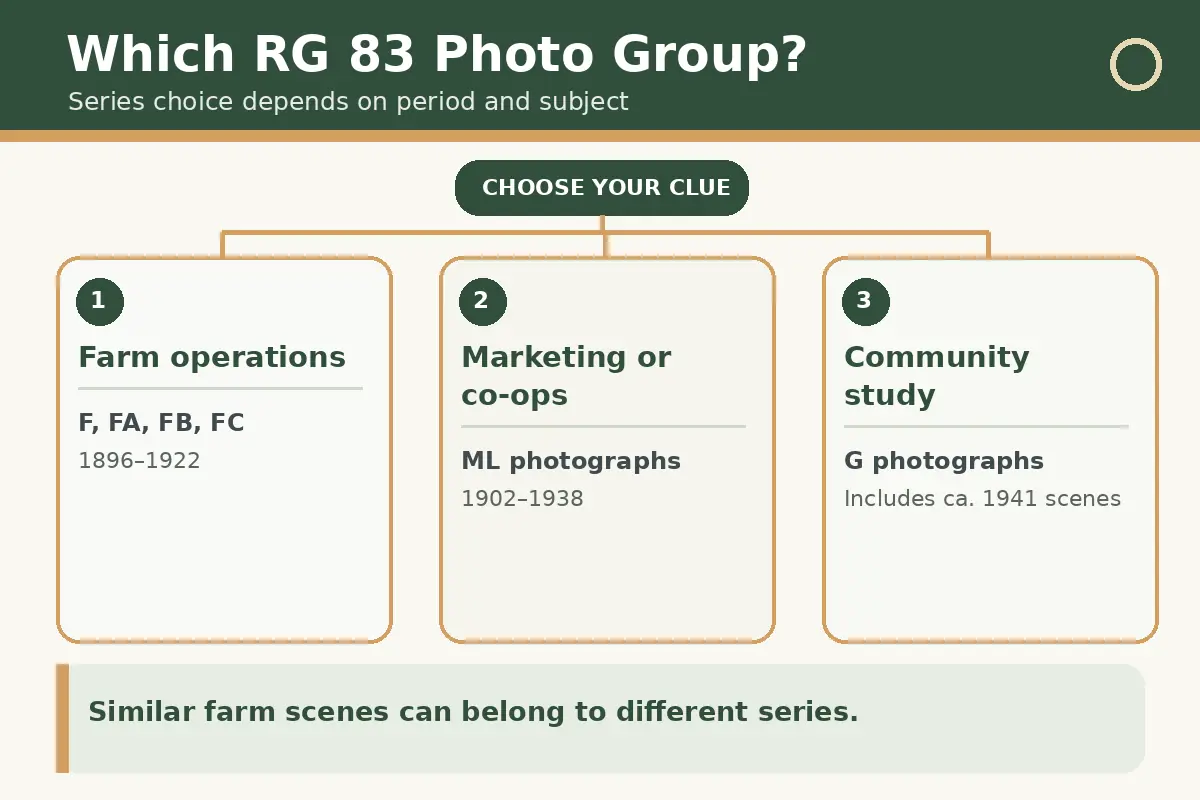
NARA lists several RG 83 image groups. Farm operations and rural life, 1896–1922, appear under F, FA, FB, and FC. The ML series addresses product standards and marketing practices, 1902–1938. The G photographs cover farming and marketing techniques over a different span and include images associated with a circa-1941 Community Stability and Instability Study. A topic or county can overlap while a creating series and historical purpose differ sharply.
Choose by the evidence needed, not by whichever search thumbnail looks familiar. If the research question concerns an early cooperative packing system, ML is a reasonable starting description. If it concerns 1941 living and working conditions, seek the G context instead. A photograph migrated to a later publication may have lost its original series identification. Copy the repository citation from the item or its album rather than assigning ML merely because fruit crates or a warehouse appear.
Read Labels and Equipment Before Identifying People
A photographic print may show a grading belt, baskets, crates, a weighing station, a warehouse, or an association sign. Record each visible feature as an observation and retain exact wording on labels if legible. A stamp on a box may identify a distributor, a commodity, or a place but not necessarily the farm that grew it. When text is partly obscured, show the uncertain letters rather than reconstructing a familiar company name without an independent match.
Avoid assigning gender, occupation, kinship, or union membership from clothing alone. People in photographs can include staff, visitors, officials, and people staged for an educational demonstration. Even a historically plausible farmworker identification must be grounded in a caption or external record. If a caption claims someone is a manager, record that attribution with its original source and test it against a dated directory or cooperative annual report where available.
Separate a Promoted Practice From Its Adoption
The Bureau of Agricultural Economics documented and promoted practical changes in marketing and agricultural economics. An image of a grading machine establishes that the machine was photographed, not that every farm in the county used it. A demonstration could present a recommended method or a model facility. Describe the scene in its own terms, and distinguish illustrative or instructional photographs from routine business records. Do not convert a general educational image into evidence about the daily work of an ancestor.
For a claim that a cooperative adopted a practice by a certain date, search for a facility-specific ledger, annual report, advertisement, regulatory inspection, or local news report that actually records operations. Compare the organization’s historic name and address; cooperatives can merge, rename, or move. If an image’s caption contains a date, decide whether it denotes exposure, processing, publication, or transfer. The original image date should not be inflated to cover the full operation period of the organization.

Locate the Business Without Presuming Ownership
Create a location ledger with the visible business name, approximate year, locality, building features, and potential independent sources. A common warehouse design is insufficient to identify an address. Look for a rail siding, street intersection, distinctive loading doors, landscape features, and signs. Compare these against dated directories, county maps, trade journals, or other reliable materials, preserving the different purposes of each source. The ability to place a building does not reveal the private members of its organization.
For genealogical identity, require a person-specific bridge such as a cooperative membership ledger, a payroll, a business filing, or correspondence naming the person at a dated location. A family orchard shipping fruit through a cooperative does not automatically make the orchard owner an officer or employee. Likewise, a packing crate labeled with a brand does not prove the photographed workers were family members. Label unverified suggestions as possibilities and keep evidence and inference in separate columns.
Locate and Cite the Original Photographic Print
Start with RG 83, section 83.10, to identify ML separately from the F and G collections. In the Catalog, try a distinctive crop, process, location, cooperative name, and the term “ML” with the group description. Do not assume that an ordinary keyword search checks every uncaptioned image. The archival guide reports record groups, not comprehensive facial identification or universal downloads.
For reference staff, provide the suspected facility, approximate years, copied caption, and original series code if known. Ask whether the mount, negative, album sequence, or item-level finding aid can be inspected. Keep the full frame and original caption together. A modern website’s cropped repost may be useful for discovery but should never replace a repository-supplied citation when making a historical identity or property claim.

More Family Story and Preservation Guides
How We Research Agricultural Photo Claims
Our method distinguishes visual observation, photographer or agency attribution, caption statement, and outside corroboration. RG 83 supports a documented ML collection concerning marketing and cooperatives; it does not provide named membership merely because the depicted subject is a cooperative. We compare dates and source types before connecting a business, building, or person. If a name cannot be supported, the public caption remains descriptive rather than biographical.
Preserve alternative facility identifications and record where evidence stops. The affiliate disclosure is available to readers; this approach does not depend on an affiliate purchase. A useful historical result might identify a packing process or building type while leaving the workers unnamed. Keeping those limits explicit helps future researchers test the same question without repeating an unsupported family legend.
No. NARA describes ML as a major marketing and cooperative set, but similar subjects appear in other collections and later publications. Verify the item-level reference.
Not reliably. It may name a shipper or brand rather than the grower; use independent business and land records.
No. Membership or employment needs person-specific dated documentation such as a ledger, payroll, or correspondence.
It is the date span NARA associates with the ML photo group, not an exposure date for any unlabeled individual photograph.
Preserve its URL as a lead, then obtain the original archive image, full caption, and series identifier before making a firm claim.