
Start With the Grant Date, Not the Modern Number
Before July 1836, the United States did not use the modern continuously numbered patent system. An early invention was identified chiefly by the inventor’s name and the date on which a patent was granted. The National Archives places these early name-and-date patents and their reconstructed records in Record Group 241. A family paper that names an invention but gives no serial number is therefore not automatically incomplete. Begin with the words of the document, the inventor’s full name, the type of machine or process, and a date that can be checked against the early patent lists.
The famous Patent Office fire of December 15, 1836 destroyed most of the original patent records then held by the office. Congress authorized a reconstruction effort in 1837; people could submit original instruments, certified copies, or sworn replacement accounts. Consequently, the date on a surviving drawing may represent when a replacement was made, not when the invention was patented. A family story that a relative held an 1819 patent can be compatible with a drawing produced in the 1840s. Keep both dates on the same research note instead of choosing one.
Choose the Right Side of the 1836 Boundary
The first decision is whether the claimed grant falls before or after the July 1836 change in numbering. For a pre-change grant, search the name-and-date route and record any later X-designated identifier. NARA describes copies of Patent Heads made during 1839–1887 for grants dating 1794–1835, and restoration-era drawings produced in 1837–1847 for patents dated 1791–1836. These are overlapping but distinct descriptions; a drawing need not have a matching Patent Head in the same container. A surname match in a retrospective list is a lead, not the end of identification.
For a numbered patent granted after the change, turn to the separate RG 241 numbered-patent records rather than forcing an X number onto it. NARA describes original utility patent drawings from 1837–1871 and patent application files extending much later. Boundaries around 1836 require particular care because the office’s administrative change and restoration of earlier material happened close together. Give an archivist an exact grant date, inventor name, device description and any identifier displayed on the paper. That compact packet makes it easier to distinguish two people who shared a surname.

Read a Reconstructed Drawing as Evidence of a Claim
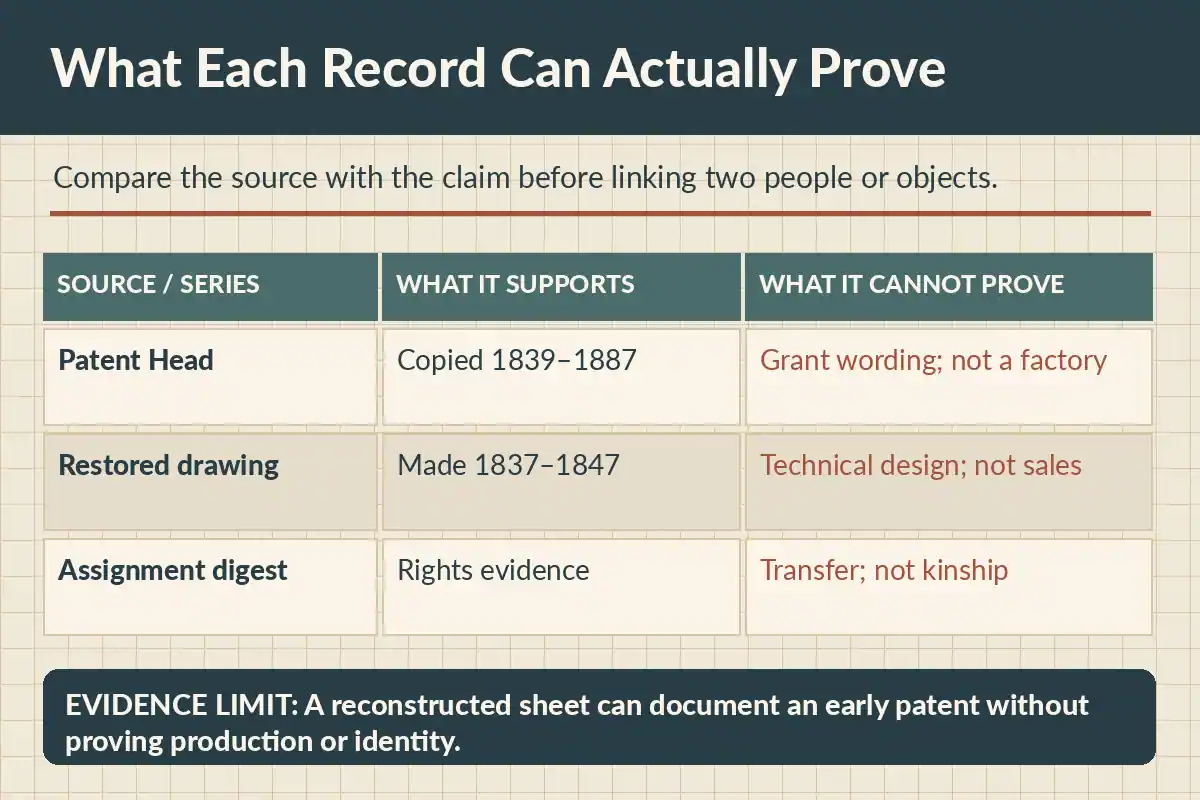
A drawing can show a mechanism, labeled parts, proportions and the way an inventor represented an idea to the Patent Office. It does not, merely by existing, prove that a factory manufactured the design, that a buyer used it, or that an ancestor earned a living from it. A later hand-traced image may preserve valuable engineering details while differing from the original submitted sheet. Ask whether the item is a reconstructed drawing, a copied specification, a Patent Head, or a modern reproduction. Record the medium and any date of copying instead of labeling every sheet an original patent.
In a useful transcription, separate the visible title or description of an invention from the researcher’s modern interpretation of its use. Copy the inventor’s spelling as written and log variants separately. When an image is cropped, request the complete sheet so marginal notes, filing references and annotations are not lost. An X identifier should be treated as a retrospective retrieval key, not as evidence of an eighteenth-century numbering procedure. Read the Catalog’s hierarchy for the file unit and item, if available, before assuming a search-result thumbnail is the complete archival object.
Compare the Patent Head, Specification, and Drawing
Patent Heads, specifications and restored drawings answer different questions. A certificate copy may establish a stated grant and its wording; a specification explains what was claimed; a technical drawing expresses the inventor’s construction. NARA’s ranges for these record types are not identical, so a missing image may reflect what survived or has been digitized rather than proof no patent existed. Maintain a short evidence table with the date on the alleged grant, the date of each surviving copy, the X number if present and the description of the device. Note explicitly where a detail appears in only one version.
One practical comparison is to place a family obituary beside the official patent information. The obituary may call a person an inventor without giving a patent date; a Patent Head may name a similarly spelled individual without a residence that can identify the person. A separate census, city directory, estate file or contemporary advertisement can connect the patented invention to a real individual or business. Neither a distinctive surname nor the fact that an old drawing exists makes that connection by itself. Prefer two independently dated sources with an identifiable place over an attractive story.
Test the Inventor Identity Without Inventing Success
Name variations matter especially in the earliest Patent Office materials. An inventor might sign with initials, appear under a normalized forename in a later index and use an entirely different wording for the invention in a local newspaper. Preserve the exact archival form and search alternate spellings methodically. Use a date window around the alleged grant and look for compatible occupations or addresses in period records. If the only proof is a distant family genealogy repeating the patent story, label that story unverified rather than citing it as a second independent source.
Distinguish a grant from a commercial result. A patent could have been granted without a documented factory, investment, assignment or sale. Assignment records in RG 241 become a separate investigation when property rights changed hands, but a name in an assignment digest is not a complete chain of ownership. Likewise, an invention’s similarity to a modern product cannot establish technological influence. State what the document supports—an identified grant, a copied drawing, or a recorded transfer—and what remains an open hypothesis. This phrasing protects both the inventor’s real accomplishment and the credibility of the family narrative.

Write a Request That an Archivist Can Answer
Start an item request with “RG 241, reconstructed name-and-date patent,” then add inventor, grant date, any X-number, drawing description and the exact Catalog or finding-aid identifier found. Ask whether the described item is a later reconstruction, what related specifications or Patent Heads are present, and whether higher-resolution or full-sheet images exist. Do not assume a photo on a public website means the entire file has been digitized. NARA’s Catalog includes series descriptions even when item-level scans are absent; that difference should shape the wording of a remote request.
When you save a citation, note the archival series, item title, identifier and physical or digital copy consulted, plus the checked date. Preserve the publication URL or finding-aid link separately from the record identifier: websites can change while descriptive identifiers remain useful. If NARA finds no surviving item, describe the scope of the search and ask whether a parallel source such as a printed patent index exists. An unsuccessful Catalog query is not proof that the inventor never obtained the grant. The goal is a documented, reproducible answer, not a forced family legend.
More Records and Archives Guides
How We Research This Archival Question
We reviewed the official RG 241 archival series description and checked the date spans and record types in the source against every decision shown in the accompanying explanations. We also used a second institutional source for the historical or collection-specific distinction. These are descriptions of archival holdings and practices; they are not evidence that a particular person, building, design, or vessel was present. We did not infer complete series survival or universal digitization from a collection heading. The evidence table marks what remains to be verified in an individual record.
For the research and citation workflow, we checked NARA’s Catalog guidance, which distinguishes record groups, series, file units, and individual items. Researchers should use current Catalog entries and repository staff to confirm custody, availability, exact date coverage, and restrictions because the printed Guide to Federal Records is a historical overview rather than a constantly updated item inventory. All reader-facing images on this page are original explanatory illustrations, not scans of original archival objects. We have not confirmed any paid partner referral; the site’s affiliate disclosure states the general policy.
They are pre-July-1836 U.S. patents that received retrospective identifiers ending in X during the later reconstruction.
No. NARA documents a reconstruction process, including original or certified copies and sworn replacement documents; survival varies.
Not necessarily. A restored drawing may have been produced later than the pre-1836 grant it describes.
No. Commercial manufacture and personal identity need separate contemporary evidence.
Include the inventor, grant date, invention description, any X-number and the most precise RG 241 Catalog reference.