
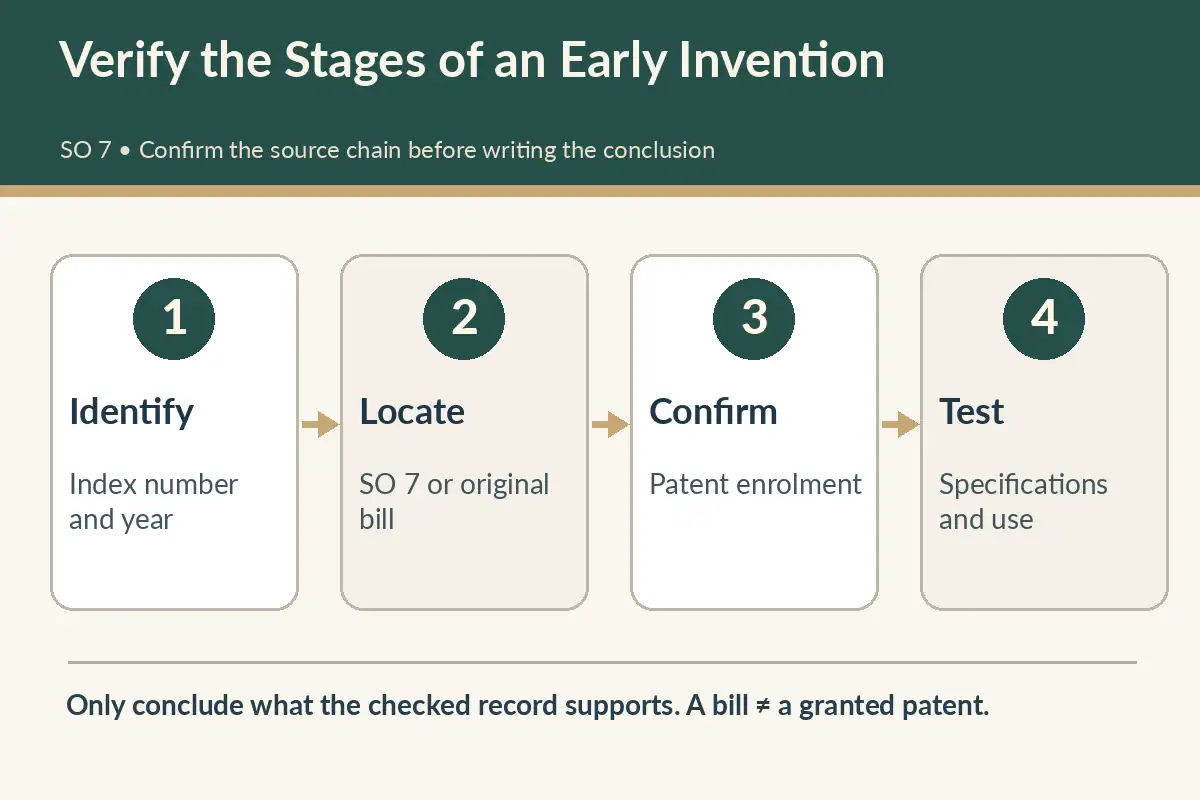
SO 7 is a route into early English patent administration, not a catalogue of every successful invention. The National Archives identifies bills authorizing the issue of letters patent from 1661 and notes that some include drawings. To research an inventor responsibly, begin with the historical index and the question being asked: did someone propose an invention, receive authority for a grant, obtain enrolled letters patent, or demonstrate that a device was built? Those are different claims, often supported by different documents.
Locate the Inventor in Historical Indexes First
The National Archives describes printed indexes compiled by Bennet Woodcroft for patents of invention up to October 1852. They include patentee, subject, chronological and reference sequences. The progressive number and the associated year allow a more reliable search than a modern keyword alone.
Record spelling variants and the historical vocabulary of the invention. A device now called an engine, pump or battery may appear under a period description. Never translate a vague subject heading into a precise technical specification without examining the patent papers themselves.

Understand What an SO 7 Bill Represents
Bills in SO 7 concern authority to issue letters patent and date from 1661 in the archive guidance. An authorization bill is part of the administrative route; it should not be described as the finished patent unless the source establishes that the grant followed.
Read the heading, parties, petition or bill text and any endorsements before drawing a conclusion. Transcribe the exact procedural language and put “authorized,” “sealed,” “enrolled” or “petitioned” in separate fields. A cancelled or revised proposal can contain historically valuable ideas without proving a final grant.
Find the Chancery Enrolment for the Actual Grant
Before October 1852 the Court of Chancery was responsible for recording patents of invention in England and Wales. The archival guide distinguishes original enrolled patents from specifications, which may have been stored separately. Therefore a citation to a bill does not replace a citation to an enrolment.
If the Woodcroft index supplies an identifier, follow the official guide to the relevant enrolled patent and verify the inventor, date and language of the grant. A specification, when one exists, can describe the claimed technique but should not be paraphrased beyond what the drawing and text show.

Avoid Treating an Illustration as a Working Machine
Some early bills or specifications include drawings. A sketch is strong evidence of a design concept, not of successful manufacture, a commercial installation or safe operation. Look for dated construction accounts, payments, contemporary demonstrations or business records if your research question concerns actual use.
Drawings can also be copied or redrawn in later printed patent compilations. Identify the source level—original accompanying sheet, later official copy or modern reproduction—and retain any statement about a missing scale. Never infer dimensions from a decorative reproduction.
Separate the Applicant from Collaborators and Heirs
The person listed in an index might be a patentee, petitioner, assignee, representative or an individual whose name was standardized by a later compiler. Those statuses are not equivalent. Capture exactly how each name is introduced in the record and check surnames against occupation and locality.
Patents may mention agents, witnesses or business partners. Their presence is evidence of the role stated, not kinship. To establish a family link, pair the patent record with civil, parish, probate or other contemporary personal documents; do not rely on a shared surname or company title.
Respect the October 1852 Custody Boundary
The National Archives places patents and specifications after October 1852 primarily with the British Library, while retaining some later dispute and policy material in other departments. Do not assume SO 7 or the early Chancery route is the correct archive for a later inventor.
An early invention can appear in a later lawsuit, disclaimer or administrative report. Keep a timeline of when the invention was first described, when any letters patent were granted and when a dispute arose. A later case cannot retroactively prove the original idea worked as advertised.
Make a Reproducible Patent Evidence Table
Record five fields for every document: archive and reference, document type, date, quoted operative phrase and a specific proposition it supports. Put the missing evidence in a final column. For example, an authorization bill may answer whether an official step was proposed but not whether protection was actually issued.
If an index points to material you cannot inspect, describe the result as an index lead only. That practice lets another researcher continue from your notes without inheriting a false claim of having read a specification or original grant.
A Worked Example of Cautious Attribution
Suppose the subject index points to an apparatus for raising water. The first question is whether the entry names an actual grant or a proposed matter. Copy the progressive number and search the historical index and associated bills without filling in missing specification details from modern illustrations. An SO 7 bill might illuminate the administrative process even when no technical specification or built device has been identified.
The strongest conclusion may be deliberately narrow: “an authorization bill for an apparatus was recorded.” To assert “a patent was granted,” inspect the enrolment and its date. To assert “the inventor made a working pump,” seek a workshop account, test report or contemporary use record. These are different kinds of corroboration, and none automatically creates the others.
A family historian should similarly keep the name on a patent record distinct from a person located in parish registers. If two inventors share a surname, occupational context, address and compatible dates are better identity tests than a family tree that assumes the match from the invention alone.
How We Research the Original Archival Evidence
Our approach begins with the document itself, not a surname match or a search snippet. For a patent bill, we log the archival creator, full series and piece reference, date and scope of the item, and the question under test. We then check historical index number, inventor identity, the administrative verb, and any original accompanying drawing. A missing field is recorded as missing, not reconstructed from another person’s record. This procedure distinguishes what was written at the time from a plausible modern interpretation.
We cross-check SO 7 authorization evidence alongside Chancery patent enrolments. We keep a separate column for contradictory observations, use contemporaneous spelling as a citation anchor and allow multiple candidates to remain unresolved. Where a catalogue summary substitutes for an original not yet inspected, we say so. The National Archives guidance cited below supplies the record-class boundaries; it does not certify any named historical person as a match.
More Records and Archives Guides
Sources, Access, and Evidence Boundaries
The following official research guidance explains the holdings and the search route: The National Archives: Patents Of Invention. State Library Victoria: Britain. Check each catalogue entry for the particular piece’s access conditions and ordering options. A source description is not a substitute for reading the original image, and digitization varies by collection.
Our editorial and affiliate policy is available in the affiliate disclosure. No purchase is required to follow the record-class decision process, although a repository or third-party image supplier may charge for document copies or access. Check the current terms directly before paying.
No. It is one route to authorization bills; use the historical indexes and Chancery records for the broader search.
Do not assume that. Confirm the actual issued and enrolled letters patent separately.
Early patents may have little technical detail. Record that limitation and look for contemporary supporting material.
No. A design drawing proves a depiction, not manufacture or commercial use.
The National Archives directs most later patents and specifications to the British Library, with exceptions for related government files.