
The National Archives identifies DV 7 as the record series for historical midwives rolls, including an early register of skilled midwives at the Obstetrical Society of London from April 1872 to July 1877 and annual rolls associated with the Central Midwives Board from 1904 to 1983. A listed woman can be researched as a practitioner, but the roll does not by itself prove she attended a particular mother, delivered a child, or worked in one household. Begin with the correct era, capture the roll year, and test the person’s identity using other contemporary records.
Choose the Right Midwife Register by Date
Begin with a year rather than entering a surname into every database. The April 1872–July 1877 register in DV 7/1 belongs to the Obstetrical Society of London, while the annual Midwives Roll arose under the Central Midwives Board after the Midwives Act 1902. Do not treat the early register as a complete predecessor series covering every intervening year, and do not assume that absence from the early volume means a practitioner was untrained or inactive. Record the historical administering body beside the date and distinguish a published roll’s stated year from any date of entry within it.
The National Archives says the DV 7 rolls can be browsed by year in Discovery. A separate searchable commercial collection covers the Midwives Roll for 1904–1959 and was scanned from copies at the Wellcome Library. Searchable availability is not the same as archival coverage: do not promise the online database includes the entire 1904–1983 span. If an online index fails, examine the roll’s actual arrangement, test variant spellings, and check whether the required year is available on site or through an ordered copy.

Transcribe Registration Without Assuming Employment
Record the practitioner’s name exactly as printed, the year of the list, the full reference, and any enrollment date, qualification or address the particular entry actually supplies. Never backfill columns from a different edition of the roll. A later registered address is a contact or listing clue; it is not proof of residence for every month, an employer, a practice location, or a particular patient’s home. Note spelling, initials and any known changes of surname as distinct observations, especially when comparing several practitioners with similar names.
Registration, qualification, practicing activity and attendance at a specific birth answer different questions. An entry can be consistent with legal or professional status while saying nothing about whom the midwife assisted. To research a particular birth, consult the relevant civil birth registration, surviving maternal or institutional records when lawfully accessible, family correspondence or a contemporaneous notice. Do not assume an ordinary birth certificate always names a midwife. Capture what each independent source records, and do not substitute one source’s generic occupational label for another source’s named practitioner.

Resolve Namesakes and Changing Addresses
Build an annual sequence rather than merging all hits under one surname. In a simple example, two women named Elizabeth Martin appear in different counties; one annual entry gives a town, while the next gives only a registration identifier. These are hypothetical details, not an actual DV 7 transcription. Compare adjacent roll years, qualification wording, dated directories and civil records before treating those entries as one professional career. If only a common name matches, mark the person as a candidate and avoid linking her to a family tree.
A move in the roll can suggest a change in contact details, not the precise date a woman moved, changed employer or stopped working. A missing year can reflect an unavailable annual volume, an indexing omission, a name change, a different status, or genuine nonappearance; establish the scope before treating it as negative evidence. Retain the full citation for each year inspected and maintain separate identity confidence for a name match, an address match, and a matched qualification or registration number.
Protect Personal Histories and Build the Next Search
Midwifery records connect to intimate family events, yet the published historical list is primarily evidence about professional registration. Respect present-day privacy when discussing people who might still be living and do not attempt to uncover confidential patient files or reproduce private health details. Prefer records already legitimately open to researchers. A reference to a practitioner in an oral family story is a lead, and a midwife roll hit can only support that story after independent evidence links the name, locality and relevant time.
For a reproducible search note the target year, the original surname spelling, every variant tested, the specific DV 7 entry or negative search, the repository and access method, and the next independent record to check. If searching a practitioner across decades, list the results chronologically in rows; leave blanks rather than making up intervening work history. The strongest conclusion might be that a certain woman was listed in a given year, with a later birth-related role still unproved. That is a precise, usable result, not a failed family search.
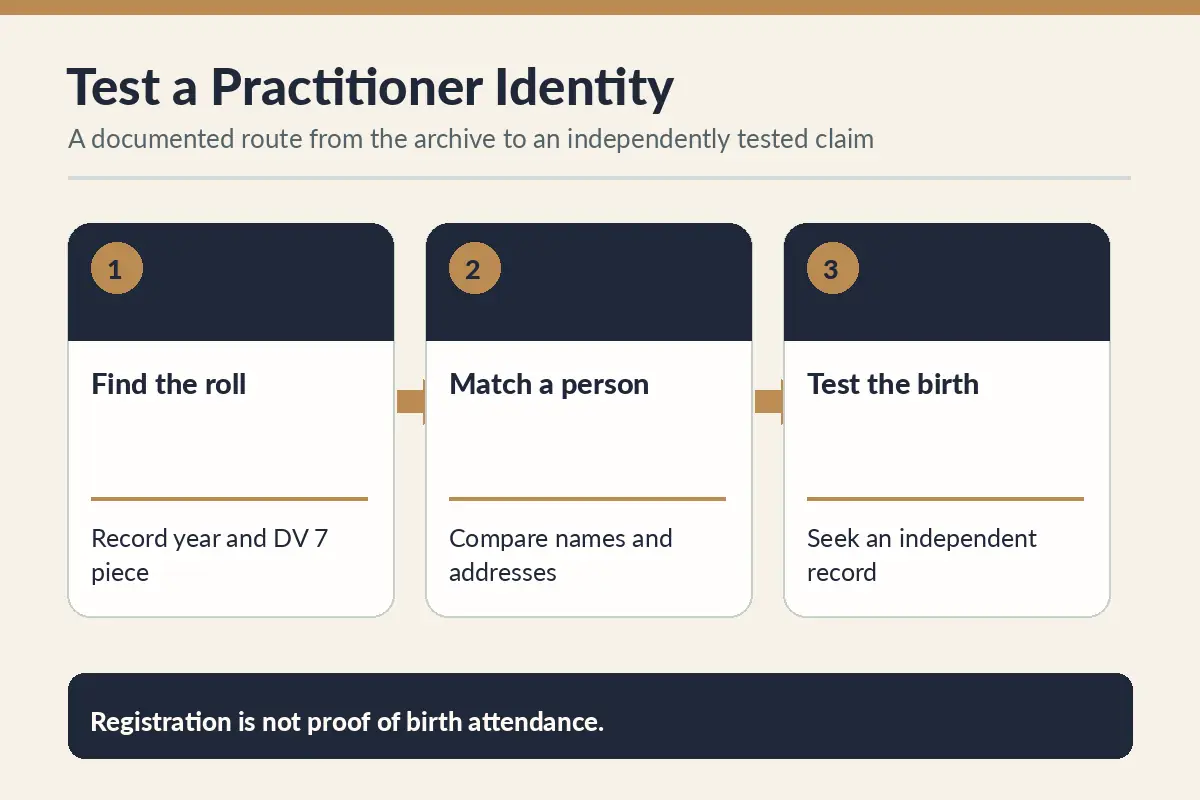
Where a researcher has a birth date and locality but no midwife name, reverse the usual search. Establish the likely practice area and documentary window before selecting any possible practitioner. Keep a separate column for who reported a birth, because an informant and a midwife are not necessarily the same person. If a later family account describes ‘the midwife at the village,’ do not convert that description into a specific DV 7 match merely because a registered practitioner lived nearby. A registration roll and a person’s memory are two differently situated sources. Their agreement about a place can guide more research but does not establish attendance.
More Records and Archives Guides
How We Research This Archive Series
Our editorial check on November 8, 2026 used primary archival guidance for the precise series and corroborating repository guidance for context and access limits. We distinguish a record series description from the evidence in an actual piece. The illustrated examples in this article explain a process, not purported discoveries of real people. Archive access, survival, privacy and catalog detail must be verified again for any individual request.
For each proposed claim, write down the research question, the date and geographical scope, record creator, full reference, page or image identifier when available, the exact words that support a narrow interpretation, and an independent source that could test the conclusion. Preserve no-results searches as search results, not as proof an event never happened. A genuine citation should let another researcher retrace the specific record. The illustrative graphics are editorial interpretations, never facsimiles of historical documents. Read our affiliate disclosure; none of these research links imply an affiliate partnership.
No. It can support an historical registration or listing, while attendance at one birth needs an independent source.
DV 7/1 is the Obstetrical Society of London skilled-midwives register for April 1872–July 1877; later rolls belong to a different registration framework.
Do not assume so. The cited commercial collection covers 1904–1959; check the original roll and catalogue for other years.
No. Record the year and wording, then compare dated directories and other evidence for work and residence.
Try variant names and a year-by-year browse, and document index and coverage limits before interpreting absence.