
Victorian electoral rolls can place an eligible voter within a defined district and year, but they are not complete lists of everyone who lived nearby. Public Record Office Victoria distinguishes parliamentary election rolls from municipal burgess or ratepayer rolls; the latter often depended on a property or rates qualification. Eligibility changed with time and the state archive holds only selected rolls. Begin by identifying the type of election, locality and year before using an apparent name match as residence evidence.
Start by deciding which Victorian election you are researching
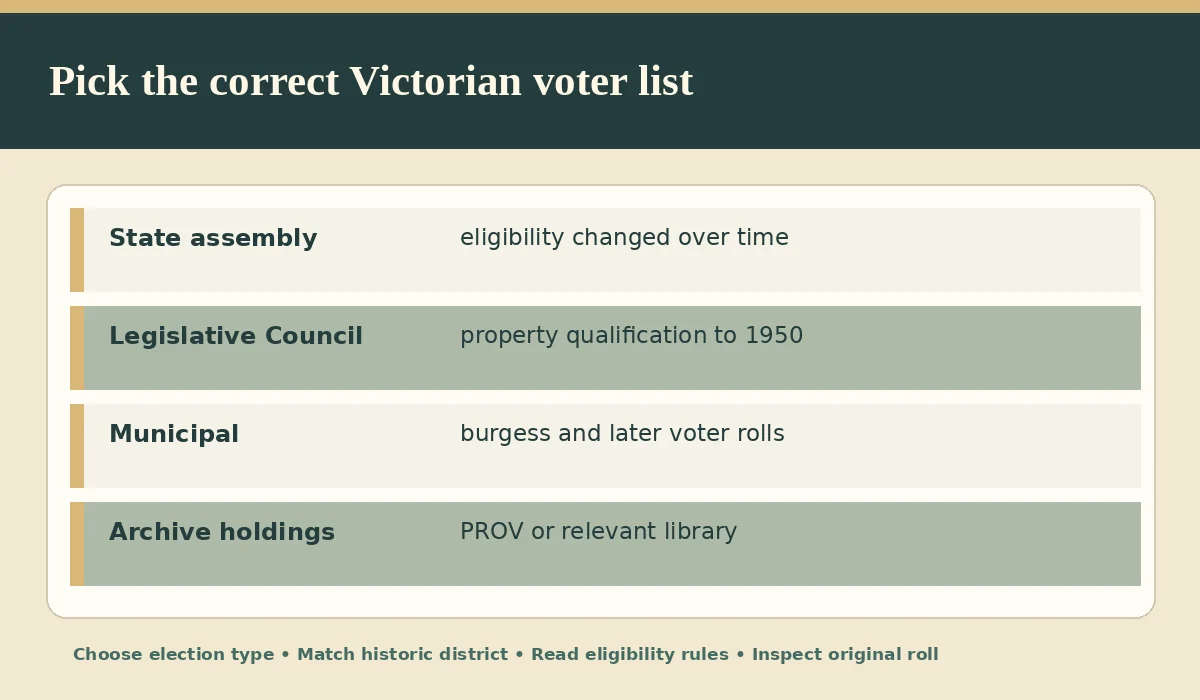
State parliamentary and local municipal rolls were compiled for different elections and may use different district boundaries. PROV’s electoral and voter rolls guide separates rolls for legislative elections from municipal lists, sometimes called burgess rolls or ratepayers’ lists. If a family story only mentions that an ancestor “voted,” seek a dated electoral notice or neighborhood clue before choosing one collection.
A municipal ward is not necessarily the same geographic unit as a parliamentary electorate. Record the municipality, ward or district exactly as listed, then look up the historic boundary for the target year. A spelling match in a nearby district is not evidence of residence until the correct registration and locality are confirmed.
Know the changing voting eligibility rules
PROV reports that all men older than 21 were eligible for Legislative Assembly voting from 1857 and women older than 21 from 1908. Legislative Council voting remained subject to land ownership qualifications until 1950. Those conditions vary by election type, and the archive cautions that the right to vote was not experienced equally in practice, including for Aboriginal people.
Do not interpret an absent woman or young adult on an early roll as absence from the community. Nor should a man’s name on a property-qualified list be assumed to represent every male household member. When writing a family history, explain the election rules that governed the record instead of describing a roll as a census of adults.
Find surviving state rolls before assuming they are online
PROV says it holds only a small number of Victorian electoral rolls. Its handbook identifies a microfiche copy of the 1856 Victorian Electoral Roll and a distinctive near-complete 1876 roll in VPRS 1226. The State Library of Victoria and other specialist libraries hold additional published rolls; library catalogues should be checked before deciding a year is unavailable. Our guide “Victoria Prisoner Registers, 1855–1948” goes into more detail.
A result in a modern commercial index may lead to a printed roll housed elsewhere. Record whether the original source is a state roll, a later transcription or a library-held edition. If your desired year is absent from the PROV catalogue, search the appropriate library rather than infer the election was not held or the ancestor was ineligible.
Use municipality-first searching for burgess rolls
The PROV municipal voter-roll guide recommends entering a suburb or municipality and choosing the historical period. Burgess rolls were used before 1939 and voter rolls afterward, though names and requirements varied. Typical fields can include full name, residence or post town, occupation, whether owner or occupier, description of rateable property and the voting entitlement. For a related choice, see our guide “South Australia Electoral Rolls, 1853–1920”.
Read the form’s column headings before copying information into your tree. A listed rateable property may be a business or rental holding rather than the voter’s home. If the form separates address from land description, preserve both. Municipal eligibility once depended on ratepayer status and other qualifications, so an unlisted tenant family can still have been present. Our guide “Tasmania Assessment and Valuation Rolls” covers a related question.

| Research checkpoint | Document a defensible observation | Do not assume |
|---|---|---|
| Voter name | registered eligible person | The same-name index proves the complete event |
| Residential address | reported listing field | The record proves a family relationship |
| Identity test | Match place, period and independent detail | A matching surname establishes the person |
| Coverage or access limit | Log missing years, item status and search route | A no-hit result proves nonexistence |
Interpret addresses and rateable property as separate facts
Consider a roll showing a fictional Elizabeth Ward with one mailing address and an interest in a property within the municipality. That does not alone prove she slept in the building or owned its legal title. A ratepayer can be associated with property for a reason other than family residence; the form’s owner or occupier designation is an administrative clue.
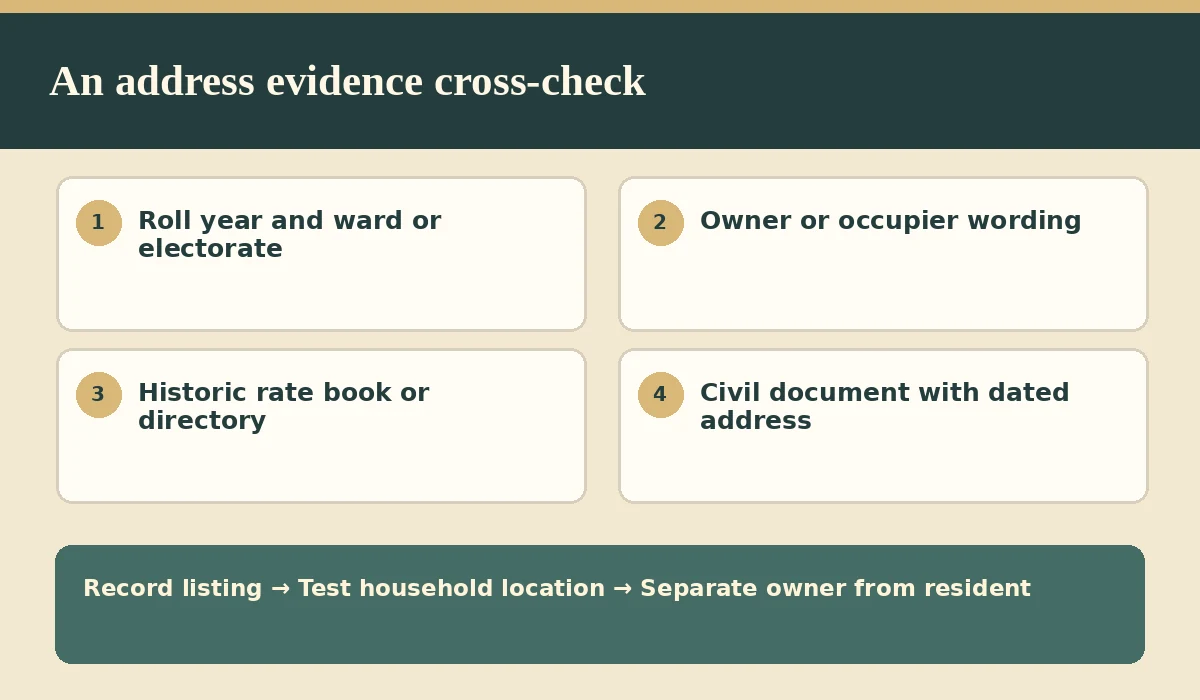
Compare the voter listing with the same-year rate book, a local directory, deed or birth registration naming an address. If two same-name candidates appear in neighboring wards, test their occupations and property descriptions separately. An address repeated across years is useful evidence for continuity, but not proof of continuous daily residence. Our guide “Victoria Council Minutes and Correspondence” shows how to find local family evidence.
Document the exact year and election type
Voting status is only meaningful for the compiled register and period. A person may appear in one municipal roll and disappear from another because boundaries, eligibility, registration or survival changed. Capture the roll’s printed year, electoral district, ward, page, individual number and whether the listing includes corrections or supplemental pages.
If a candidate appears in a commercial database, verify that its collection title is not actually a Commonwealth roll beginning in the twentieth century. Federal, state and municipal lists can coexist and differ for the same person. A result in one collection cannot be silently converted into a record from another government.
Use a fictional family to avoid a namesake mistake
Imagine two fictional men named Charles Bennett, one appearing in a rural municipal list and the other in a metropolitan state electorate. Similar ages or occupations from a family story can make them seem interchangeable. Prepare a pair of records with exact district, printed year, owner/occupier status, occupation and listed property.
Now compare an independently dated address from a marriage certificate or directory and, if necessary, a property document. If the metropolitan candidate has no independent identity link, do not merge him into the rural family. Record what the two registers prove and what remains open. The correct conclusion may be that only one candidate fits an ancestor with confidence.
Cite the holding institution and qualify a no-hit result
A citation should identify the record creator or election body, type of roll, locality, year, page or entry number, holding institution and actual access method. For VPRS 1226, retain its series identifier; for a State Library copy, give its edition and catalog location. If using a transcription, make that derivative layer clear.
Close with a claim such as “a person of this name was listed as an eligible municipal voter for this ward in this year,” not “the family lived there throughout the decade.” If a surname is absent, note the scope of eligible voters and missing records. A well-defined alternative search is the same period’s rate book, civil record or local newspaper.
How We Research Victoria Electoral Rolls
We checked the linked sources on 2026-10-22. Source descriptions are not a substitute for inspecting a specific original manuscript. The worked identities are fictional and intended only to show how to test a record. Rights, fees, privacy rules, digitization and finding aids can change: recheck item-level conditions when requesting or reproducing documents.
More Records and Archives Guides
Original Archive Finding Aids for Victoria Electoral Rolls
Public Record Office Victoria distinguishes state and municipal registers, changing voting rights and limited PROV holdings (prov.vic.gov.au).
PROV describes pre-1939 burgess rolls, later voter rolls, rates-based exclusions and typical fields (prov.vic.gov.au).
PROV family-history handbook describes the 1856 roll, distinctive 1876 holding and library alternatives (prov.vic.gov.au).
This guide contains no affiliate links. Respect restrictions on identifiable living persons, sensitive allegations and copyright when researching or sharing historical sources. See the GenHis affiliate disclosure for our site-wide link policy.
No. They list eligible registered voters under the rules and surviving coverage of a particular election.
Municipal voter or ratepayer lists, with changing property, rate and other eligibility requirements; PROV describes pre-1939 burgess rolls.
No. Voting eligibility changed by date and chamber; PROV notes Legislative Assembly rights for men from 1857 and women from 1908.
PROV describes a microfiche 1856 roll and a near-complete 1876 roll in VPRS 1226, alongside other library holdings.
No. Compare the address and property columns, then use rate, title or directory evidence to test occupancy.