
Public Record Office Victoria’s central male and female prisoner registers, VPRS 515 and 516, can connect a person to an admission, prison number, physical description, offense entry and sometimes a photograph. Yet they are not a statewide list of every man ever imprisoned in Victoria. PROV describes 1855–1948 registers covering Melbourne-area prisons, with regional prisons represented for female prisoners; male prisoners in regional gaols may need different series. Begin with a name or alias and an approximate incarceration date, inspect the register image and then use a court or gaol source to test what actually happened.
Choose the correct prisoner register and custody area
PROV describes VPRS 515 as the Central Register of Male Prisoners and VPRS 516 as the corresponding female series. Its guide lists Melbourne-area institutions including Pentridge, the hulks, Eastern Gaol and early stockades. Female records also cover regional prisons in the central registers; the guide specifically cautions that regional male prison records may be elsewhere. Decide whether the historical claim concerns a Melbourne-area institution or another gaol before interpreting a missing result. For a related choice, see our guide “Brisbane Gaol Prison Registers, 1850–1901”.
Write down the prison name as it appears in a newspaper, court record or family document, not just the modern town. Prisoners could be transferred, so a Pentridge entry may refer to a previous admission elsewhere. A central entry does not establish the site of arrest or conviction without a separate field supporting that conclusion. Use PROV’s regional prison agency pages when the expected person is a man held beyond the central register’s scope. For a related choice, see our guide “Scottish Prison Registers”.
Search by surname, alias, and prison number
PROV advises searching a prisoner’s name or alias, or a known prisoner number, and applying year filters when the result set is large. Try alternate spellings and initials before concluding the person is absent. If you have a prison number from a newspaper or court report, that can be more discriminating than a surname alone. For a historical woman, consider the surname used at the time and a previous surname that may appear on an entry.
The archive also offers online alphabetical index PDFs by date range when the regular search fails. Use an index hit to retrieve the number, then open the matching register page. Keep the page, number, series and item identifier in a single note so that an apparent match can be checked again. An alias in a register is recorded information; it does not independently prove the individual used that name outside the prison system.

Read the original entry rather than a search-result snippet
According to PROV, possible columns include prisoner name and number, personal description, distinguishing marks, trial details, conviction, offense, sentence, transfers or admissions, behavior and release date. Not every entry includes every detail. Photographs begin around 1870 for prisoners serving longer sentences, so absence of a photograph for a shorter sentence should not be called evidence of a missing image or an alternate identity.
Transcribe the actual column heading before copying a number. A prison arrival date is not automatically a sentence date; an offense description may be a contemporary administrative label rather than a modern legal classification. Maintain separate fields for alleged conduct, charge, recorded conviction, sentence, admission and release. Where handwriting or damage obscures a word, record it as uncertain rather than repairing the text from an unsourced biography.
Check duplicate names and repeated custody events
Consider a fictional ‘M. Sullivan’ whose surname appears in two decade-separated registers. One result includes a matching trade and physical description; another lists a different place of origin. These are competing candidates until further evidence shows whether one person returned to custody or two different people shared a name. Compare age and physical details across dates cautiously—reported ages, occupations and descriptions can vary—and prioritize a consistent prisoner number or case identifier when available.
Make a comparison chart covering name form, alias, birth locality if recorded, physical details, prison and admission date, court and release event. Follow the court reference to a trial record when a verdict or sentence is important. A prisoner register is created for prison administration; it may summarize prior court events inaccurately or without the supporting testimony. A family relationship cannot be inferred solely from another prisoner’s similar surname or adjacent entry.
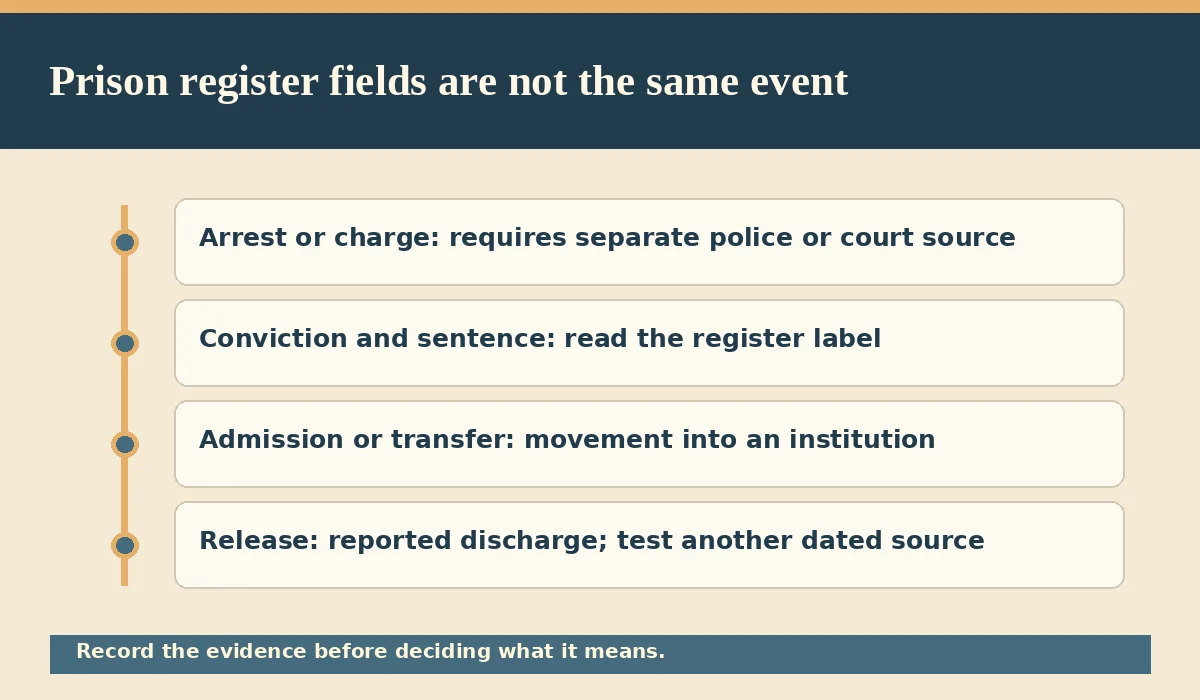
| Research checkpoint | Document a defensible observation | Do not assume |
|---|---|---|
| Arrest or charge | requires separate police or court source | The same-name index proves the complete event |
| Conviction and sentence | read the register label | The record proves a family relationship |
| Identity test | Match place, period and independent detail | A matching surname establishes the person |
| Coverage or access limit | Log missing years, item status and search route | A no-hit result proves nonexistence |
Find regional gaol books and records outside the central index
A failed search in VPRS 515 must not be turned into a claim that the named man was never jailed in Victoria. PROV names individual regional prison agencies such as Ballarat, Bendigo, Castlemaine and Geelong, whose holdings require their own series checks. Look for records titled prisoner received, prisoner discharged or similar, and match the institution and year. Central female register coverage also needs checking at the item level rather than assuming every regional entry survived. Our guide “Adelaide Gaol Prisoner Registers, 1848–1912” covers a related question.
Read each series description for inclusive dates and available volumes. Some series may be online and others may need a reading-room order. Record missing years explicitly. Newspaper notices are useful to locate an arrest or appearance but do not prove a detention record exists or that the charge ended in conviction. If only a police notice survives, label the event at the stage actually evidenced by that notice.
Apply historic privacy and publication safeguards
PROV publishes digitized open historical registers but its privacy framework allows closure of some records of a personal or private nature. An old record in a catalogue does not guarantee immediate access to every page, particularly where later personal data may be involved. Check current item status rather than attempting to bypass a restriction. Even public files can contain allegations, sensitive descriptions or details about third parties not relevant to a genealogical claim. For the fuller picture, see our guide “Victoria Electoral and Voter Rolls”.
For a published family history, cite evidence with care and avoid repeating lurid labels without context. Explain that offenses and conduct rules were defined by the period’s law and social conditions. A photographed person in a nineteenth-century prison register should not be used to infer the criminality of descendants. When an entry names living people or recent relatives, minimize disclosure and follow applicable privacy and reproduction rules. Our guide “NSW Gaol Photographs, 1870–1930” covers a related question.

Cite the prison entry and test its independent corroboration
Your citation should identify Public Record Office Victoria, VPRS 515 or 516, register item or volume, prisoner number, image or page, and access date. If you found a person through an alphabetical index, cite that finding aid separately. Do not replace a series reference with a vague link to ‘criminal records.’ Preserve any uncertainties in the name or number so another researcher can reproduce the lookup. If that is your next decision, our guide “Victoria Criminal Trial Briefs, 1841–1949” explains how to find cases in VPRS 30.
Use a court register or dated newspaper report to test the alleged event, and a civil, employment or residence document to test identity. The ideal conclusion distinguishes the person being held, what the prison recorded about the court outcome, and whether an independent source confirms the link. Where a second source contradicts the admission date or given name, record the conflict openly and choose a targeted follow-up instead of silently combining the records. Our guide “Yatala Labour Prison Registers” covers a related question.
How We Research Victoria Prison Registers
We checked the linked sources on 2026-10-22. Source descriptions are not a substitute for inspecting a specific original manuscript. The worked identities are fictional and intended only to show how to test a record. Rights, fees, privacy rules, digitization and finding aids can change: recheck item-level conditions when requesting or reproducing documents.
More Records and Archives Guides
Original Archive Finding Aids for Victoria Prison Registers
PROV’s official series guide identifies VPRS 515/516, searchable fields, index/digitization limitations, jurisdictional scope and possible biographical details (prov.vic.gov.au).
PROV lists criminal trial briefs and separate prison-related series, useful for confirming outcomes and local records (prov.vic.gov.au).
PROV explains Section 9 privacy closures that can affect later personal, prison and related records (prov.vic.gov.au).
This guide contains no affiliate links. Respect restrictions on identifiable living persons, sensitive allegations and copyright when researching or sharing historical sources. See the GenHis affiliate disclosure for our site-wide link policy.
They are the male and female central prisoner register series described by Public Record Office Victoria.
No. PROV directs searches for regional male prisoners to records held for the individual gaol.
No. Photographs became common from around 1870 in longer-sentence cases; photographs are not universal.
Yes. PROV recommends surname, alias or prisoner number, and supplies alphabetical index PDFs for further lookup.
No. Separate police claims, prison notes, court verdicts and independent identity evidence before drawing conclusions.