
Public Record Office Victoria describes VPRS 2144 as the microfilm copy of VPRS 946/P, a mixed set of Registers of Deserters and Discharged Seamen. The contents are not a single continuous passenger list. Some volumes deal with seamen reported as deserters; another records men discharged before a shipping master. If a family story says an ancestor worked on a vessel, first ask whether the likely event was desertion, formal discharge or arrival as a passenger.
Choose a maritime event rather than a surname alone
A ship can appear in an immigration list without any crew member appearing in this series. Conversely, a seaman named in a deserter register might not have immigrated permanently. This article uses an event-first method: probable ship and port, approximate month, then the applicable register unit, then identity checks. It is different from a general passenger-arrival guide because its record creator tracked maritime employment and administrative reports.
Find the correct part of VPRS 2144 by date and port
The PROV series description identifies a Port of Geelong register, Unit 1, principally 1857–1925, with earlier entries for January 1852–July 1853 and January 1856 placed at the back of the volume. Other deserter registers in Units 2–8 concern 1878–1924 and are incomplete. These date ranges must not be converted into a claim that every year, port or vessel was consistently recorded.
The source also distinguishes registers of discharged seamen from registers of desertion. Use the original unit description before requesting an image or film and preserve its arrangement. Search by ship or report date if the name is uncertain. An online catalogue reference identifies the series; it does not mean every entry is searchable in full text or freely displayed as a separate item.

Extract the ship and biographical fields carefully
According to the archive description, a Geelong deserter entry may include the date, vessel name, vessel origin, seaman’s name, birthplace, age, height, hair and eye color, with occasional extra remarks. Later registers may add an official ship number, rating, previous ship, date of report and references to later service or police gazettes. Treat every observed field as a reported characteristic of a person at a historical moment, not a guaranteed permanent identifier.
Names and physical descriptions can be transcribed inconsistently, especially across ports and administrative offices. Keep uncertain letters as uncertain in your notes. A birthplace may mean a town, country or broad jurisdiction; compare the exact written form before converting it to a modern map. A ship’s official number is more discriminating than a vessel name alone, which may have been reused.
Avoid equating a report with a judicial finding
A deserter register records an administrative report made within the seafaring system. It does not by itself show that a seaman was tried, found guilty, imprisoned or permanently disappeared. A later remark could revise what was known. In a public family history, use careful wording: “named in a register of reported deserters,” followed by an exact archival reference and date.
This distinction matters particularly when seeking a relative who later appears in a household or marriage record. Being recorded as absent from a ship may explain a research gap but cannot establish motive, voluntariness or later legal outcomes. If an allegation requires evaluation, look for a contemporaneous court record or a clearly linked official correspondence item instead of projecting modern assumptions onto the label.
Correlate dates, port, vessel and another source
Make a working table with the sailor’s recorded name, ship, report date, ship number when available, place of birth, age and archival unit. Compare it against another maritime record, a newspaper shipping notice, a seamen’s agreement or a later civil record. The stronger the overlap in ship and time, the more useful a namesake match becomes. But agreement between two records copied from one original report is not independent corroboration.
If the family alleges arrival at Melbourne but the register concerns Geelong, test whether the same vessel called at both ports rather than merging them. Port names and vessel routes are part of an evidence chain, not interchangeable labels. Log the unresolved link and a specific next search, such as a shipping master record or the chronological run of local shipping notices.
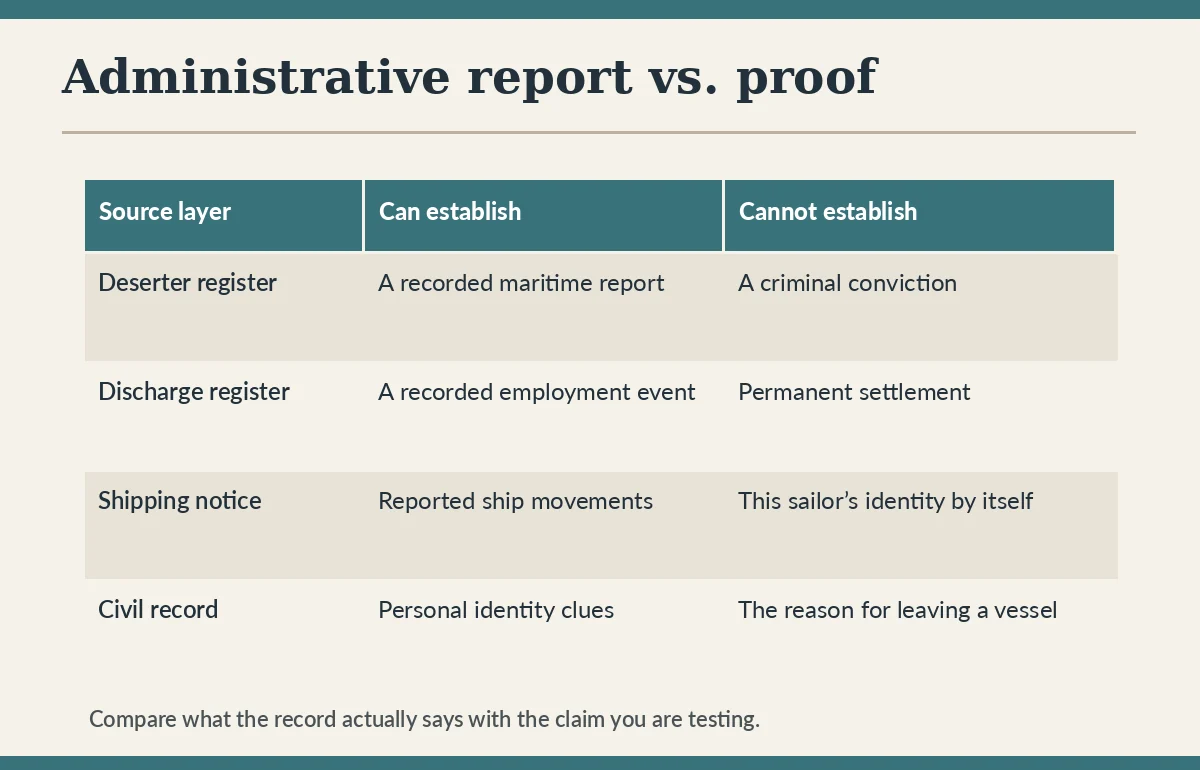
| Source layer | Can establish | Cannot establish |
|---|---|---|
| Deserter register | A recorded maritime report | A criminal conviction |
| Discharge register | A recorded employment event | Permanent settlement |
| Shipping notice | Reported ship movements | This sailor’s identity by itself |
| Civil record | Personal identity clues | The reason for leaving a vessel |
Work through a fictional sailor namesake problem
Imagine an illustrative register entry for seaman James Carter, age 26, associated with the ship Southern Star in 1883. These invented details demonstrate method only, not an actual archival page. Family records also refer to a James Carter in Victoria. Record the reported vessel and date, then check a dated document identifying the family member’s birthplace and age before deciding the two names refer to one person.
If another James Carter appears in a port list, the ship’s official number or the seaman’s trade may help distinguish the records. If an 1885 marriage lists the occupation “laborer,” that does not refute former seafaring work, but it does not establish it either. Keep the maritime record as an unproven candidate until a credible independent link connects the events.

Use the PROV series citation and a defensible conclusion
Cite Public Record Office Victoria, VPRS 2144 (microfilm copy of VPRS 946/P), the correct unit, the entry date, and the page or image locator. Distinguish the series description from an inspected register page. Ask the archive about its current search-room index for Geelong entries and film access, rather than treating a historical index note as a guarantee of present online coverage.
When presenting your conclusion, state whether you verified a maritime employment event, a reported desertion, a documented discharge or only a matching name. Save variant names and negative searches for other units. This modest discipline turns an emotionally charged family story about a “missing sailor” into a careful, reproducible investigation.
How We Research Victorian Seamen Registers
We compared the archive’s own descriptions of this collection and its finding aids on 2026-10-22, mapped known time and coverage limits, and distinguished administrative observations from genealogical inferences. The worked names are fictional and explicitly illustrative. The steps describe how to verify a record rather than claiming we inspected an ancestor’s personal file. This guide is educational, not legal or professional archival advice; confirm access conditions and source images with the repository before relying on an individual record.
More Records and Archives Guides
Archive Collections and Finding Aids for Victorian Maritime Records
Original Public Record Office Victoria series reference for maritime register microfilm (prov.vic.gov.au).
PROV-supplied public series description with unit arrangement and fields (researchdata.edu.au).
PROV archive record-series listing of the Department of Trade and Customs, including maritime holdings (prov.vic.gov.au).
Editorial disclosure: This independently prepared research guide contains no sponsored recommendations or affiliate purchase links. View the GenHis affiliate disclosure for the site-wide link policy. Avoid publishing sensitive information about living people; copyright and archival restrictions may apply.
It is the Public Record Office Victoria microfilm copy of VPRS 946/P, combining several seamen-related register series.
Yes. Its Unit 1 is the Port of Geelong deserter register, with dates described in the PROV series record.
No. It documents an administrative report; any court outcome requires separate evidence.
The series description reports birthplace and age among possible fields, as well as ship information and sometimes physical characteristics.
The units cover different events, ships and incomplete dates; try the right port and register before inferring absence.