
The State Records Office of Western Australia describes extensive government railway staffing collections, including WAGR Record of Service Cards, Series 23, dated 1900–1980. A service card may record name, date of birth and employment history. The range describes a collection, not an assurance that every employee worked throughout it or that every individual card is available online. Begin with the worker’s name, likely decade, occupation and a station or workshop if the family knows one.
Start with a named railway worker and an employment window
Western Australian railway administration changed names repeatedly. WAGR as an organizational label therefore requires care when used for records spanning earlier or later departments. A family may remember “the railways” but a person might have worked for a private company, a contractor or a tramway. Establish the employer before assuming a government WAGR card must exist.
Distinguish Series 23 consignments before searching
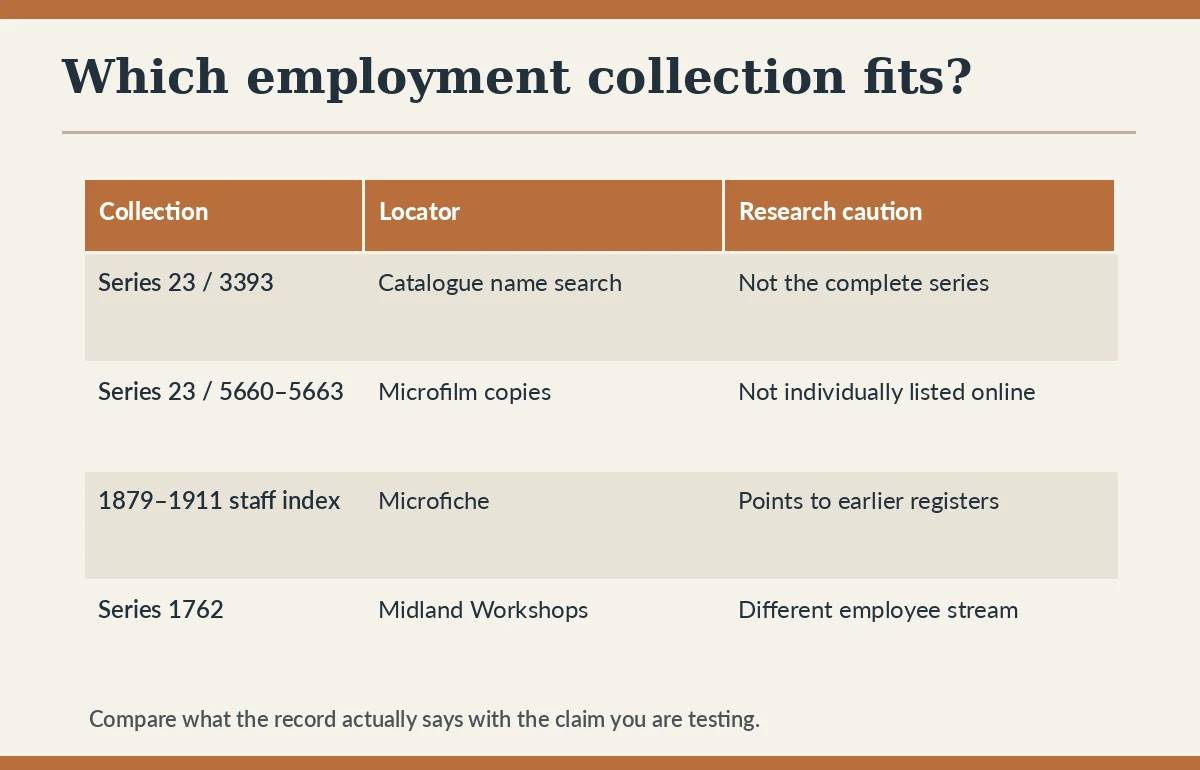
According to the State Records Office, the principal Series 23 consignment 3393 is individually listed in the catalogue and can be searched by name. Four other consignments, 5660–5663, are not individually listed and require consultation of microfilm copies. This difference is crucial: a catalogue search that finds no card in 3393 has not searched all cards in the series.
For each candidate, save the exact title, series, consignment, item reference and any relevant service date. If a person is missing from a named online listing, follow the archive’s directions for the unlisted consignments instead of concluding that the career was invented. Researchers using the State Library and Archives building should check current onsite equipment and access arrangements before traveling.

Route earlier employees through the staff index and registers
The WAGR Staff Records Index, 1879–1911, is a microfiche index to employees noted in various railway employment registers for 1879–1905. Its date span differs from that of Series 23. A worker hired in the nineteenth century may therefore be more likely to appear in an employment register or a personnel record than in a later service card. Search by surname and possible initials, and copy the exact reference as shown. Our guide “NSW Railway Employee Records” shows how to find service cards and registers.
The repository also describes Personal Records, 1876–1946, from Westrail’s Accounting and Audit Branch, including accessions 1746–1754, 2628 and 2629. Do not assume the contents duplicate Series 23, or that a record referred to as a “personal record” contains modern personnel-file fields. Consult the collection description and the individual item before asserting what was recorded about an ancestor.
Check Midland Workshops and casual employment separately
Midland Workshops has a separate record-of-service card series, Series 1762, dated 1900–1990, with catalogue name listings. That is a distinct route for workers whose careers involved the workshops. The same archive describes Series 491 employment registers for 1933–1950, particularly casual and relief employees on railway-line construction, and a boiler shop register for 1930–1942.
Choose a series that fits the worker’s location and role. A named engineer in a construction gang, a temporary laborer and a clerk at a station might appear in different records. When a surname appears in more than one stream, verify the individual rather than merging all entries into one career. Preserve uncertainty where ages, job titles or dates disagree with family recollections.
Read dated service without assuming a household address
Transcribe each posting or appointment exactly as written on the card: date, role, department, station or workshop and any later alteration. A card can describe employment movements, not necessarily residential migration. Workers might commute, transfer temporarily or leave relatives at a previous address. If a rail employee appears at a station outside Perth, that is not sufficient proof that the entire family moved there.
Build a dual chronology: railway employment on one side, independently established home addresses on the other. Electoral rolls, birth registrations and property records can help test residence, with their own limitations. If two cards share a name, a recorded date of birth can be particularly helpful as an identity check; it still should be compared with at least one other source instead of accepted without scrutiny.
| Collection | Locator | Research caution |
|---|---|---|
| Series 23 / 3393 | Catalogue name search | Not the complete series |
| Series 23 / 5660–5663 | Microfilm copies | Not individually listed online |
| 1879–1911 staff index | Microfiche | Points to earlier registers |
| Series 1762 | Midland Workshops | Different employee stream |
Use a fictional workshop-to-station transfer
Imagine a fictional William Hughes whose 1927 service entry names a Midland role and whose 1932 entry mentions a regional rail station. A family history says his wife remained in Perth until 1935. The service entries document a recorded employment path but do not settle the family’s residence. Check William’s date of birth and employment identifier, then consult independent records from each location and year. For the same kind of choice in another place, see our guide “Scottish Lightkeeper Registers, 1837–1921”.
If a second William Hughes worked for the same employer, do not attribute both cards to one person. Compare workshop, occupation, dates of employment, initials and known family addresses. The best conclusion may be that one card is established and another remains a namesake candidate. That is a useful result because it prevents a false narrative of constant relocation or an implausibly long career.

Request the correct item and cite its exact consignment
Use the official WAGR research page to establish which record group fits the question, then confirm catalogue details for the item you want. Record whether the information came from a searchable catalogue entry, a microfiche index, a microfilm copy or an original card. Each layer can be cited, but an index finding must not be described as a firsthand inspection of the complete record.
Historical staffing records may contain later twentieth-century material. Check current access conditions and minimize unnecessary disclosure about living employees. The strongest published family-history account gives documented employment dates, labels uncertain assignments and recognizes that official personnel files can be incomplete, damaged or organized under predecessor agencies.
How We Research WAGR Railway Employee Cards
We compared the archive’s own descriptions of this collection and its finding aids on 2026-10-22, mapped known time and coverage limits, and distinguished administrative observations from genealogical inferences. The worked names are fictional and explicitly illustrative. The steps describe how to verify a record rather than claiming we inspected an ancestor’s personal file. This guide is educational, not legal or professional archival advice; confirm access conditions and source images with the repository before relying on an individual record.
More Records and Archives Guides
Archive Collections and Finding Aids for WAGR Employees
Official State Records Office guide for WAGR staffing series, catalogued and unlisted consignments (www.wa.gov.au).
Official archival repository and current catalogue/access entry point (www.wa.gov.au).
Editorial disclosure: This independently prepared research guide contains no sponsored recommendations or affiliate purchase links. View the GenHis affiliate disclosure for the site-wide link policy. Avoid publishing sensitive information about living people; copyright and archival restrictions may apply.
The State Records Office lists principal Series 23 consignment 3393 by name in its catalogue.
Series 23 consignments 5660–5663 are not individually listed and require a microfilm search.
The archive identifies name, date of birth and employment history as typical contents of Series 23 cards.
Use the separately name-listed Series 1762 workshop service cards.
No. Check an independent dated address or family document before asserting a household move.