
Western Australian convict records must be searched as a chain of documents, not as one list of surnames. The State Records Office of Western Australia (SROWA) documents convict transportation to the Swan River Colony in 1850–1868. Start with a ship and an individual’s convict number where recorded, then check the convict lists, general or character registers, district ticket-of-leave papers and later freedom or departure material. These sources answer different questions. Transportation proves a recorded arrival; a district entry can show monitored work and locality; neither by itself proves parentage or permanent settlement. This guide provides an exact series-to-question route for connecting those pieces without confusing transported convicts with local prisoners.
Check the transportation period and legal category
The WA State Records Office dates the official transportation program from the Scindian in June 1850 to the final ship, Hougoumont, in January 1868. It warns that the historical convict-register total includes some local prisoners, so a person’s appearance in the administration system does not automatically mean transportation from Britain. Earlier Parkhurst juveniles are also a distinct case and must not be forced into a 1850–1868 ship series. Establish which kind of person your evidence describes: transported convict, local prisoner, ticket-of-leave worker, or another related category. An accurate first classification determines which record group can provide proof of an actual voyage.
Find a ship-list candidate before assuming identity
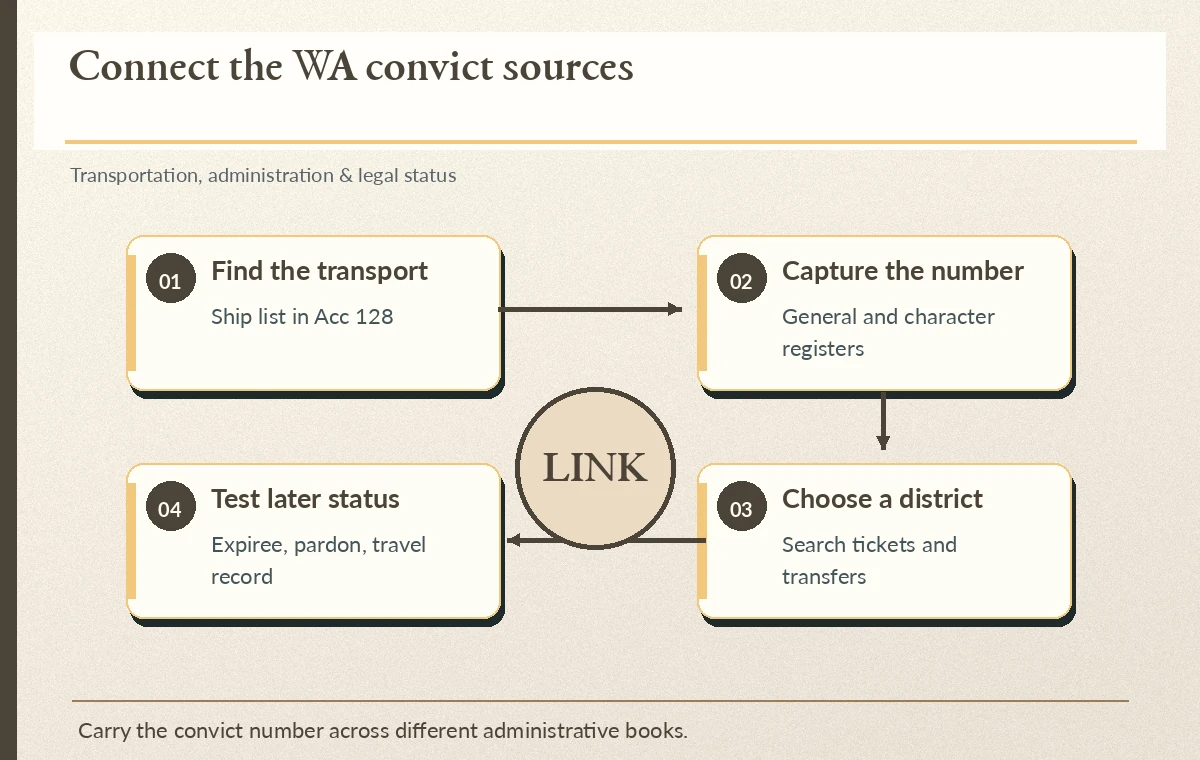
The SROWA describes Convict Lists and Registers, 1850–1868, Accession 128 (AN 358), as holding most of its convict passenger lists. Its published guide names the Fremantle Passenger Index and an associated genealogical society index, historically provided on microfiche, as ways into the lists. Seek name, ship, arrival and convict identifier, then inspect the actual transport-list document if available. Not every list includes identical particulars, and other transportation lists may preserve facts absent from a general register. Record the vessel spelling as it appears, because several ships with similar names can confuse searches and citations. To go further, our guide “Tasmania Convict Records” shows how to find conduct registers and trace a sentence.
Treat the convict number as a link, not an identity by itself
General registers and character books in Accession 1156 (R-series, AN 358) are arranged around assigned convict numbers. They can record sentence, crime, physical characteristics and sometimes next-of-kin information. Capture the complete number and the person’s ship and trial details, not just the surname. A useful linkage compares the same number across more than one official document while checking that recorded chronology agrees. Administrative identifiers are powerful internal cross-references, but transcription error or a mismatched candidate remains possible. Never use a number copied from an unsourced family website without checking the corresponding original record or reliable archive description.
Read character books as official descriptions, not facts beyond dispute
A character book is a government-produced description of the person under penal administration. It may summarize conduct or reputation through institutional categories; those labels express what officials entered, not an objective character assessment. When a physical description or offence is included, transcribe it accurately and cite the page, but avoid converting a descriptive field into a moral conclusion. Some entries provide kin details, yet the informant and source may be uncertain. Compare reported age, origin, trade and relatives with independently produced civil and family records. Keep narrative claims smaller than the archive’s evidence, especially where colonial systems imposed punishment and restricted movement.

Search ticket-of-leave records by district and date
Ticket of leave in WA could permit paid work under restrictions rather than ending the conviction. The SROWA identifies registers for Perth District (1850–1875), Swan District (1859–1866) and other court and police districts. Registers can include a ticket date, employer, wages or work district, depending on the volume. Use the known convict number or documented locality to select a likely district and time span; do not assume a worker stayed in Fremantle. A name absent from one district register is not evidence of unemployment or death. Search transfers or neighboring holdings when the original entry indicates movement.
Follow transfers, pardons, expiry and departure separately
WA’s archive describes registers for expirees, conditional pardons, receipts and discharges, and correspondence about the convict establishment. An expiree had completed a sentence; a ticket-of-leave holder still faced restrictions; a conditional pardon represented another status. These categories are not synonyms. One later nominal register records some expirees and conditional-pardon holders departing through Albany in 1863–1894, but that is not a complete statewide outbound passenger list. When testing whether an ancestor left WA, cite the actual departure entry and compare its ship and date with a later record elsewhere. Silence in that register proves little.
Worked example: two men who share a common surname
Imagine a fictional researcher tracing Patrick Byrne, said to have settled near York. Two passengers with that name occur in indexed materials, but only one matching register links the correct ship to a distinctive convict number. The researcher follows that number into a district ticket-of-leave entry and checks whether an independent marriage or land record confirms the later locality. The second Patrick is preserved as an alternative candidate. If there is no matching district record, the outcome is unresolved, not permission to borrow the first convenient ticket-of-leave file. This example is hypothetical; it is not an actual convict register transcript.

Know what to do when a microfiche is the next step
Online guides often describe collections whose original registers are not all searchable images. The SROWA notes microfilm and microfiche access at the State Library and State Archives, with some catalog entries pointing to additional correspondence or court files. Write down the accession number, archival network number, relevant district, the years needed and any person number before approaching an archive. Ask which surrogate can be inspected and whether copying and access conditions apply. Do not invent an “instant download” or assert that every ship list is online. If a researcher supplies a transcription, cite it as a derivative until the original has been checked.
| Archive record | Best question | Key caution |
|---|---|---|
| Acc 128 convict lists | Who is listed on a ship? | Transport vs local prison status |
| Acc 1156 register | Which number and identifying traits? | Officials may report errors |
| District ticket of leave | Where could a person work? | Not unrestricted freedom |
| Expiree/departure records | Did a later status or voyage occur? | Surviving lists are incomplete |
State your conclusion with legal and historical care
A defensible conclusion might be that a person with a particular convict number arrived aboard a documented ship and later appeared on a named district register. It does not automatically establish that the person became a free settler, married a particular partner or fathered a child. Penal documents also reflect colonial dispossession and compulsory labor; use careful neutral language without romanticizing the system. Give the precise repository, accession, register or series, page and access date. When linking a family, name the independent evidence that supports the link and explicitly label gaps. Respect the archive’s current restrictions, especially for records spanning much later prison administration.
How We Research
We mapped collection labels directly from the State Records Office of Western Australia’s published convict guide: ship lists (Acc 128), R-series registers (Acc 1156), district tickets of leave, and later status files. We cross-checked the archive’s passenger-list and prison-record guidance to keep transportees, local prisoners, and later restrictions distinct. No original nominal file or family identity is invented as evidence. The worked scenario demonstrates a source-to-source identity test, not a factual convict case. Researchers should recheck catalog access, restrictions and the actual image before asserting a place, legal status or kinship.
More Records and Archives Guides
Primary sources and archive guides
Official WA state archive describes Acc 128, Acc 1156, ticket-of-leave records and specific gaps (www.wa.gov.au).
WA state archive explains convict passenger index routes and ship list coverage (www.wa.gov.au).
WA archive distinguishes convict administration from later prison series and privacy restrictions (www.wa.gov.au).
This guide contains no affiliate links. Archival labels are period administrative terms, not endorsements of penal practices. Check present-day access rules and handle information about living relatives with care. See GenHis affiliate disclosure.
The official transportation program ran from 1850 to 1868, though other penal categories and related records cover different years.
It identifies the key convict lists and registers group containing much of the surviving ship-related passenger material.
It links an individual within penal administration records, especially the general and character registers; identity still needs cross-checking.
No. It permitted forms of employment subject to geographic and reporting restrictions.
No. The State Records Office describes important microfilm, microfiche and reading-room access routes.