
Tasmania’s convict records are unusually rich, but a name in the Tasmanian Names Index is only the beginning. Libraries Tasmania documents conduct registers, indents, descriptive lists, assignments, punishments, permissions and later freedom records across different archive series. One person can appear in several kinds of records, and their wording reflects a coercive colonial system rather than a neutral life story. This guide explains how to search by name, find the right CON series, compare identifying details, distinguish alleged behavior from recorded administrative action, and follow the person beyond transportation without forcing an unsupported family connection.
Start with the Tasmanian Names Index
Libraries Tasmania says that about 76,000 convicts were transported to Tasmania from 1804 to 1853 and that many can be located in its online Names Index. Begin with a name variant and the most reliable known clue: approximate arrival, ship, sentence, origin or occupation. Treat the result as a candidate because common names recur, spelling varies and different record series can repeat a person. Record the exact archive series, identifier and image or catalog link for every plausible hit. A compiled name entry does not itself establish where a convict was born or whom they later married.
Match a person across ship, trial and description
Use a compact identity grid for each candidate: ship and arrival date; place and date of trial; sentence; recorded age or physical description; and any separately reported family information. One shared name or ship is rarely sufficient. Dates may be transcribed, abbreviated or inconsistent across records, so compare the original images when available. A tattoo, trade or native place may distinguish two namesakes, but note that officials’ descriptions and reported origins can contain error. The goal is a defensible same-person link, not a search-result count that happens to fit a family narrative. Our guide “Western Australia Convict Records, 1850–1868” adds more detail on this.

Choose the correct conduct-register series
Libraries Tasmania lists assignment-system conduct records for male convicts as CON31 and female convicts as CON40. It lists probation-system records as CON33 for males and CON41 for females, alongside other supplementary and later groups. These archival series reflect administrative systems and dates, not a single continuous register for every individual. Check which series actually covers the person’s custody period before interpreting a missing record. Female convicts continued to be assigned after the men’s probation system began, so a rigid rule based only on arrival year can send you to the wrong series. Our guide to Cascades female Factory admission Register, 1833–1834 adds more detail on this.
Read indents and descriptions separately
Indents are recorded in distinct series, including CON14 for male convicts and CON15 for female convicts. Descriptive lists include CON18 and CON19, and may describe physical characteristics or identifying marks. A conduct book, by contrast, concerns a person’s administration and recorded conduct. Save each document type under its own citation; do not combine details into a fictional ‘master file’ as though one clerk observed everything at the same moment. If handwriting is unclear, compare repeated names or terms on neighboring entries, and mark your own uncertain transcription explicitly.

Interpret conduct entries with historical care
The Libraries Tasmania abbreviation guides explain headings for trial, transport sentence, ship, gaol or hulk report, alleged offense and punishment. Distinguish a convict’s reported statement, an official accusation, a judgment or punishment entry, and later administrative notes. A terse notation does not necessarily preserve the person’s account or the full circumstances. Neither modern moral labeling nor the absence of charges is a reliable substitute for an evidenced life history. Cite the exact wording with context and explain unfamiliar language rather than silently rewriting a colonial official’s judgment as an established biographical fact.
Track movement, labor and changes in status
A person may appear on assignment or appropriation lists, in correspondence, or in notations for tickets of leave and pardons. Libraries Tasmania’s online guide lists assignment papers (CON13) and appropriation lists (CON27), but dates and coverage vary. Record a specific employer or district only when the source actually states it, and separate intended placement from proven residence. A ticket of leave, conditional pardon and certificate of freedom are distinct statuses and must not be collapsed into a single ‘freed on arrival’ date. Create a timeline that cites each transition from one document to another.
Worked example: two people with the same name
Consider a fictional search for a transported man named William Carter. The Names Index returns two candidates whose arrivals were close together. One conduct book shows a particular ship and trial place; another descriptive list records different identifying characteristics. The researcher makes two separate grids and refuses to merge their employers, sentences or spouses. A later land or marriage record is then tested against the right candidate’s dates and location. This invented exercise shows why an indexed name is not a complete identity, and why painful historical narratives deserve the same careful attribution as any other record.
Research a life after the sentence
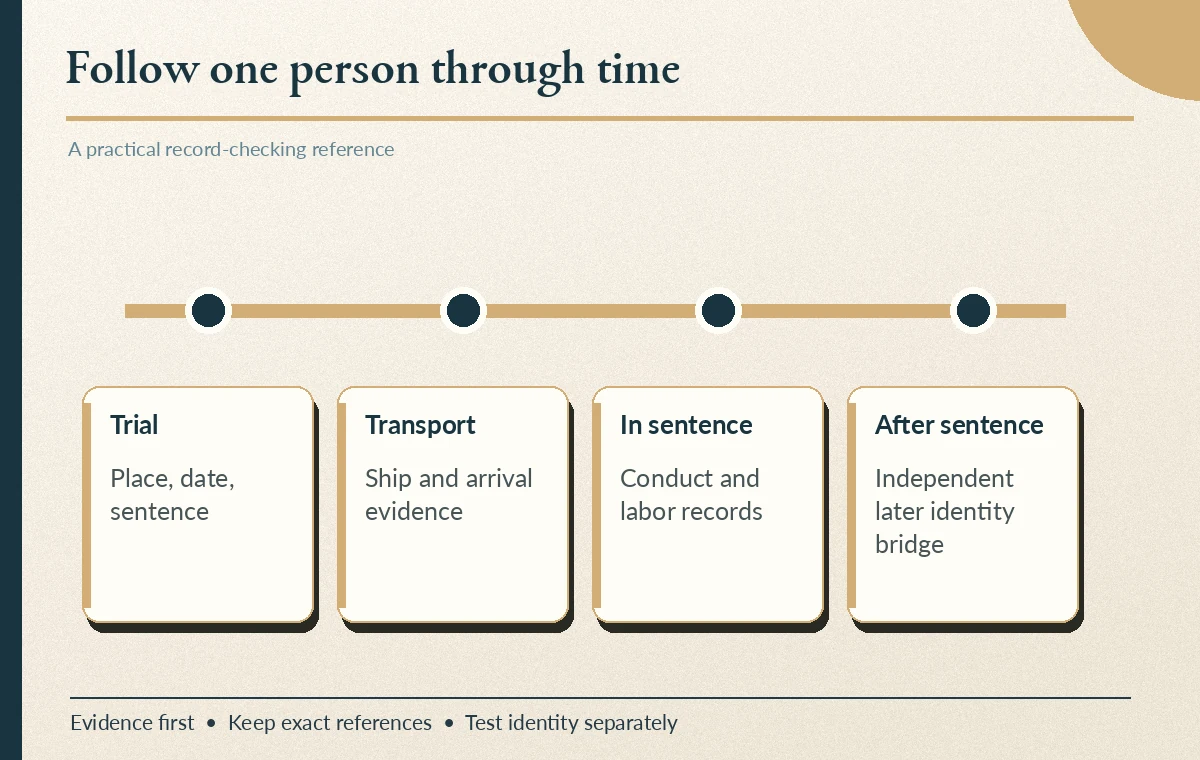
Libraries Tasmania warns that many former convicts become difficult to trace after sentence expiry: some moved elsewhere, changed names, or left few records. Search later local BDM registers, departures, licenses, newspapers, land and court sources, always respecting their actual chronological reach. Victoria’s goldfields attracted some movers, but a plausible move is not proof of one. Where the evidence ends, say so. A later marriage or parent-child claim should rest on a documented bridge from the known convict to the independently identified person in the later record, not on a shared surname or family legend. Our guide “Tasmania Convict Assignment Records” goes into more detail.
| Record family | Example archive series | Best question |
|---|---|---|
| Conduct registers | CON31/CON40; CON33/CON41 | What did officials record during sentence? |
| Indents | CON14/CON15 | How was this transported person described? |
| Descriptions | CON18/CON19 | Which physical identifiers were reported? |
Write ethically about a coercive archive
Transportation records were made by powerful institutions controlling people under sentence; categories and labels may reproduce prejudice or punishment-driven language. Quote offensive terminology only when necessary for a specific historical claim and clearly attribute it to the document. Avoid romanticizing imprisonment, erasing the experiences of Aboriginal Tasmanians, or asserting undocumented relationships with living descendants. Do not assume any convict reference automatically connects a modern person to an offense. State what the document records, what your analysis infers, and what remains unknown. That distinction gives readers a more accurate and humane account.
How We Research
This guide was developed by comparing official registry or archival descriptions with the public search process and testing each recommended inference against its stated record type. Dates, jurisdiction boundaries and access restrictions are attributed to the relevant custodian; examples are expressly fictional. We distinguish a source’s literal statement from an interpretation and a question needing corroboration. Online coverage, fee rules, and search interfaces can change, so recheck the authority’s current guidance before paying or concluding that a record is absent.
More Records and Archives Guides
Primary sources and archive guides
Libraries Tasmania overview of transportation and Names Index (libraries.tas.gov.au).
Official CON series, dates and indexed record groups (libraries.tas.gov.au).
Conduct register fields and assignment-system abbreviations (libraries.tas.gov.au).
Probation-system conduct register fields and cautions (libraries.tas.gov.au).
Disclosure and research limits: This is independent educational genealogy writing, not legal advice or an archive endorsement. This guide contains no affiliate links. Historical records may contain harmful colonial terminology, erroneous claims, and information that should not be exposed about living people. Respect current archival restrictions; see GenHis affiliate disclosure.
Libraries Tasmania provides a Tasmanian Names Index linking to many convict-related archival records.
No. Indents, conduct registers and descriptive lists serve different administrative purposes and have distinct series.
They are Libraries Tasmania conduct-register series for male and female convicts arriving under the assignment system.
No. Separate allegations and reported statements from recorded administrative actions and independent evidence.
Test later civil, land, departure, court and newspaper records, keeping a documented identity bridge from the convict entry.