
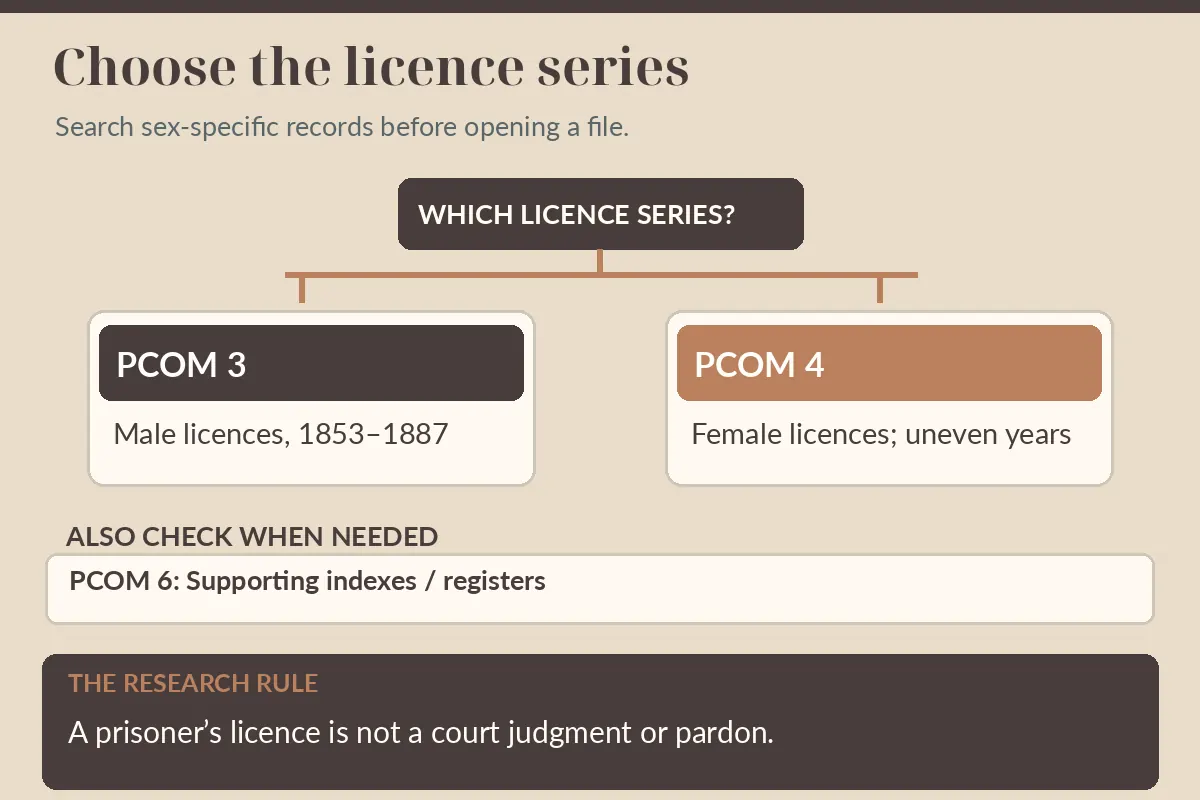
For a Victorian convict released under licence, search PCOM 3 for male files or PCOM 4 for female files, and read the licence terms and any revocation notation as a separate administrative event. These Home Office and Prison Commission records broadly cover 1853–1887, with different survival patterns. A licence to live outside prison subject to conditions is not an acquittal, pardon or proof that a sentence was overturned. The National Archives prisoners guide explains record classes; see our affiliate disclosure before paid database use.
Choose PCOM 3 or PCOM 4 Correctly
Start with an identifiable person rather than an unusual offence. Gather a full name and aliases, birth estimate, known conviction town and year, prison, occupation or relative’s address. The surviving file may reflect institutional spelling and the name used in court instead of a later civil or married name. A same-name match in an online criminal search does not establish that this was the relative in your family tree. Record the catalogue piece number and any unique licence number before drawing conclusions. Separate the date of the criminal case from the date of conditional release.
The two principal series represent different subjects: PCOM 3 concerns male licences, and PCOM 4 concerns female licences. For female convicts, the Archives specifies searchable licence ranges of 1853–1871 and 1883–1887, a reminder that a series-wide 1853–1887 title does not promise equal surviving coverage in every year. Never apply a generic male-file result to a woman because the surname matches. PCOM 6 registers and indexes can also help navigate surrounding prison-commission paperwork where catalogued. Each administrative route should be logged with its actual coverage and evidence type.
Read the Licence and Its Revocation Notes
A ticket-of-leave file may describe the conviction and sentence, previous imprisonment, personal description, occupation, literacy, named next of kin, later supervision and behavior. PCOM 3 series documentation describes examples with marital status, number of children, residence of family, physical description and prior convictions. Not every individual file holds every field; only list a fact when you have observed the relevant page. A relative named as “next of kin” is an institutional designation that must be verified, not an independently established biological connection. A criminal charge is not itself a conviction; check the finding or sentence.
Identify the Conviction and Prison Chain
Distinguish three events with dates: conviction and sentence in the court, incarceration or prison transfer under a sentence, and licence granting conditional liberty. A later endorsement might note revocation, a move or another official action, but an absence of endorsement is not automatically proof of continuous freedom. If a licence form was copied after a decision, note when the underlying event occurred and when the office compiled the document. Do not treat a release address as long-term residence; police, parish, census or marriage records can test what happened after the licence was issued.
From the 1870s, some licences include a prisoner’s photograph, and The National Archives notes that photographs become more common later in the series. The existence of a photo is not universal, and a modern database thumbnail is not a substitute for reading the document’s full contextual fields. If an image is present, note whether it was attached to the licence, taken for prison administration or reproduced from another file. Do not infer ethnicity, family connection or personality from visual appearance. Compare descriptive fields and a proven identity link rather than relying on vague facial resemblance to a family portrait.
Use Photographs Without False Certainty
The records can mention prior convictions, offences, character and institutional judgments. Quote such statements as attributes of specific documents, and check verdict, sentencing and later review in relevant court papers before presenting them as an established criminal biography. Officials’ descriptions can be biased, inaccurate or incomplete, particularly concerning women, poverty or health. Administrative labels do not establish motive or credibility. Avoid publicizing sensitive information about recently living individuals or descendants when a genealogical purpose can be met without exposing unnecessary details. Always use historically precise language and attribution.
Online image coverage depends on provider, record selection and year; a surname search cannot replace checking the original TNA catalogue series and dates. Some images may be accessible through subscription services. When no licence appears, consider that the person may not have been released under this scheme, the relevant year may not survive, or a name is indexed differently. Local prison and quarter-sessions documents may instead identify the person, while national licence material records a different administrative step. Keep the scope of a no-result search explicit, including which sex-specific collection and index were actually examined.
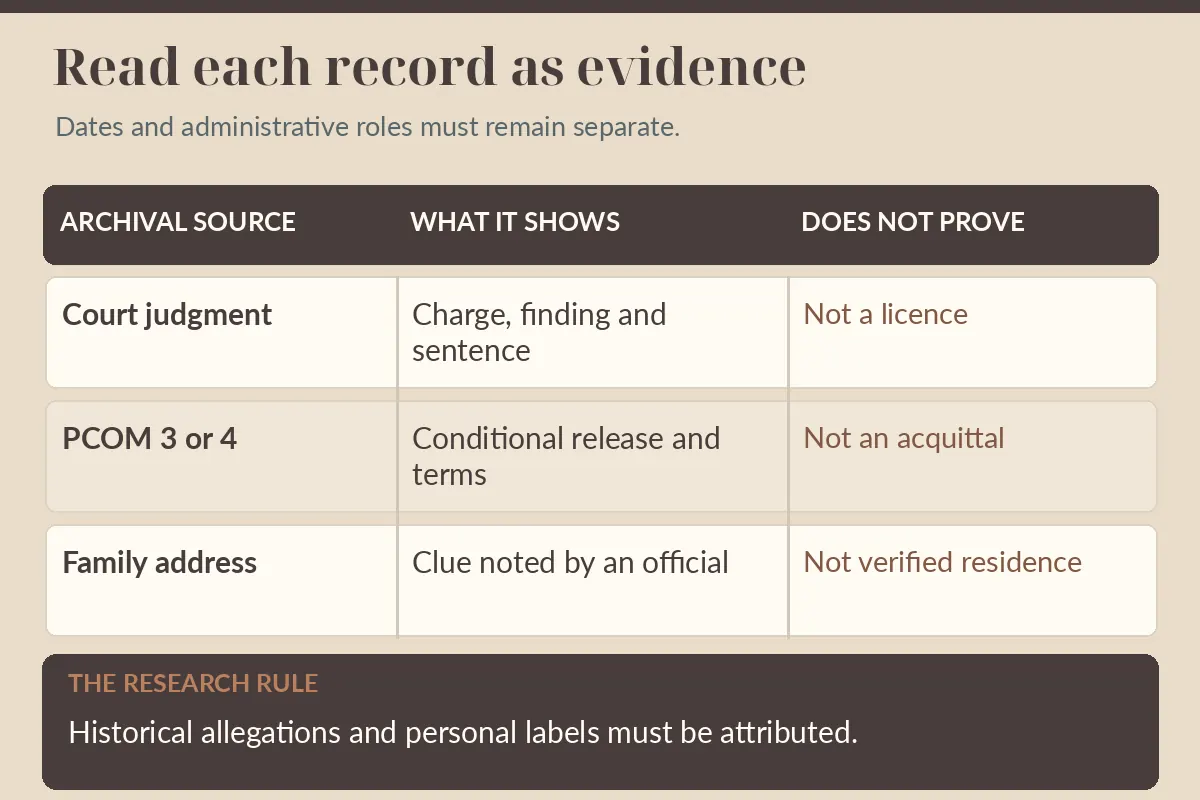
| ARCHIVAL SOURCE | WHAT IT SHOWS | WHAT IT DOES NOT PROVE |
|---|---|---|
| Court judgment | Charge, finding and sentence | Not a licence |
| PCOM 3 or 4 | Conditional release and terms | Not an acquittal |
| Family address | Clue noted by an official | Not verified residence |
Resolve Missing Files and Duplicate Names
Suppose a fictional Elizabeth Ward was sentenced in 1869 and her name appears in a PCOM 4 licence issued in 1871. Her daughter’s marriage registration in 1876 shows a similar surname and occupation. Those records cannot be fused merely by dates or surname; compare the licence’s family address, age and aliases with independent civil and parish entries. A story that Elizabeth “was pardoned in 1871” would overstate the licence. The sounder claim is that a prison authority recorded conditional release on the named date, subject to terms and subsequent official history if recorded.
Build a chronology with document citation, named subject, administrative stage and exact wording. Enter the conviction, committal, confinement locations, licence date, later endorsements and independent family record as separate lines. For a next-of-kin entry, add “stated relationship” and “corroboration needed” columns. If you use a copied transcript, retain the original spelling and warn about abbreviations or ambiguous dates. A partial file may preserve details about transfer without the whole court case. Resist composing a seamless narrative across those documentary gaps; uncertain transitions should remain visible.

Separate the Release Date From Family Events
A safe citation includes The National Archives, PCOM 3 or PCOM 4, piece and named licence number, specific page, creation or event date, and source of the accessed image. Photograph citations should identify the image’s associated file and not imply it is a formal independent identity certificate. If a modern catalogue item contains a conviction summary, state that it is a catalogue description rather than testimony read in the original. Where available, cite the sentencing court record independently so the licence is interpreted as part of a longer justice-system sequence rather than as the complete legal case.
More Records and Archives Guides
How We Research Conditional Release
We route the search by sex-specific file series, check actual date and name-index coverage, then read the conditional licence and each later notation rather than treating “release” as a single final outcome. We use court material to establish the underlying sentence and contemporary civil records to test identity, address and reported kin. Photographs and officials’ judgments remain attributed to their creation context. The finished research claim says exactly what PCOM 3 or PCOM 4 records, and does not infer a pardon, permanent residence or hereditary fact from it.
No. A licence allowed conditional liberty; it was not in itself an acquittal or pardon.
PCOM 4 is the female licence series; the named surviving periods are uneven.
No. They occur in only some files and become more common from the 1870s onward.
It is an institutional statement to compare against independent birth, marriage or other family records.
Check exact year coverage, aliases, court material, and the right PCOM series before asserting that no licence existed.