
PMG 4 records payments of half pay to British Army officers from 1737 to 1921. These ledgers can place a named officer in a specific pay administration, but they are not service biographies or automatic certificates of retirement. The National Archives says that the volumes became alphabetical after 1841, a change that materially affects research. Begin with an officer’s approximate period, rank and regiment; then find the actual ledger and inspect its headings. The vital distinction is between being listed for half pay, holding a particular commission and having definitively left military service.
Start With an Officer and an Accounting Question
A census or family document calling someone a “retired officer” may be summarizing a much more complicated career. Before 1871, an officer could leave active duty by selling a commission or go on half pay; pension entitlement was not universal. The National Archives lists PMG 4 among half-pay records, while WO 24 and officer appointment series answer different questions. Record a firm identity clue, such as the regiment, approximate dates or a Gazette notice, before seeking a ledger. Do not turn an index match into a final retirement event.
Write the exact question: Was this man drawing half pay at a particular accounting date, did he change regiments, or is a later pension or family description consistent with the payments? A surname without a commission or unit clue is weak evidence. Officer surnames and initials repeat across generations, while the pay system could continue after an active assignment ended. Keep the claimed age and known commissions in a timeline independent of the payroll to avoid building a circular identification.
Use the 1841 Alphabetical Filing Change
The British Army officers guide gives PMG 4 coverage from 1737 to 1921 and says that volumes after 1841 were arranged alphabetically rather than by regiment. For earlier records, start with a plausible regiment and the dates of the account. For later returns, a surname initial is more useful. The National Archives’ First World War pension guide likewise explains that later ledgers are grouped by surname initial and generally require browsing rather than a complete name search. Check the actual piece description before choosing a volume.
A late alphabetical entry does not mean every year or name is represented by an independent file. Examine the ledger section headings, pay period, rank, any sums or changes, and whether a line is crossed through or carried forward. Accounting annotations may refer to an earlier period. Do not silently convert an amount into a salary rate, a pension award or a residence address. Record the original amount and its accounting context exactly as shown.

Differentiate Half Pay, Commission and Pension
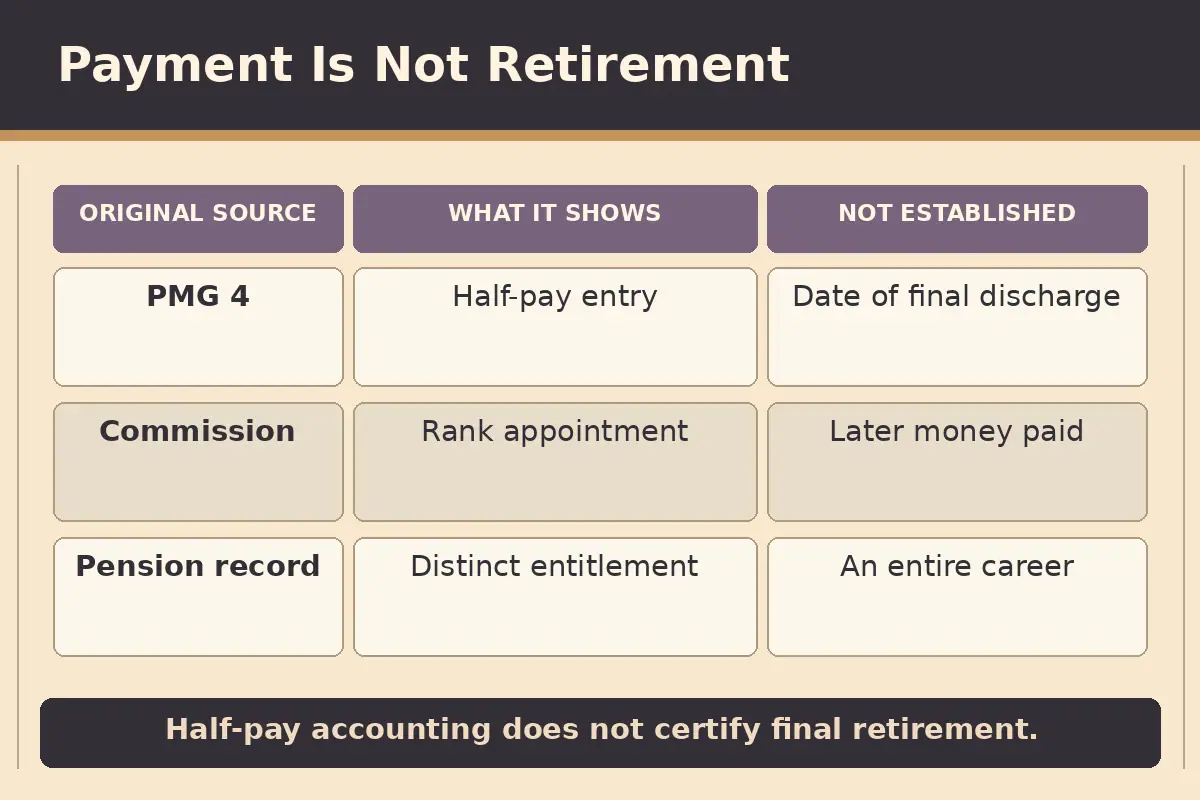
Half pay was an administrative and financial status that differed from an officer’s active posting. The National Archives describes WO 24/660–747 as records of officers on half pay from 1713 to 1809; WO 76 provides other service summaries; appointment and commission evidence may be in different series and the London Gazette. Compare them by date and person. Finding the same surname in a commission notice and a PMG 4 ledger does not by itself establish one continuous career, especially if the entries are years apart.
Place every fact in a table headed OFFICER, EVENT, SOURCE and PROOF LIMIT. A Gazette announcement may establish a published appointment, and a half-pay ledger may establish a pay listing, while an independent pension record concerns entitlement under its own rules. If the ledger’s rank differs from a family obituary, check whether the pay entry is older or refers to a different namesake. Pension rights, military rank and social use of a title are separate historical claims.
Read Amounts and Dates Without False Precision
Transcribe the ledger as a financial record rather than guessing the intervals between visible entries. Some records may specify accounting quarters, arrears or adjustments. The date of a receipt or posting is not necessarily the first date the officer was on half pay. A zero or missing amount must be interpreted with the heading, not labeled dismissal or death automatically. If a line is carried into another volume, preserve its reference and examine the succeeding account where available.
For a difficult identity match, compare the officer’s commission chronology, regiment and any stated pay code against an independent Army List. If only initials appear, a second officer of the same surname can remain plausible. Track competing candidates without silently combining them. A ledger may document a known person’s financial status while providing few birth, marriage or family details, so avoid treating the relative sparseness of personal fields as a defect that can be fixed by inference.
Compare Related Sources and Account for Lost Evidence
The National Archives identifies multiple military pension families, including PMG 3–14, WO 23–25 and WO 42. Their administrative purposes differ. Searching PMG 4 cannot replace a specific widow’s claim or an officer’s commission record. Choose the next series based on the question and known dates, not because every half-pay entry supposedly has a related personal dossier. A WO 24 match may be especially useful before 1809, but corroborate the person and unit before equating two handwritten lines.
Catalogued item dates, physical access restrictions and indexes may vary. A negative surname search is only meaningful after checking the appropriate alphabetic segment or regiment-year volume. Retain a research log listing the exact pieces, dates and spellings examined, along with any unreviewed sections. If half-pay evidence does not survive for the right period, seek independent Army Lists or Gazette appointments and say plainly that the original ledger claim remains unproven.
More Records and Archives Guides
How We Research an Officer’s Half-Pay Status
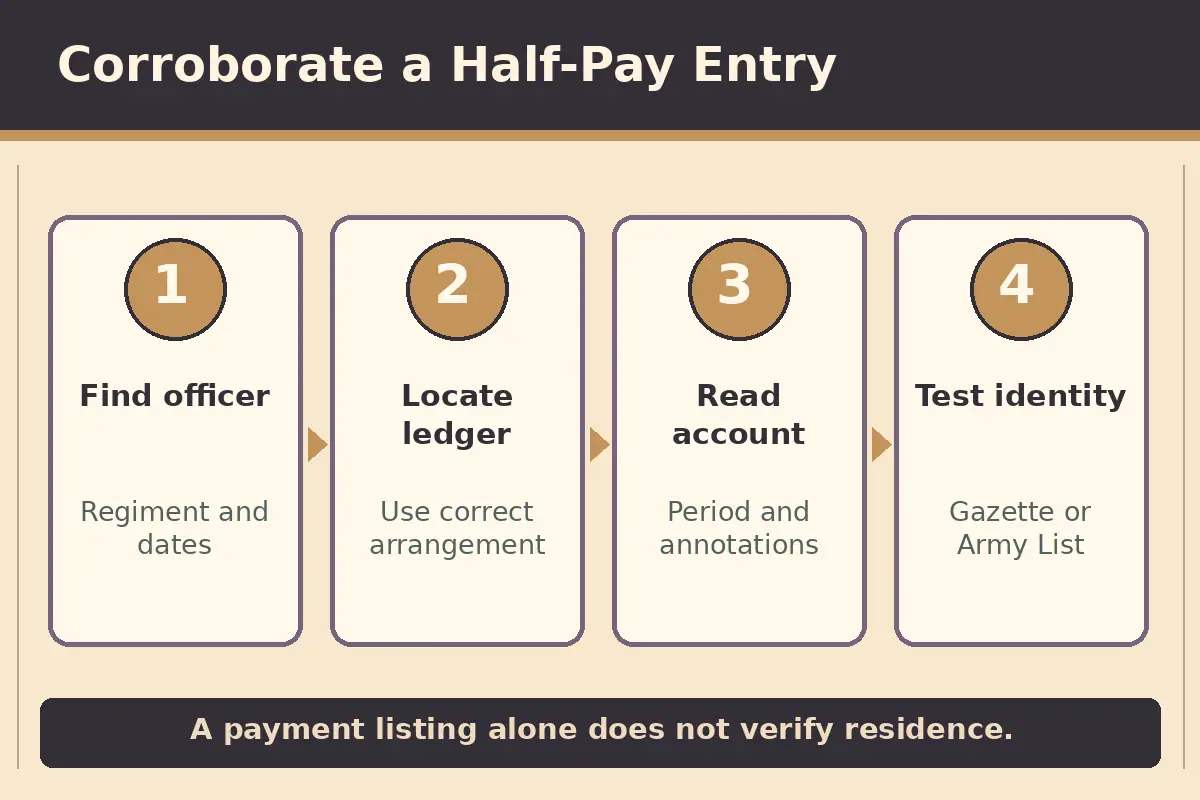
Our method starts with a dated commission clue and chooses the PMG 4 volume using the filing system in force: regiment and period before the 1841 change, surname grouping afterward. We capture ledger headings and all administrative qualifiers, then test identity with a separate source rather than constructing a career solely from cash entries. An uncertain amount remains an original transcription with no invented conversion to an entitlement, retirement date or family residence.
The National Archives’ officers guide details the half-pay system and PMG 4’s arrangement. Its pensions guide explains later surname subdivision and browsing limitations. These provide archive routes, not individual biographical evidence. Retain the original citation and compare any interpreted conclusion with appointment documents. See the GenHis affiliate disclosure for our linking policy.
No. It documents a half-pay accounting status; commission and retirement questions require separate sources.
The archive says that volumes from after 1841 were organized alphabetically rather than by regiment.
Not solely because he appears in the payroll. Confirm residence independently.
No. Read the original ledger heading and the distinct rules governing payments and pensions.
Browse the appropriate piece and surname or regiment section and log the actual scope searched.