
Begin a British Boer War service search with a soldier’s unit and regimental number, not just a matching surname. The South African War lasted from 1899 to 1902, but British military records were created by different commands, regiments and volunteer formations. The UK National Archives research guide sends researchers to WO 100 medal rolls, Imperial Yeomanry files in WO 128 and WO 129, and other series for units raised in South Africa. These sources answer different questions; a medal entitlement is not the same as a full service history.
Determine Which Force the Person Joined
Start by recording the precise regiment or corps, any service number, rank, dates and location from an obituary, photograph, family paper or surviving discharge. The Second Boer War involved regular British soldiers, militia, Imperial Yeomanry, and contingents formed elsewhere, including units raised in South Africa. A single database called ‘Boer War records’ may mix these categories. TNA’s South African War overview distinguishes land, naval and other branches; the correct archival route depends on the service context.
Imperial Yeomanry was a particular volunteer mounted force, not a synonym for every British soldier in the conflict. Likewise, a locally recruited South African regiment should not automatically be assigned to a regular British Army archive series. If the unit is unknown, use contemporary army lists, a dated campaign account or a family record to develop candidate units; label the conclusion provisional until a name, number or independent evidence links the person to one. A photograph showing a uniform style alone rarely provides an exclusive unit identification.

Use WO 100 as a Medal Entitlement Source
WO 100 consists of campaign medal rolls arranged chiefly by service formation. The National Archives’ medals guide explains that rolls generally record the recipient’s regiment or number and relevant clasps, with possible marks about receipt or return. They are not personnel dossiers: they may lack birthplace, parents, home address or a complete enlistment narrative. Transcribe the individual row including annotations, identify its roll heading and preserve the date and page. A medal-name hit should be called an entitlement record, not a verified military biography.
For an index with a familiar surname, search the same regiment and number in a second source. An initial, rank or spelling may differ between rolls, and soldiers might be transferred. Medal clasps refer to campaign entitlement conditions; they should not be translated into an invented minute-by-minute battlefield account. Even if an index labels a soldier as ‘served in South Africa,’ distinguish the listed award from independent proof of a specific event. The strongest statement is about what the particular roll records, with its archival citation.
Follow Imperial Yeomanry Numbers into WO 128 and WO 129
For the Imperial Yeomanry, TNA identifies attestation and discharge material in WO 128 and registers and casualty books in WO 129. The volunteer forces guide says WO 128 is arranged by regimental number. This makes the number a much stronger retrieval key than surname alone. Compare number, unit and rank across a medal roll and an attestation paper, then read personal fields exactly as the file presents them. Not every soldier will have a complete file, and a casualty-book entry does not imply death unless the actual notation says so.
A later transfer into the regular army or subsequent First World War service may place useful papers in another sequence. The TNA guide warns that an earlier Boer War career can be represented in later service material. Avoid constructing one career by combining two same-name records from separate decades; retain an identity matrix with age, birthplace, regiment and number. A discharge is a dated administrative action, not automatic evidence of where a veteran settled afterward. Continue the civilian timeline with local records.

Check WO 126 and WO 127 for South African Units
If an ancestor joined a locally raised South African unit, consult the TNA guide’s WO 126 enrolment forms and WO 127 nominal rolls. These series use unit-focused arrangements and should not be searched as if they were a single alphabetical UK-wide service record. Match the unit name exactly, including spelling and historical changes. If a name appears on a roll, determine whether the list describes enlistment, strength at a particular date, or another administrative purpose before treating it as proof of continuous service throughout 1899–1902.
British and Australian colonial or Commonwealth troop records also have different custodians. A record in a UK WO series is not a guarantee that a colonial contingent’s original personnel dossier is held in London. Identify the colonial government or later national archive involved before assuming one catalog covers all forces. If your question concerns a family member in an Australian contingent, the National Archives of Australia’s separate Boer War record guide illustrates why pre- and post-Federation custody can differ.
Distinguish Enlistment, Campaign, Injury and Death
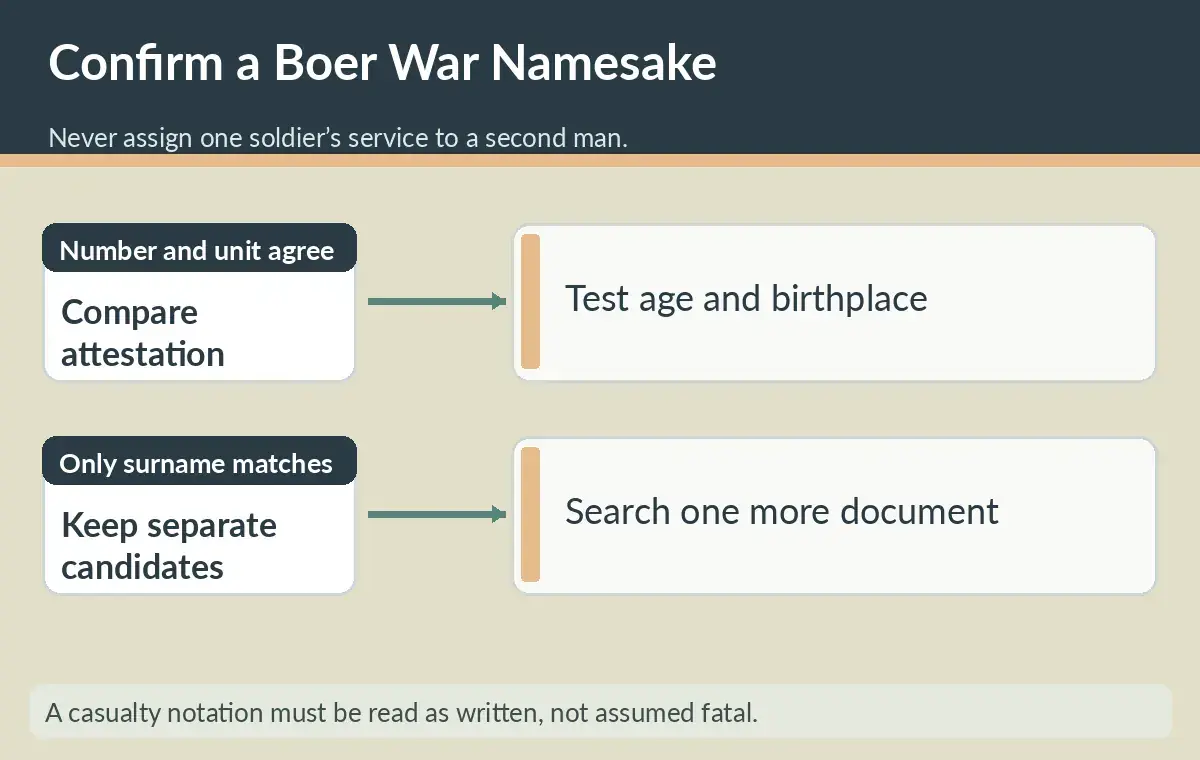
A record of attestation documents that a person presented or was accepted for enlistment on stated terms; it does not by itself document every subsequent engagement. A medal roll concerns award entitlement; it may support a campaign claim but cannot replace operations records. A casualty list may report wounded, missing, captured or killed statuses, often using period terminology. Read the actual category and date rather than turning every casualty notation into a death. Death and burial require suitable independent records, preferably those contemporaneous with the event.
Suppose two fictional soldiers named James Grant occur in Boer War medal rolls. One has service number 317 in a mounted unit and the other 173 in a regular infantry regiment. The shared name and war period do not make them one person. Preserve each unit and number, compare age or birthplace in attestation records, and obtain an external family document if neither original clearly matches. The exercise prevents claims of service, decorations or battle injuries being assigned to the wrong ancestor.
Cite the Unit, Roll Page and Administrative Outcome
A usable citation names the person’s recorded form of name, unit, service number, record type, series and piece, page or image, and archive holding it. For a WO 100 medal roll, retain the roll’s heading and any legible clasp entry. For WO 128 or WO 129, record the precise document within the case rather than treating a database search result as the archival item. Check image access conditions: some indexed images are available only through providers charging for viewing, whereas TNA catalog descriptions can be checked separately.
Keep conclusions scoped to source type: ‘WO 100 lists a man of this name and number as entitled to a specified medal,’ not ‘the family member was at every action named in a narrative.’ Record any contradictory service numbers and a dated next search. The site’s affiliate disclosure applies; mentioning a commercial index is not a claim of sponsorship. The final research target is a documented identity link from the service record to the family, not merely a recognizable surname.
More Records and Archives Guides
How We Research This Collection
We matched the National Archives Boer War overview with its separate guides to soldiers, volunteer forces and medal entitlements. The article routes regular, Yeomanry and locally recruited forces by their proper series, while using a fictional namesake example to demonstrate why a shared medal-roll name is insufficient.
The South African War discussed here ran from 1899 to 1902.
British campaign medal rolls; they are not complete military service dossiers.
The National Archives lists WO 128, with registers and casualty books in WO 129.
Check relevant unit-based WO 126 enrolment and WO 127 nominal-roll holdings.
It supports the roll entitlement noted but does not replace independent evidence for a specific action.