
An Inquisition Is Not a Conveyance
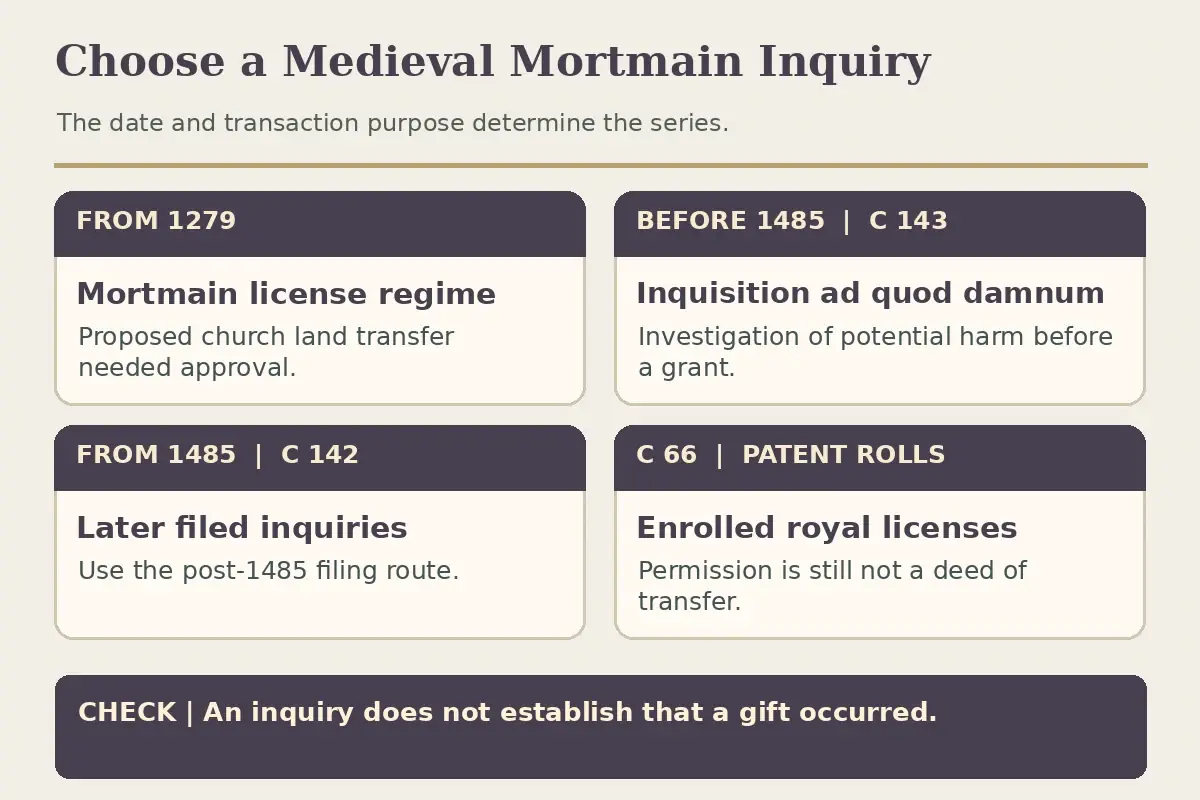
C 143 holds medieval inquisitions ad quod damnum, investigations into whether a proposed grant would prejudice royal or other rights. A central use was mortmain: after 1279 a transfer of land to a religious house required royal license. The National Archives directs researchers to C 143 for related inquiries, C 66 for enrolled licenses, and to C 142 for later inquisition filings from 1485. These records can show what authorities considered before a transfer, not that the land necessarily changed hands.
Ask a narrow question before searching: which land, community and proposed grantor appear in an inquiry? A church, abbey or hospital may be described using a name different from a modern parish. The religious institution’s identity and the estate’s local jurisdiction matter more than matching a single surname. The inquiry may mention neighboring rights, rents or services. None of those statements alone proves a genealogical relationship or that a particular person occupied the land.
The National Archives guide to religious houses and their lands provides the chronological route. Its distinction between inquiry and enrolled license is essential. A C 143 reference may be the beginning of the evidence trail, but a completed legal transfer could require an appropriate enrollment or separate charter. Resist translating a question put to a jury into a declaration of final ownership.
Use the 1279 and 1485 Decision Gates
The Statute of Mortmain introduced the licensed-transfer regime from 1279, making the period relevant to how many proposed ecclesiastical acquisitions appear in the records. Do not assume this one mechanism explains every transfer, grant or landholding over the entire medieval era. The religious-houses guide states that inquisitions ad quod damnum from 1485 are filed with post-mortem inquisitions in C 142, not in the earlier route to C 143. Choose the date before concluding a specific inquiry is missing.
Use the exact inquiry date when recorded; where a clerk uses a regnal year, verify the monarch and accession convention instead of guessing a modern date. A calendar heading might summarize several parties or land parcels, so copy the original reference, folio or item number and the names as written. Search variant Latinized institutional names and historical county names. A modern property title with a similar name does not prove identical boundaries after centuries of change.
The National Archives also describes C 143 inquiries preceding grants of market and fair rights, not merely mortmain licenses. A match in C 143 therefore must be classified by its stated purpose. Check whether the petition concerns a religious land gift, a fair, a franchise or another proposed grant. If you conflate them, a named person in a market-right investigation could be mistakenly placed in an abbey’s chain of title.
Separate Proposed Gift, Licensed Act and Possession
Build three evidence columns: C 143 INQUIRY, C 66 LICENSE, and INDEPENDENT TRANSFER OR POSSESSION. The inquiry may record land description, proposed grantor, recipient and possible loss to the Crown; read the actual wording rather than assume all such fields occur. A license in the Patent Rolls may authorize a transaction subject to conditions. A separate deed, confirmation, rental or account may be needed to show whether land was transferred and subsequently held.
A proposal might be abandoned, amended or followed by a grant at a different date. The names of jurors or witnesses on a record do not turn them into grantors, tenants or blood relatives. Distinguish a measured holding from the fee, rent, or right involved. If the inquiry names one manor but the license uses a broader jurisdiction, do not join them on surname alone. Copy boundaries, recipients and exact units where provided.
The markets and fairs guide points to Lists and Indexes XVII and XXII as finding aids for C 143. Index coverage and spelling limitations are not proof of the existence or absence of a license. In the proof table, keep original language, calendar paraphrase, uncertainty and the next record to consult. Each arrow between documents should represent a verified cross-reference, not a presumed inevitable succession.

Research People Without Manufacturing a Family Line
A medieval person may be designated by an occupational surname, patronymic, place of origin, religious office or land relationship. Treat each as a dated identification, not a modern fixed surname. Compare names and descriptors within the right manor and temporal window. If a grantor shares a surname with someone in a later deed, determine whether they are plausibly the same individual, a successor or unrelated. An inquiry into possible damage gives no automatic descent line.
Religious houses sometimes received revenue rights, property interests or services rather than exclusive occupation of every acre named. A tenant could remain while superior rights changed. The hierarchy of lordship, tenancy and use is easy to flatten into a false modern ownership sentence. Ask which right the original Latin describes and whether the source reports a proposal, permission, execution or later administration. Seek trustworthy translation help when technical vocabulary is uncertain.
For an estate narrative, add a dated charter or deed if one survives, an enrolled record and an independent manorial or religious house account when relevant. Use careful phrases such as “the inquisition considered a proposed grant” until a completed transfer is documented. An unlocated C 66 enrollment is not proof the proposal was rejected; note whether the proper year, roll, index and name variants have actually been examined.

More Records and Archives Guides
How We Research C 143 and Medieval Grants
We start with historical jurisdiction and transaction date, search C 143 for a potentially relevant inquiry, and inspect the original before interpreting the result. After the 1485 boundary we redirect inquiries to the appropriate C 142 context. We next test any C 66 license against the documentary evidence for execution. A sound conclusion says precisely what the inquiry found or proposed and what, if anything, other records establish as a completed act.
These diagrams teach the 1279/1485 date choice, a three-way evidence matrix and a conditional verification chain. They are explanatory graphics rather than reproductions of medieval originals. We never present a missing roll, a calendar summary or a witness name as decisive proof of ownership. A full citation includes repository, series, piece, internal locator and historical date, plus access status and any unresolved reading.
Check Discovery and the archive’s latest retrieval details before requesting materials. If the archival term cannot be translated confidently, make the uncertainty visible. Read the affiliate disclosure for commercial transparency. For family history, one correct statement about what the Crown investigated is more valuable than an impressive but unsupported list of medieval ancestors.
An official inquiry into whether a proposed grant might cause damage to royal or other rights.
A mortmain licensing regime applied from 1279 to many proposed transfers of land to religious institutions.
The National Archives says later inquiries are filed in C 142 alongside post-mortem inquisitions.
No. An inquiry concerns a proposed transaction; check C 66 and independent transfer or possession evidence.
No. Their roles establish involvement in a proceeding, not ancestry or inheritance.