
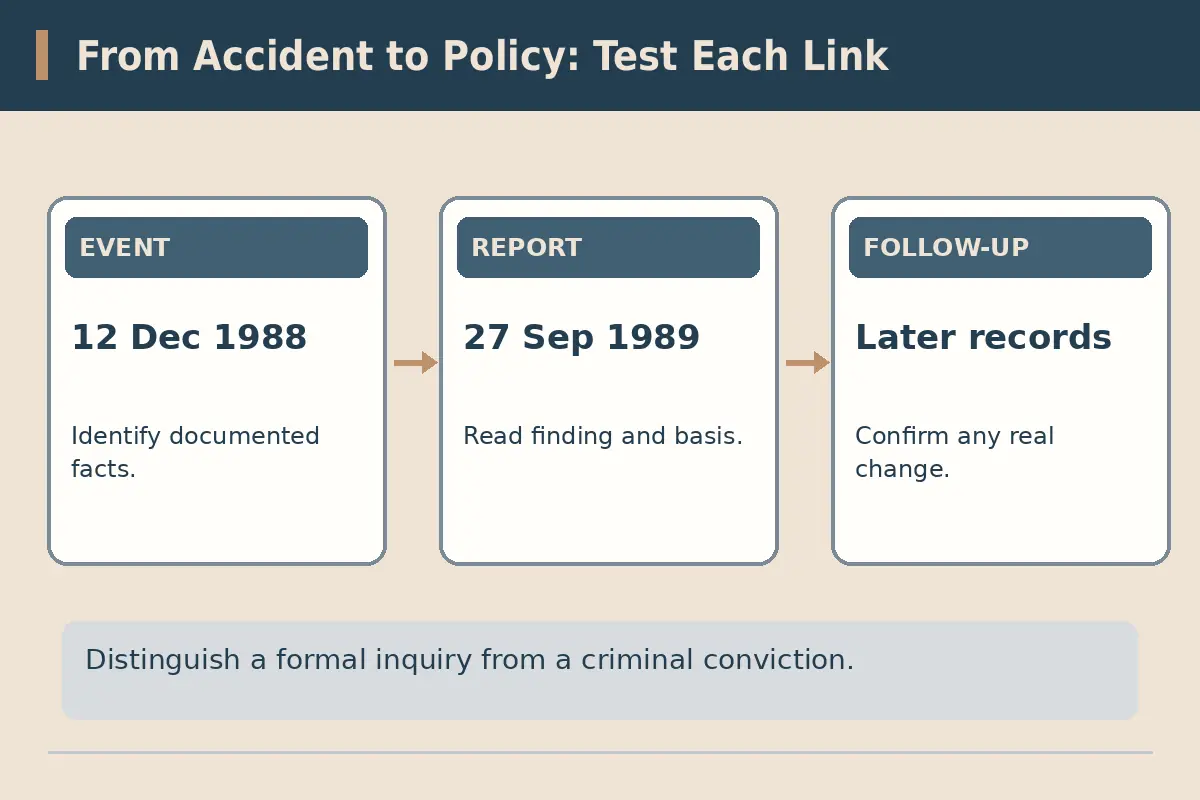
The Clapham Junction railway collision occurred on 12 December 1988. The official investigation was published on 27 September 1989; The National Archives identifies MT 143 for records of the formal inquiry. Inquiry testimony, the report’s findings and later safety changes are separate kinds of evidence and should not be collapsed into blame assigned by a later retelling. This guide gives a precise source route, identifies what the archive can and cannot show, and names the independent documents needed before a personal or geographic conclusion becomes defensible.
Separate the Accident Date From the Inquiry Date
Begin with the exact event: the Clapham Junction railway collision on 12 December 1988. The formal investigation led by Anthony Hidden QC produced a published report dated 27 September 1989. Those dates serve different purposes. A witness may describe what happened on the morning of the collision; the published investigation is a later assessment of evidence; records of implementation may be later still. A chronology that uses only the report date will misplace the accident, while one dated only 1988 obscures how subsequent findings were developed.
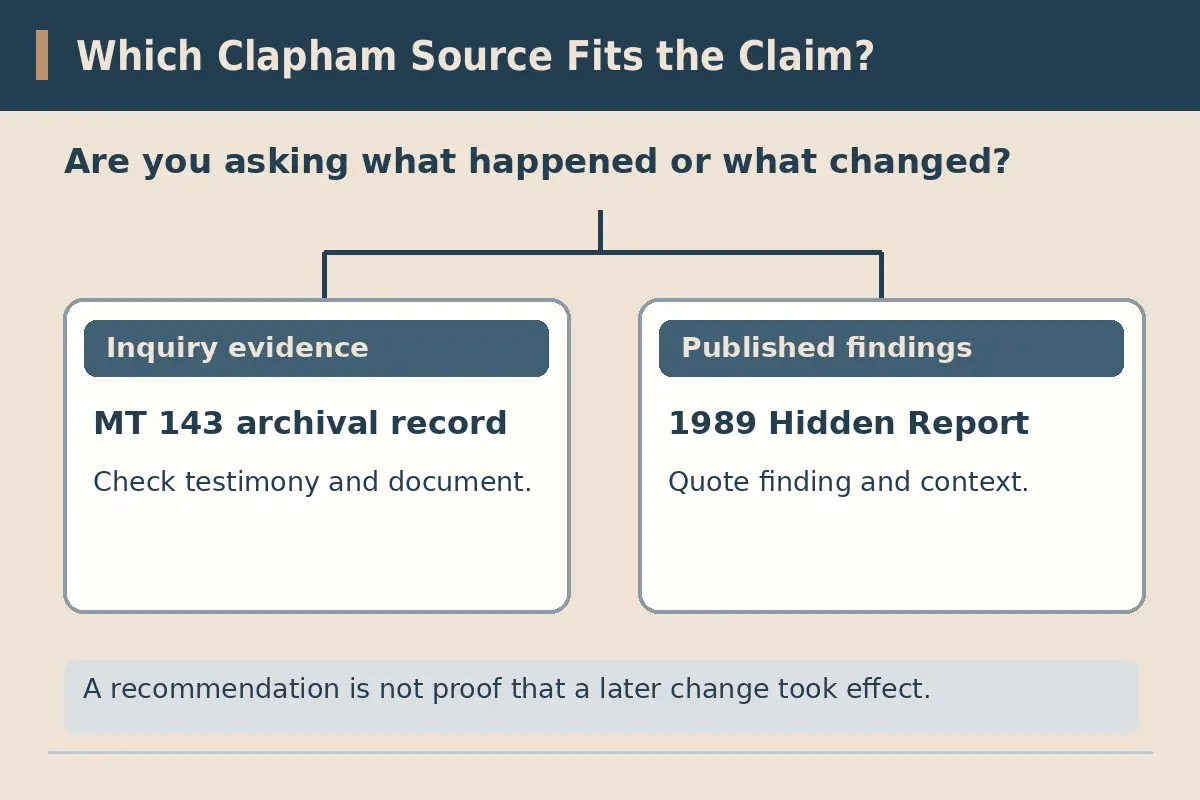
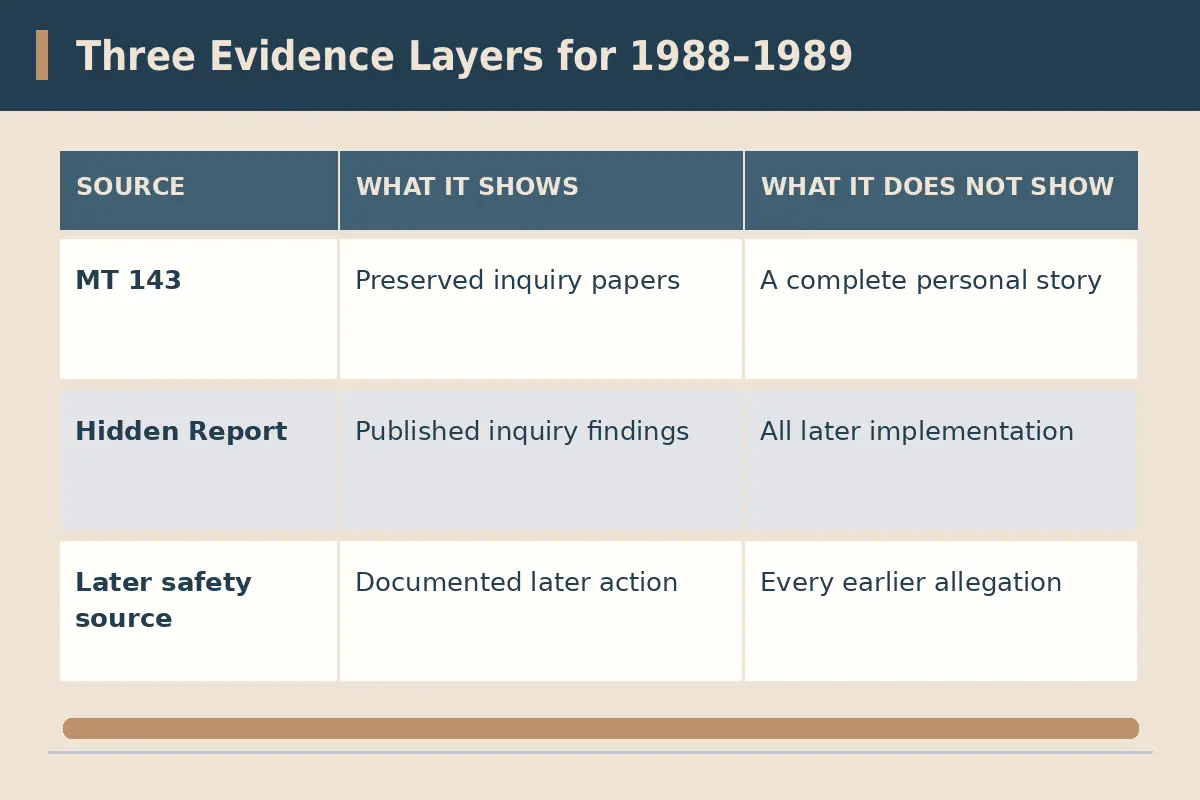
The National Archives railways guide points specifically to MT 143 for the inquiry material. Do not suppose that all evidence is searchable by the names of passengers or staff, or that the series comprises one searchable transcript. Find the relevant catalogue references, record the title and file dates actually described and follow the access instructions for each piece. Keep contemporaneous accounts separate from later summaries. A headline, family recollection or anniversary article can provide leads but should not replace the formal investigation when reporting the inquiry’s findings.
Locate MT 143 and the Published Hidden Report
Use a targeted Discovery search with MT 143 and the incident, then compare the resulting titles, coverage and repository information. The National Archives guide names the series, but a series-level reference does not identify which document contains a particular witness statement. When a piece is available, cite the full number, document date and page or folio. If only the catalogue entry is accessible, say so openly rather than presenting the series summary as if it were direct testimony.
The Railways Archive hosts a detailed record of the formal Hidden investigation and gives its publication date as 27 September 1989. It is a useful bridge between a published inquiry and the archival holdings named by the National Archives. When reading the report, capture the exact section in which a finding appears, and distinguish any appendix evidence from the investigating author’s conclusion. A source transcription, original report scan and modern website summary are not interchangeable source levels, even if they discuss the same event.
When comparing contemporary news to the final report, watch for changing terminology. Early press accounts may describe the incident before technical examination was complete. Later reports may amend numerical summaries or interpret several contributing conditions together. Use the precise source and date of each figure or explanation; do not blend them into a single invented contemporaneous statement. The public inquiry was established for examining the accident and lessons for safety, not as a shortcut to criminal guilt.
Distinguish Witness Statements, Findings and Allegations
An inquiry can include recollections, technical tests, documentary exhibits and evaluative conclusions. An individual witness’s account is evidence of what that witness reported; the inquiry’s factual finding reflects an assessment of the available material; a modern narrative may select only one aspect. The Hidden investigation examined immediate and underlying causes, including signalling work and procedural weaknesses. Cite the report itself before assigning an explanation to a named person. Do not turn a criticism of a process into a legal verdict about an employee.
Use a column for claim status: reported in testimony, established in published findings, contested or unresolved, and independently corroborated later. A claim about railway signal operation should be checked against technical diagrams and the report’s explanation, not inferred from an evocative photograph. Where the report quotes witnesses, preserve the attribution and context. Missing evidence may constrain the investigation; it does not license a theory based only on who held a job title. Avoid naming or characterizing affected individuals beyond what reliable sources justify.
Verify Whether Recommendations Were Implemented
The 1989 report made safety recommendations in response to the collision. Their existence is directly established by the report, but an adopted change requires separate evidence: subsequent railway procedures, regulator publications or documented organizational action. Do not treat “recommended,” “accepted,” “begun” and “completed” as synonyms. Similarly, a later rule may have several causes and may apply to particular functions rather than every railway. Keep the organization, effective date and documented scope visible in a follow-up evidence table.
A practical comparison has three dated columns: the concern described in the inquiry, the proposed remedy and the later source that demonstrates any actual implementation. If a later safety review refers back to Clapham Junction, quote the specific relationship it states instead of assuming all current rules arose from this single accident. The distinction is valuable for local historians and technical researchers because it prevents retrospective narratives from replacing the documented sequence of inquiry, acceptance, modification and operation.
Build a Responsible Accident-History Citation Trail
For a hypothetical example, a researcher wants to know whether a particular signal problem was identified by the inquiry and whether the corresponding testing procedure changed. The correct route is to find the report section describing the technical fault, check the supporting evidence if available in MT 143, then locate later safety guidance for the claimed change. An online forum’s explanation should not be accepted merely because it uses technical vocabulary. Cite exact passages and keep disputed interpretations next to their sources.
An accident history also concerns people harmed. Avoid gratuitous reuse of casualty names or speculative personal stories. A formal investigation is not a biography database, and a family connection requires independent evidence from lawful, appropriate records. Bibliographies should distinguish The National Archives as custodian of inquiry files from the Railways Archive as an accessible source for the published report. Capture stable links, full archive references and date of consultation; preserve any gaps without declaring a conclusive verdict on matters the inquiry did not determine.
Local history can document how the railway infrastructure and official practices changed without constructing unverified anecdotes about individual passengers. Search dated maps or technical plans only where the proposed comparison is clear. A later image of junction signalling may not depict the 1988 arrangement. If an illustration is a reconstruction, label it as such and cite the archival document from which each factual claim was drawn.
More Records and Archives Guides
How We Research This Archive Series
This guide starts with the official description in The National Archives’ research guidance, not a claim that we have inspected a particular person’s private file or a specific original piece. The archival statements here concern the series or research method. A hypothetical example is labelled as such; it is not a newly discovered historical event. We use the Discovery search guidance to distinguish keyword matches from archive holdings and document contents, because catalogue descriptions do not transcribe every word of an original.
For every real candidate, record its historical place or person’s name, the creator, document type, date, full MT 143 piece or item reference, access restrictions, and the exact claim being tested. The official citation guide explains how to document those references so another researcher can retrace them. An unread document remains a catalogue lead, never proof of imagined details. If a record is missing, preserve the searched terms and dates and examine survival and alternate custodians before interpreting the gap.
Before sharing a conclusion, audit the difference between original source wording and your interpretation. Require independent evidence for any further claim about an individual, property owner, legal effect, or completed action. Respect archival access limits and living people’s privacy. This website also provides an affiliate disclosure; no paid partnership or commercial access is implied by these archival references.
The National Archives railways guide identifies it as the archival series for the official Clapham Junction rail disaster inquiry.
The collision occurred on 12 December 1988; this differs from the subsequent inquiry report date.
The formal investigation by Anthony Hidden QC was published on 27 September 1989.
No. Read the context and distinguish testimony, documentary evidence and conclusions in the published report.
No. Check later dated implementation evidence before claiming a recommendation took effect.