
Military School Records WO 143 can provide useful evidence only when the document type and its limits are understood. Begin with the official research guidance and distinguish what the repository holds from what a family story suggests. This guide gives a source-specific search sequence, the meaning of each relevant field, and a tested way to separate an original record from a mistaken name match.
Start With a Named School and a Plausible Period
The National Archives points researchers toward WO 143 for some records of soldiers’ children associated with the Duke of York’s School and the Royal Hibernian School, beginning in 1801. The series is not a national school admissions database and does not promise a record for every pupil. Begin with a named school, date range and the child’s independently documented identity.
A family story saying that a child attended “an army school” may refer to a different establishment. Search the contemporary name of the institution and the historical place, not just its modern successor. Record whether a source identifies a pupil, a teacher, or merely mentions an institution’s budget. Do not treat a catalogue series title as proof that a particular family belonged there.
Understand Why These Records Are an Exception
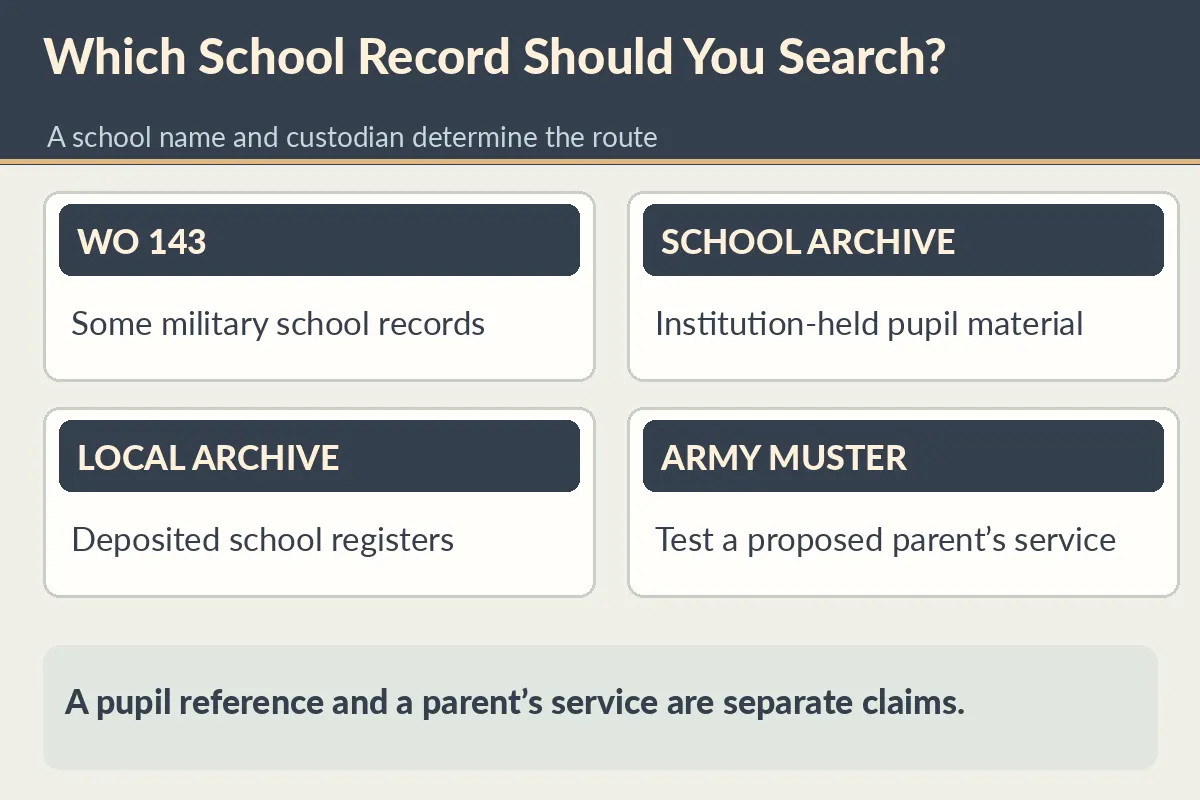
The National Archives’ general schools guide emphasizes that ordinary individual school files are not its main holding and often belong with local authorities, schools, charities or local archives. WO 143 is a special military-school lead noted in the Army muster and pay-list guide. This different administrative origin matters: War Office records may reflect military dependants or institutional management rather than complete educational histories.
Keep a list of possible custodians. If a child’s name cannot be found within the relevant WO 143 descriptions or surviving volumes, look for institutional archives or local records according to the school’s history. Missing central material is not evidence that the child never attended. Be wary of modern databases that combine pupils from multiple schools without displaying the archive source for each.
Identify What a Pupil Entry Actually Says
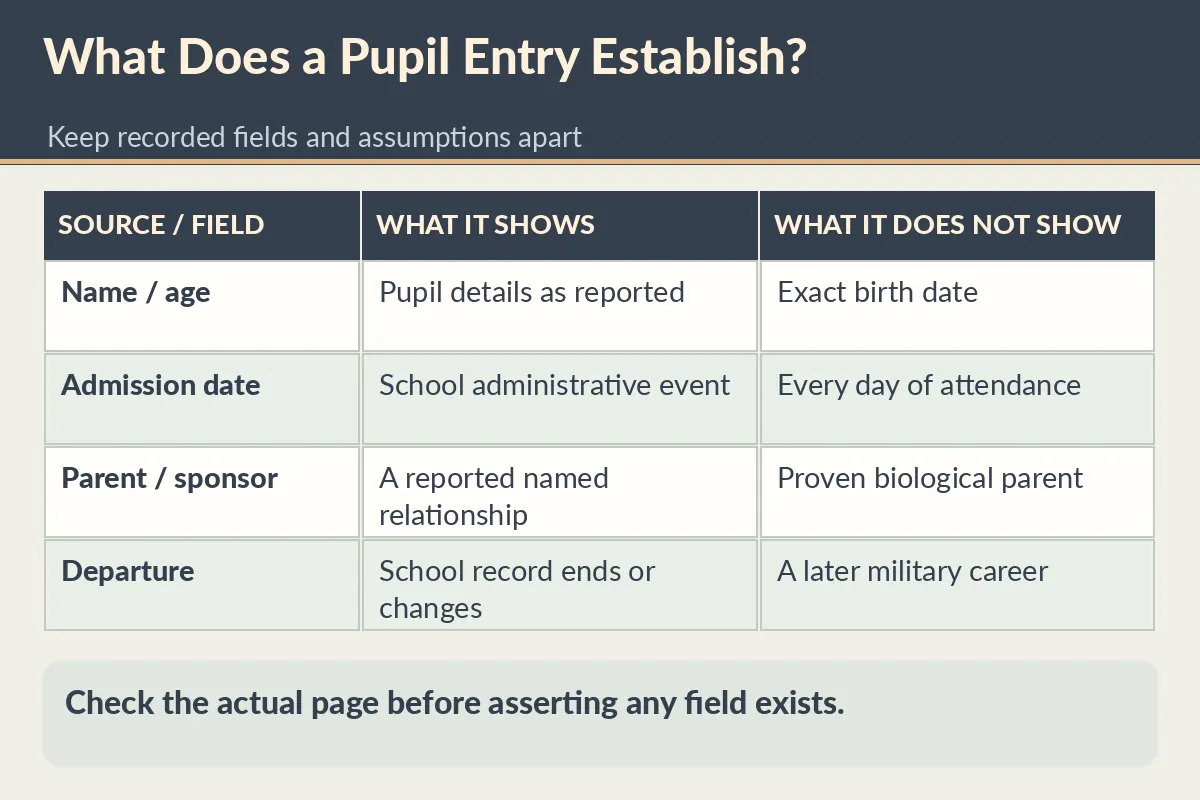
When an individual record is located, copy the full headings and nearby entries. It may give a pupil’s name, admission detail, age, parent or sponsor information, service connection or departure, but the fields cannot be assumed before the original page is read. The administrative purpose and format of a particular WO 143 item govern what can be concluded.
Distinguish the date a child was admitted, a later register review, and the approximate date of birth calculated from a reported age. Ages can be rounded or wrong. A pupil may be recorded under a shortened name, a guardian’s surname or variant spellings. If a school entry has a parent’s name, keep it as a reported relationship until corroborated by another contemporary source.
Prove the Soldier Connection Independently
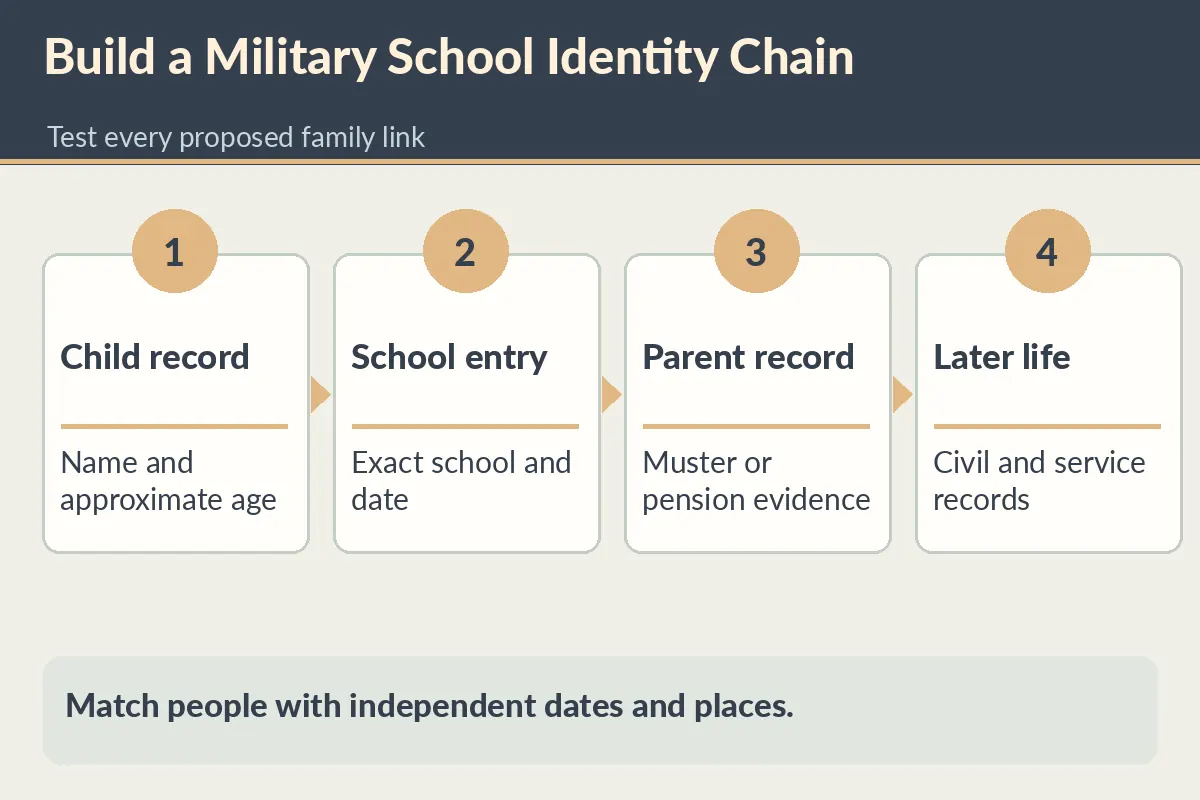
A military school association can be a strong route toward a soldier-parent hypothesis, but being eligible for a school place is not the same as a surviving proof of fatherhood. Search a known regiment in contemporaneous army musters or pension papers and compare names, location and relevant dates. The National Archives’ army guide explains that pay lists and service records vary considerably in survival.
The possible father’s service dates must match a plausible family chronology. A soldier of the same surname in the correct regiment may be an uncle, guardian, unrelated sponsor or another man entirely. Compare baptismal records, guardianship papers, marriage details or a household census when available. Do not transform a child’s school entry into a claim about a soldier’s regiment without a separate record naming that association.
Handle Admission, Attendance and Departure Separately
School administration often records milestones for its own accounting or oversight. A dated admission does not prove continuous daily attendance, and a departure notation does not explain the pupil’s later occupation unless it explicitly states it. If a register is incomplete, gaps between observations should remain visible in a chronology rather than be filled with an imagined education.
Build a three-date worksheet with reported age, documented entry and last confirmed school reference. If a candidate later enlisted in the army, test enlistment independently in the proper service series. Military-school training does not prove that a student eventually became a soldier; another career is entirely possible. The archive page is not a substitute for personal later-life records.
Compare Candidates Without Merging Siblings
Families sometimes reused names, and siblings may appear in the same institution at different periods. Keep birth order, estimated ages and any separately documented parent or guardian names in a comparison table. When a pupil entry gives only an initial and surname, avoid assigning it immediately to the best-known descendant. Search the entire register context for other candidates.
A family member’s obituary could provide a useful school clue, but it is later testimony and must be evaluated separately. A county, military posting or address change may explain where a parent lived at a certain period, not a school admission by itself. Exclude a candidate only on supported chronology and identifying details; do not treat one incomplete school volume as exhaustive evidence.
Write a Source-Specific Finding With Honest Gaps
Your result should identify the exact document rather than saying “WO 143 proves this family.” State which child is named, which school, what date and which fields the record contains. Cite the original piece and page or folio where inspected, then compare independent evidence for age, parents and later career. If there is no surviving individual entry, report the precise search scope.
A good next action is tied to a claim: check a military muster for a proposed father, examine a parish baptism, or contact the institution’s archive for a missing year. Respect privacy for any relatively recent pupils or living descendants. A transparent source chain gives a future researcher a way to agree, disagree or search further without inheriting unsupported family assumptions.
How We Research This Archive and Its Limits
Our research method starts with the National Archives record guide and a second official archival description. We establish why the document was created, what dates and places it covers, how its finding aids differ from original pages, and whether the item has restrictions or known survival gaps. An index hit only identifies a candidate. A signed statement reports a claim or legal act but may not independently establish the truth of its subject. The next source must be genuinely independent where possible. We record the catalogue piece, leaf or image, original column heading, transcription uncertainty, dates of observation and interpretation, and each same-name alternative. Before sharing a conclusion, we check whether changing jurisdictions, archival custody or missing years invalidate the assumption. The diagrams are original explanatory artwork, not facsimiles.
More Records and Archives Guides
Official Sources, Availability, and Disclosure
The first official guide supports the record series and its search route: WO 143 includes some records of soldiers’ children at Duke of York’s School and the Royal Hibernian School from 1801. The second archival guide adds this limitation: National Archives school guidance describes limited central holding and directs individual school searches to local or institutional custodians. Check the current catalogue entry for the specific piece, including view, copy and digitization availability; these vary even within a series. Images shown here are conceptual illustrations rather than source-document scans. Read our affiliate disclosure before using any commercial source links.
No. It is a specific War Office lead for records relating to certain military schools and children.
The National Archives describes records of these schools from 1801.
Not on its own. Confirm any named parent and service connection in independent contemporary records.
Check item-level survival and search the school, charity or local archive responsible for other records.
No. Later enlistment or occupation requires a distinct dated service or civil source.