
WO 54/208 is a targeted source for the Royal Corps of Military Surveyors and Draughtsmen: The National Archives says it lists dates of appointments and promotions. Use that as a career-event clue, not as a diary of assignments. A promotion can be documented without establishing that the person surveyed a particular county, drafted a named map or served continuously at one place.
The National Archives explains that the Ordnance Survey combined military and civilian staff in different periods and that personal records are scattered. Its Board of Ordnance guide warns that many WO 54 descriptions cannot be searched by individual name in the online catalogue. That distinction determines the research method: a catalogue search identifies a piece, but the original may require browsing.
Define the military survey role before searching
Write down whether your candidate was an officer, military surveyor, draughtsman, sapper or civilian assistant. These terms describe different duties or administrative settings, and a later family biography may use “Ordnance Survey employee” for all of them. The specific attraction of WO 54/208 is its list of appointment and promotion dates for the Royal Corps of Military Surveyors and Draughtsmen.
Begin with the approximate year of the reported appointment and a reasonably complete name. Avoid assuming that an inscription on a map is the surveyor’s own signature: published maps can acknowledge institutions, engravers and survey directors. A dated name in a staff record is a much firmer starting point than a decorative map cartouche or modern online attribution.

Search the correct item even when names are not indexed
The Board of Ordnance guide cautions that WO 54 is not generally searchable by person name in Discovery. Use the exact WO 54/208 reference, browse the catalogue and check access arrangements for the original. If a name search returns nothing, that can simply reflect item-level description rather than absence of the employee.
Inspect the entry itself. Preserve the exact spelling, initials, appointment title, promotion date and any marginal remarks. A later compilation can summarize several career events without proving the employee was present at headquarters on the date each entry was copied. Cite the document as a list with its source date and distinguish that from dates it reports.
Separate promotion from an actual local posting
Suppose a relative was promoted as a military draughtsman in a given year. The WO 54/208 entry may be evidence of professional rank or an administrative step, but does not place him in a specific field party. Seek an independent order, deployment list, wage account, dated correspondence or signed survey work before attributing a map or location.
Do not read promotions as a mandatory sequence for every soldier: some individuals may have changed departments or left the corps. Each claimed interval needs its own documentary anchor. An apparent gap between two dated entries may reflect the type of list rather than inactivity. Keep “not found here” separate from “not serving.”

Choose related Ordnance Survey and Army sources by role
The National Archives Ordnance Survey guide lists other staff material: OS 1/1/1 for Royal Engineer officers, OS 3/285 for civil assistants, and OS 3/341 for a family register of 16 Survey Company. These are not cumulative volumes of WO 54/208. Use each one only if the rank, organization, period and person make it relevant.
A service record or muster may establish enlistment and unit movements but not authorship of an Ordnance Survey product. For a military surveyor, a direct reference to a survey office, specific commission or named project is more probative. Avoid joining two different men because they share surname and profession; compare rank, place, initials and dates.
Trace military-to-civilian transitions carefully
Some Ordnance Survey civil assistants had previously worked with military survey companies, according to the archive guide. That is an invitation to test a transition, not proof that every draughtsman eventually became a civilian employee. Compare the dates of the military list with OS 3/285 or another civilian personnel entry before narrating a retirement and second career.
Record when a term changed and what each contemporary source calls the individual. A later biography might compress twenty years into “worked at the Survey,” hiding separate appointments and jurisdictions. Your timeline should carry explicit unknown periods and links to the documents rather than filling blank years with continuous employment.
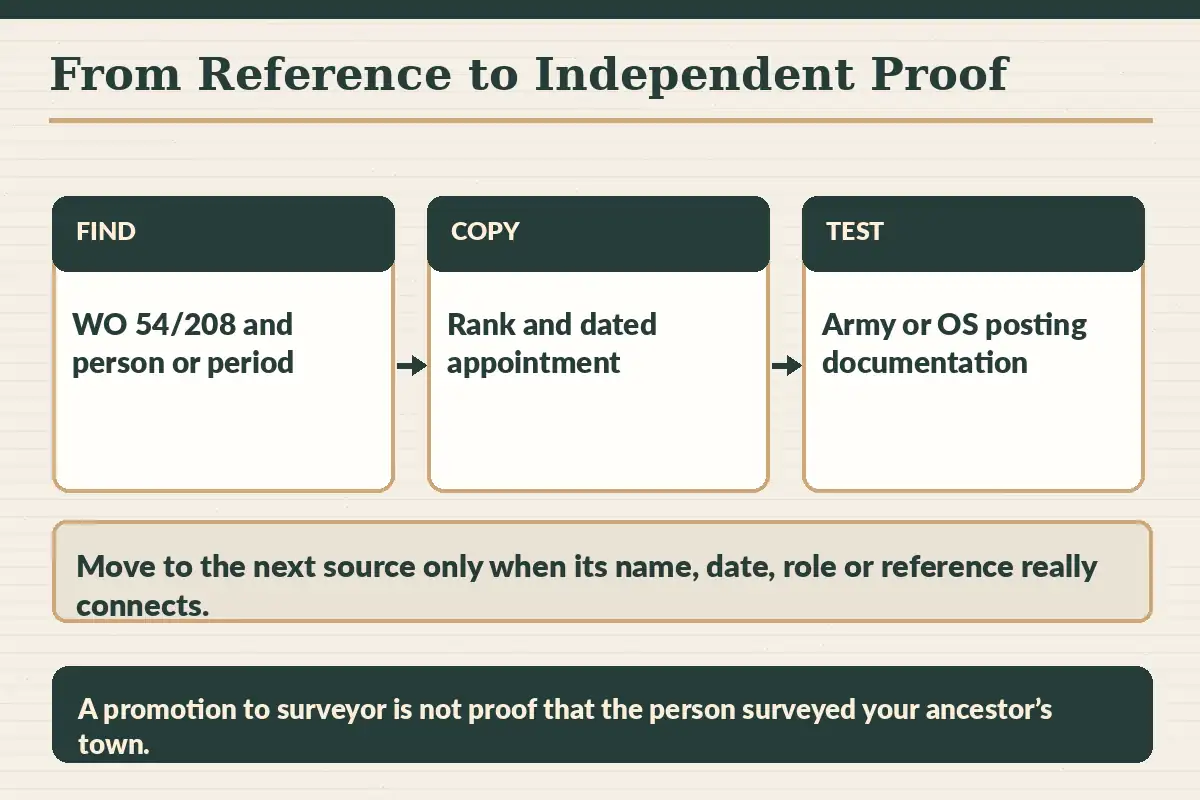
Report the narrowest defensible result
A good archival citation identifies WO 54/208, the relevant entry, date and repository, followed by the original wording that supports the appointment. If you have not seen the original, cite the TNA guide as a route and avoid claiming the full entry was examined. Keep image and transcription separate from interpretation in your notes.
End with one falsifiable next step. If you know only a promotion, the next search should target a rank-appropriate duty or posting list. If the person disappears from later military material, test a civilian register or discharge source. A concise, accurately dated appointment is valuable evidence even when the record cannot establish a complete professional or family biography.
Create a source-linked research ledger
Set up columns for full archive reference, historical creator, actual date of the item, date of the event it discusses, original wording, evidence category, named people and roles, independent comparison source, access limitations and unresolved questions. WO 54/208 names military surveyors and records appointment or promotion dates, not every task, posting or map that followed. Start each new research session by rereading the previous entry rather than depending on memory; this protects subtle differences between an original, a printed summary and a database index. A failed surname search is useful only when the search range and the underlying record coverage are recorded.
Make the narrowest claim supported by your strongest source: An appointment or promotion date. Never quietly convert that into every field assignment. Before adding a relative to a tree, compare identifying details, not just a surname and date range. If your documents disagree, preserve the conflict and specify which additional original could settle it. Equally important, describe whether you saw the original image or only an archive guide, catalogue summary or third-party index. This method creates a conclusion that another reader can independently test.
More Records and Archives Guides
How We Research and Verify the Sources
We checked the archive’s published research description on 2026-11-03. The National Archives identifies WO 54/208 as the corps appointment and promotion list and distinguishes military from civilian Ordnance Survey staff. The cited description establishes the collection and its limits, not the existence of any particular ancestor in it.
We checked the archive’s published research description on 2026-11-03. The Board of Ordnance guide explains why WO 54 records often require browsing by year or function rather than name searches. The cited description establishes the collection and its limits, not the existence of any particular ancestor in it.
We distinguish the record route from the family claim and do not represent stylized cover art as an original manuscript. No paid record vendor or partnership is presumed. See our affiliate disclosure.
The National Archives describes a list of appointment and promotion dates for military surveyors and draughtsmen.
No. The Board of Ordnance guide warns that WO 54 normally requires browsing by period or subject.
No. Find a separately documented work assignment or authorship link.
No. Both military and civilian employees worked for the Survey in different periods.
Check OS 3/285 or other staff records and match dates; do not assume a transition occurred.