
For a dissenter whose family was in London or Hampshire in 1696, C 214/9 and C 214/10 offer a narrowly dated route to oath or affirmation rolls. A name on such a roll records the relevant act and administrative context; it is not a baptism entry, proof of membership in a particular chapel, or proof that two matching surnames belong to one family.
The National Archives guide to nonconformists identifies these two pieces specifically for London and Hampshire dissenters in 1696 and directs researchers to view the originals at Kew. The same guide lists other, distinct oaths for Quakers and ministers in C 213, and recusant fines in E 376 and E 377. None of these sources can be substituted casually for another.
Treat London and Hampshire as a precise gate
Start by confirming whether the individual was plausibly in London or Hampshire in 1696. A surname associated with a nearby county in a later census is not sufficient. The archive’s nonconformist guide identifies two C 214 pieces for the specified year and jurisdictions. Inspect both catalogue descriptions before assigning a particular reference to a locality; do not guess piece allocation from the numbering.
Write down exactly what you know from an independent record: household, occupation, approximate age and locality. Ask whether this fits an adult capable of taking the recorded oath or affirmation. A relative born much later cannot be identified as the original signer simply because the family later used the same surname. The narrow date makes age and place more useful than broad surname distribution.
Distinguish an oath from recusancy penalties
The National Archives explains that recusancy penalties and oath or affirmation rolls arose from different administrative circumstances. E 376 and E 377 concern recusant fines for 1592–1691; C 214/9–10 concern London and Hampshire dissenters in 1696. One series is not a direct index to the other and an individual should not be labeled a convicted recusant merely for appearing on an oath roll.
Record what the actual roll says about the act, signature, mark, name and any role. Do not assert someone signed personally if the image shows only an enrolled name. Where wording is difficult to read, transcribe uncertainty in brackets in your research notes. A researcher should not infer that an oath implies lifelong adherence to one denomination.
Know which alternative C 213 records actually fit
The same research guide separately identifies 1696 oaths for Quakers in Colchester, ministers in Cumberland and Baptist ministers in London under particular C 213 items. These are not a single national database of dissenters. Search an alternative only when the geographical, occupational and religious facts justify it, and note the specific piece consulted.
A London Baptist minister’s entry in a C 213 roll is different evidence from a London lay dissenter in C 214. Likewise, a Quaker described in an unrelated town cannot automatically be identified as a Hampshire dissenter. Preserve those categories and document the official repository reference rather than folding all results into a generic statement that your family “appears in the 1696 dissenters list.”

Build an independent identity comparison
For a common surname, compare the 1696 entry with dated parish, nonconformist chapel, tax, occupational and testamentary records, as appropriate. The National Archives notes that records outside the Church of England have varied custodial and denominational histories. Not every chapel register survives, and some later registers transcribe earlier events; identify the original creator and date before declaring a match.
A two-candidate worksheet is useful. Put the oath name in one column and two possible people in separate columns; add residence, occupation and known relatives only where they are expressly documented. A name match without place or a connecting relationship remains a lead. If neither candidate can be linked to the roll, leave the signer unidentified rather than attaching the record to the most famous namesake.
Do not turn a religious record into a vital record
An oath or affirmation is not equivalent to baptism, marriage or burial, and absence from such a roll does not prove attendance at Church of England services. Many nonconformist families appear in both established church records and separate congregation registers at different dates. Use independent family events to construct kinship; use the oath to add a narrow fact about a particular adult when identity is defensible.
Distinguish the date a person took an oath from a record’s later compilation or filing. The series scope may provide the year even if an individual entry lacks a day and month. Do not invent a precise signing date; quote the roll’s actual wording or make clear that you are using the catalogue-level date.

Plan the archive consultation accurately
The National Archives specifies viewing the C 214 originals at Kew. Check current ordering and access conditions in Discovery and identify which of the two pieces is relevant before visiting or requesting a copy. Catalogue search results may mention the unit of description, but should not be cited as if the original text had been transcribed and examined.
Save the full reference, page or folio, original spelling and any adjacent people or annotations. If your search was limited to electronic descriptions, write “catalogue only.” The outcome may be a documented adult dissenter in a locality in 1696 while parentage and religious affiliation remain uncertain; that is still a useful and properly delimited genealogical finding.
Create a source-linked research ledger
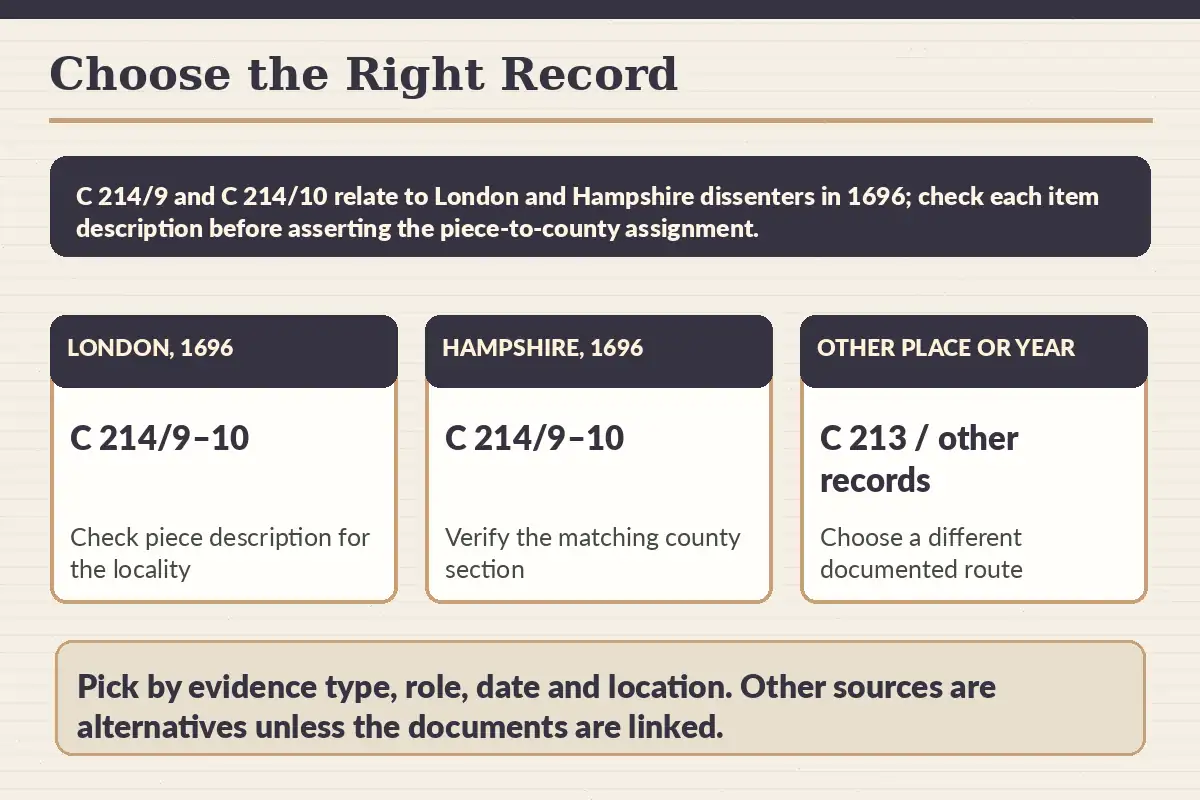
Set up columns for full archive reference, historical creator, actual date of the item, date of the event it discusses, original wording, evidence category, named people and roles, independent comparison source, access limitations and unresolved questions. C 214/9 and C 214/10 relate to London and Hampshire dissenters in 1696; check each item description before asserting the piece-to-county assignment. Start each new research session by rereading the previous entry rather than depending on memory; this protects subtle differences between an original, a printed summary and a database index. A failed surname search is useful only when the search range and the underlying record coverage are recorded.
Make the narrowest claim supported by your strongest source: An oath or affirmation entry. Never quietly convert that into a baptism or precise kinship. Before adding a relative to a tree, compare identifying details, not just a surname and date range. If your documents disagree, preserve the conflict and specify which additional original could settle it. Equally important, describe whether you saw the original image or only an archive guide, catalogue summary or third-party index. This method creates a conclusion that another reader can independently test.
More Records and Archives Guides
How We Research and Verify the Sources
We checked the archive’s published research description on 2026-11-03. The National Archives specifies C 214/9–10 for London and Hampshire dissenters in 1696, with Kew access, and distinguishes other nonconformist record categories. The cited description establishes the collection and its limits, not the existence of any particular ancestor in it.
We checked the archive’s published research description on 2026-11-03. The National Archives Discovery guidance explains how to identify individual pieces and access the correct physical record rather than relying solely on a catalogue hit. The cited description establishes the collection and its limits, not the existence of any particular ancestor in it.
We distinguish the record route from the family claim and do not represent stylized cover art as an original manuscript. No paid record vendor or partnership is presumed. See our affiliate disclosure.
No. They are oath or affirmation rolls associated with London and Hampshire dissenters in 1696.
The National Archives guide directs researchers to consult the originals at Kew; check current ordering details in Discovery.
No. The guide lists multiple record classes with different places and administrative purposes.
Not by itself. Use the text of the roll and separately sourced congregation records.
No. Correlate the adult with independent, dated family and locality evidence before making a kinship claim.