
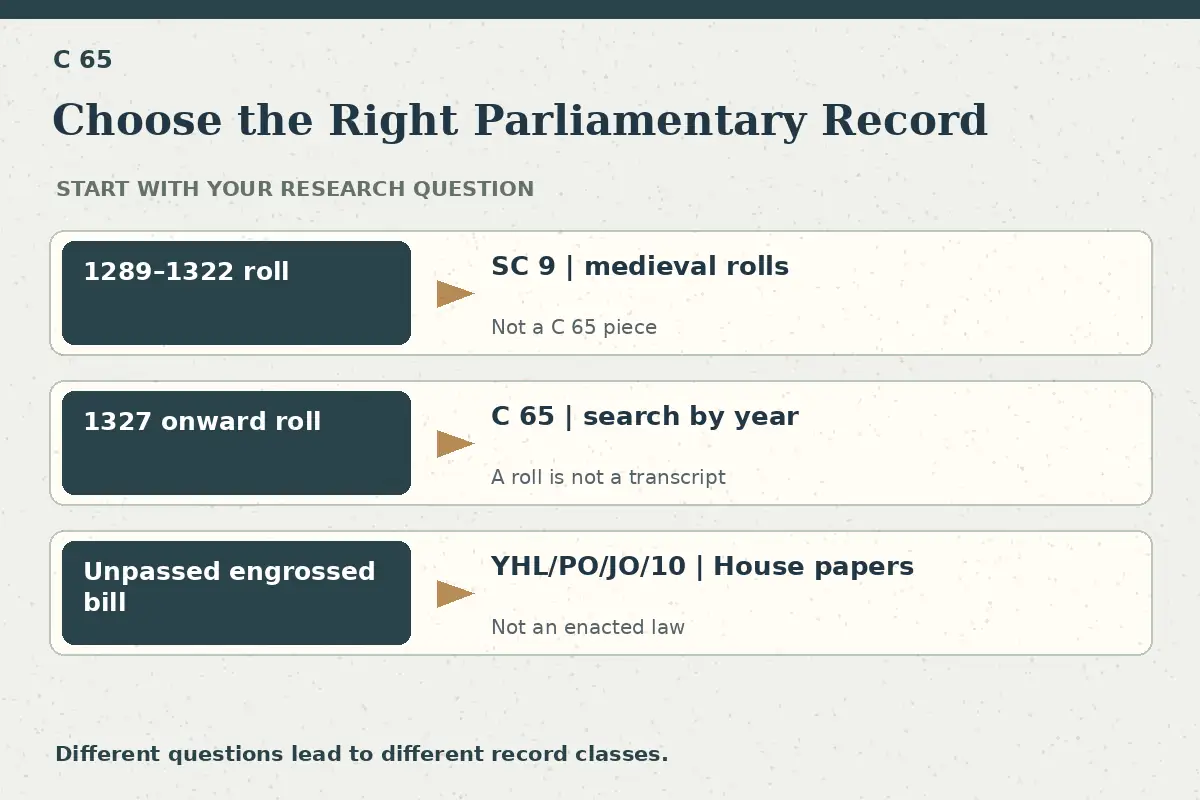
The Parliament Rolls in C 65 are a route to the official record of parliamentary proceedings, not a transcript of what every member said. They may identify a person, a locality, a petition or a legal measure, but an indexed mention by itself does not demonstrate that a bill became an Act, that land changed hands or that a modern family descends from a named medieval petitioner. The National Archives places the earlier surviving rolls for 1289–1322 in SC 9 and the later records, from 1327, in C 65. Decide the date and the exact claim before searching.
Choose the Correct Roll Before Searching a Surname
Begin with the year or regnal period of the event. A medieval parliamentary reference dated 1307 belongs in the SC 9 search route, not C 65; a documented session in 1381 points toward C 65. The National Archives also explains that translations and transcriptions of medieval rolls from 1275 to 1504 may be consulted through the Parliament Rolls of Medieval England publication. The translation is a reading aid and still needs an exact underlying reference.
Later rolls are not all equally searchable. The guide says to search C 65 by year for records between 1327 and 2010, and that rolls after 1504 are not online. An internet result for a historical person may derive from a published summary rather than a roll image. Preserve the name of the edition, volume, page and translated passage, then determine which roll and entry it represents.
Historical spelling and language complicate a surname search. Medieval and early modern rolls may use Latin, Anglo-Norman or Medieval French; scribes also vary place names and titles. Put each wording exactly as found into a two-column transcription: literal text and a cautious modern reading. Do not silently replace a place with its present-day county if territorial or parish boundaries changed.
Distinguish an Enrolled Act From a Failed Bill
The Parliament Rolls contain principal decisions and Acts, plus procedural material. The record of a proposal or petition is therefore not automatically proof that it passed. The original-Acts guide distinguishes engrossed bills without Royal Assent, located in House of Lords Main Papers YHL/PO/JO/10, from enrolled or original Acts. A researcher who finds a petition should next ask where the final legislative text or enrolled outcome appears.
There is an important period gate inside C 65 itself. From 1483 to 1534, C 65 includes enrolled copies of public and private Acts; afterward it contains all public Acts, but private Acts only where an enrolment fee was paid. Therefore, failing to locate a later private measure in C 65 cannot establish that no measure existed. Search original parliamentary copies and relevant journals before asserting absence.
From 1849 the record copies of Original Acts were produced in Parliament and a duplicate was kept within C 65. For a specific later measure, compare the act title and session with the original Act reference and printed legislation; do not promote a draft bill or a later paraphrase into the legal text. Record whether you consulted the act itself, a calendar, a catalogue entry or a commentary.

Test Person, Land, and Citizenship Claims Separately
A family name in a roll can designate a petitioner, subject, litigant, officeholder, witness or a party affected by legislation. The record should be transcribed using the role it actually states. An entry granting a right to a named person does not show the person exercised the right, nor that heirs with the same surname inherited it in unbroken succession.
Naturalization illustrates the problem. Before 1844, naturalization generally required a private Act of Parliament, and the citizenship guide points to Parliament Rolls in C 65 as an additional record source. An act may list people and professions, but a supporting petition may contain different biographical details. Confirm the exact person with place, occupation and contemporaneous records, not simply with the match of a surname in a printed index.
If an act deals with a manor, town or road, seek a separate deed, court record, map or local administration record to establish what happened afterward. Legislative authority, an executed transfer and residential occupancy are different claims. Maintain separate citations and dates for each; a change in local powers is not proof that a particular individual lived in the affected place.
For a pre-1844 naturalization case, compare the person named in a parliamentary record with a distinct petition or related manuscript in the House of Lords papers, where surviving. Write down who presented the request, who was legally named, and whether the wording grants legal status or merely asks for it. A later census that records a birthplace is useful identity evidence but cannot stand in for the Act itself. This three-source distinction is especially important when names were spelled differently across centuries.

Make a Reproducible Roll-to-Act Ledger
Create an evidence ledger with the columns search date, parliament or regnal year, series and piece, entry or folio, original language, person and documentary role, stated action, and verification needed. Add a separate field identifying a transcription or translation, including editor and publication page if relevant. This prevents a printed translation from being cited as if the original roll had been inspected.
For a hypothetical petition attributed to “Thomas of X,” record only that the petition text mentions Thomas. To assert parliamentary relief, find the enrolled outcome or final Act; to assert kinship, find another independent source connecting Thomas to the proposed relative. If a later book supplies a pedigree without citations, annotate it as a claim rather than allowing it to fill the evidentiary gap.
When the roll cannot be found, distinguish a missing original from an unsearched manuscript and an index that lacks the name. Check the correct year, SC 9 versus C 65, alternate spellings and whether the target was a private bill whose text may be in a different record group. Your result may be “not established with records examined,” not “did not happen.”
More Records and Archives Guides
How We Research C 65 Records
We check the original Acts and Royal Assent guide for dates, the survival of private Acts and the location of failed bills; then the Parliament research guide for translations, piece selection and access. The British citizenship guide supplies a specific test of how personal legal rights can enter parliamentary records.
The examples are hypothetical and do not reproduce a purported medieval roll. We never treat a calendar, petition or family tradition as a completed Act or a proven parent-child relationship. Editorial relationships are explained in our affiliate disclosure.
No. The National Archives identifies SC 9 for rolls between 1289 and 1322 and C 65 for the principal series from 1327.
No. The rolls record formal proceedings and decisions, not verbatim parliamentary debate.
No. Check enrolled Acts and, where applicable, the separately preserved bills lacking Royal Assent.
No. After 1534 the C 65 enrolment of private Acts depended on payment of a fee.
Only if independent records connect that person to the documented family line; surname similarity is insufficient.