
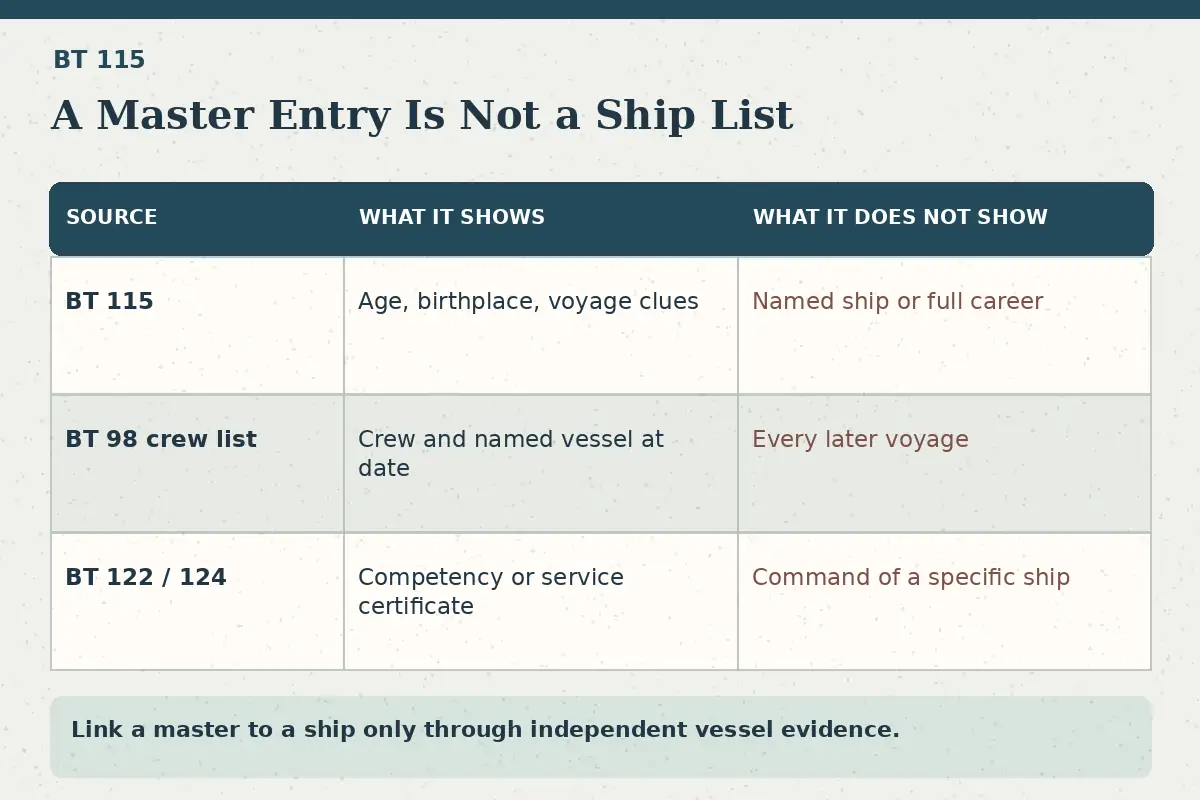
BT 115 is the alphabetical register of merchant ship masters for 1845–1854. It is a promising starting point for a named master, but it is not a complete log of his career and it does not identify every vessel he commanded. The National Archives’ historical search guidance notes that successful BT 115 searches can yield age at first recorded voyage, birthplace and voyage data, while ship names are not included in the register itself. Read those limits before attaching a ship or family story to the person. The original record must be matched to corroborating maritime documents.
Use the Correct Register for the Mid-Nineteenth Century
Begin with the target’s full name and alternative spelling, and establish an approximate birth period. BT 115 is organized alphabetically and limited to 1845–1854. Do not confuse it with BT 113, the seamen’s ticket registers, or BT 114, their surname index, which serve a different search function. A merchant master may appear in multiple sources, but identical surnames and an overlapping date do not prove one record refers to the same person.
The officers guide points readers to a searchable BT 115 version on Findmypast, where access may require payment. Preserve the archival reference when using a vendor transcription, and compare an image with the index where possible. A name hit on a derivative site is not a second independent primary source if it reproduces the same register.
The years in the collection title are limits of the record group, not necessarily the entire career of a master. Someone could have served before 1845 or after 1854. If an apparent absence occurs, document surname variants, birth years and indexing limitations rather than concluding he was not a master. Other certificate and crew records may cover different periods.

Transcribe What the Register Actually Supplies
The National Archives says a successful BT 115 search may reveal age at first recorded voyage, place of birth and voyages, but ships’ names are not included. That is a distinctive evidentiary boundary: a voyage-related date or notation is not permission to guess the vessel from a contemporary shipping newspaper. Transcribe every field and unfamiliar abbreviation without silently filling missing names.
For a hypothetical “John Brown” listed in the early 1850s, compare birthplace and age with independent records before accepting him as your family’s captain. An age at a recorded voyage is not necessarily a certified date of birth, and a birthplace label may refer to a town with several namesakes. Other candidates must remain in the log until a distinguishing fact excludes them.
Capture the page or image number, original volume if shown, date of access and the full wording of notes in the register. Distinguish a clearly printed voyage date from an interpreted reference code. If the image is illegible, record uncertainty rather than silently adopting an automated transcription. It is acceptable to conclude only that a candidate appears in the register.
Find a Ship Through Separate Crew Evidence
To name a ship with confidence, seek a crew list or agreement rather than reading a ship name into BT 115. The National Archives identifies BT 98 as an important early collection of agreements and crew lists, with arrangements that change over time. Depending on year, a port of registry, alphabetic ship-name range or official number may be useful, but those are navigational methods, not facts contained in your master’s BT 115 entry.
An independently identified ship can be cross-checked against its official number, registered port, voyage dates and named master on a crew document. A ship name alone is not a unique identifier; vessels were renamed and more than one vessel could share a name. Keep the date and vessel identity adjacent to each other in the research table.
The register’s existence does not prove a particular voyage was completed, that the ship reached a given port or that a person stayed aboard for an entire journey. Different evidence is needed for those claims. A departure notice, crew agreement, arrival record and later master’s certificate each speaks to a narrower fact; together they may support a fuller account if the identifiers agree.
When a possible ship is located, write a ship-identity line with name, official number where applicable, registered port, document date and named master. Test those fields together before attaching a voyage to the BT 115 candidate. A later vessel with the same name may be different, and an officer might have held more than one qualification. This ledger also makes it easier to spot a service date that conflicts with the candidate master’s age.

Distinguish Master Registration From Certification
Officer certification is another route but not a synonym for the master register. The National Archives officers guide describes certificates of competency or service and points to other Board of Trade series, including BT 122 and BT 124. The GOV.UK historical records resource likewise separates BT 115 from those certificate series. Do not say a BT 115 entry proves an examination pass or a specific qualification.
If a certificate number is located in a separate index, inspect the correct certificate or application record. A certificate of competency reflects passing the relevant examination; a certificate of service rests on a different qualification route. Neither alone proves that the individual was master of a named ship on a date. A ship-level crew record remains necessary for a particular command claim.
Make a comparison ledger with the fields name spelling, birthplace, estimated age, BT 115 reference, separate certificate identifier, independently identified ship and voyage evidence. Annotate “not supplied” where BT 115 lacks a ship name. A well-labeled gap is valuable: it tells the next researcher exactly which record is needed and prevents an attractive but unsupported career story.
One concise conclusion might be: a candidate of the right name and birthplace appears in BT 115; a separate crew list records a master aboard a named ship in a particular year; the identities agree on two independent details but a definitive link remains open. This is more defensible than claiming an entire maritime career from an alphabetical register. Revisit the entry if a new certificate or home address later resolves the ambiguity.
More Records and Archives Guides
How We Research BT 115 Records
We read the National Archives officers guide for the BT 115 date span, derivation from crew lists and related certificate systems. We use the pre-1914 merchant seamen guide to distinguish registers and ship-level agreements, together with GOV.UK historical-record guidance for the parallel BT reference numbers. The National Archives search-information sheet explicitly identifies the missing ship-name field.
The example person and ship comparisons are hypothetical. We do not create vessel names or assert a certification without the separate record. Our affiliate disclosure states editorial relationships.
The National Archives identifies it as an alphabetical register for 1845–1854.
Not necessarily; the National Archives search-information description specifically says ship names are not included.
No. BT 114 indexes seamen’s ticket registers, while BT 115 is an alphabetical register of masters.
No. Test certification separately using appropriate certificates and registers, including BT 122 or BT 124.
An appropriate crew agreement, muster, port record or other contemporaneous ship-level evidence; compare vessel and person identifiers.