
To trace ownership of a British merchant ship registered before 1854, begin with its historic home port and approximate registration year, then look for the vessel in the BT 111 indexes and the BT 107 registration transcripts. The National Archives ship-registration guide stresses that these registers concern vessels and their owners, not complete crews. Record the port registry number together with the year: these early numbers could be reused in different ports and years.
Decide Whether You Need a Ship Register or a Crew List
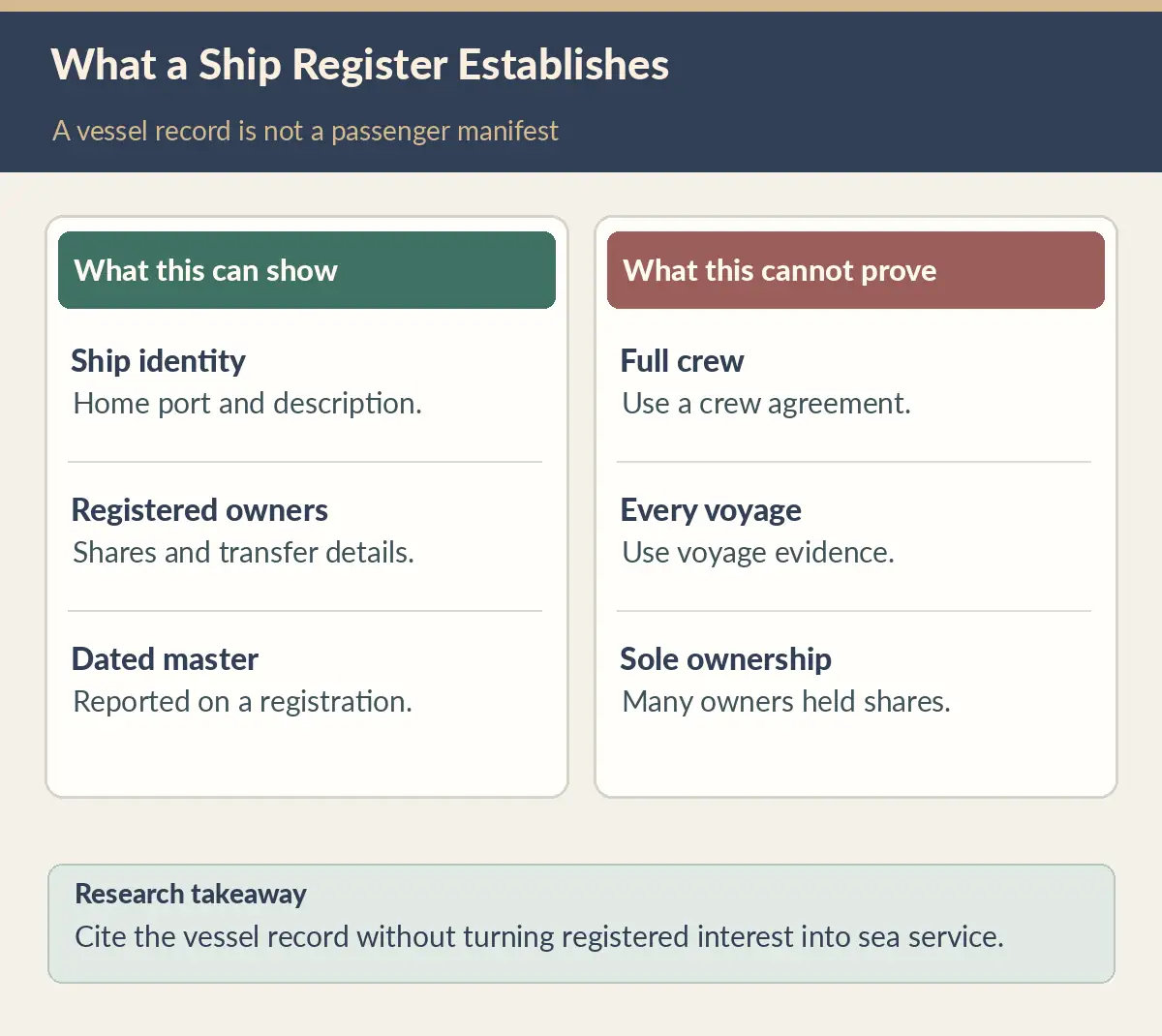
A researcher may know a sailor’s name from a diary, a newspaper notice or a family photograph and ask for the ship on which that person served. A shipping register is not normally a person-first seaman index. The British registration records track a vessel’s identity, home port, construction, masters and owners, whereas crew agreements and service records address mariners aboard.
Start with the question: are you proving a ship’s ownership, identifying the vessel mentioned in a family source, or proving that a named crew member served? These are separate research routes, and success with one does not answer the other. Keep the ship’s name, estimated year and possible port in a simple search sheet.
Use the Home Port and Year as Early Identification Keys
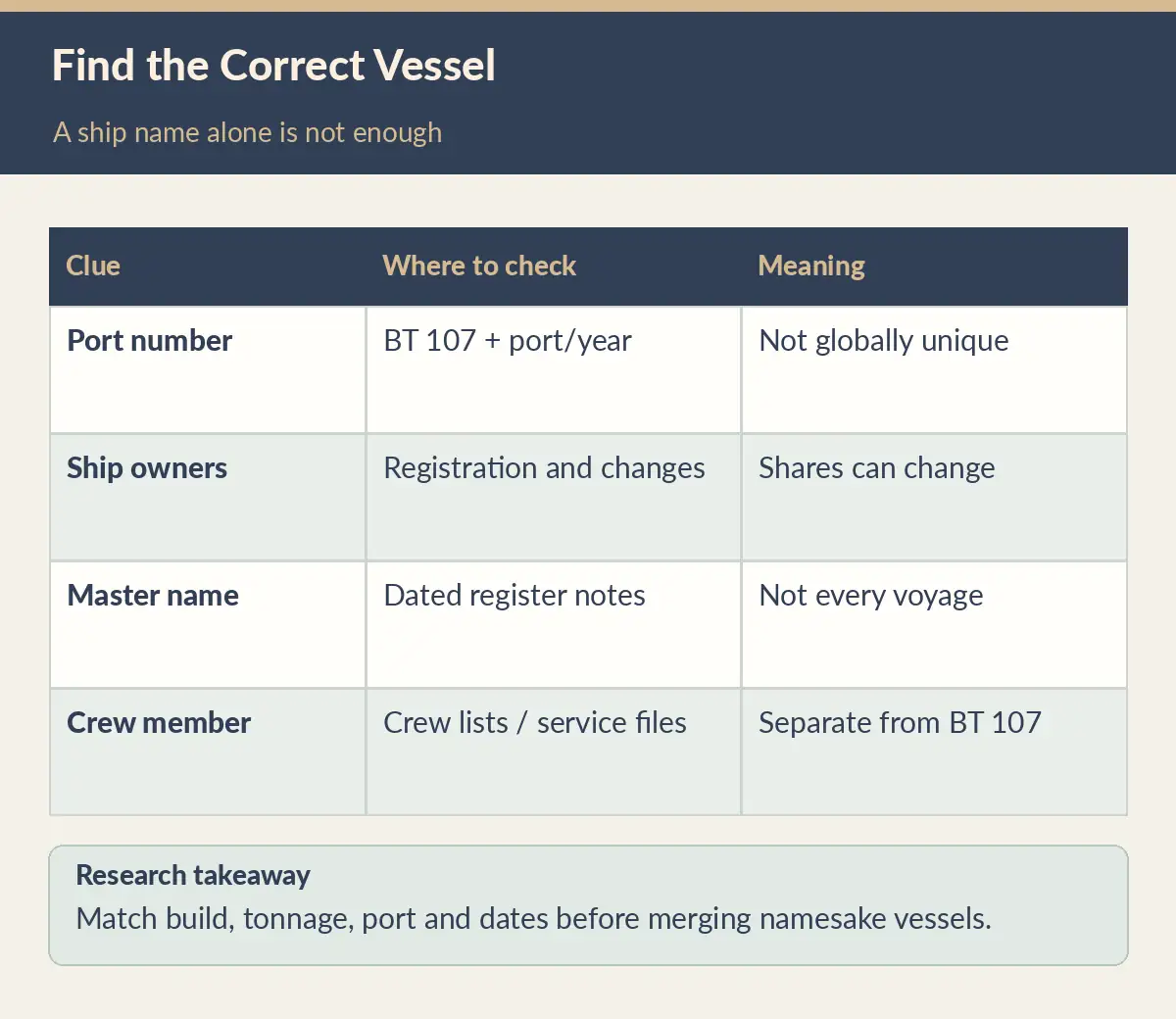
Under the historical registration system each vessel received a numbered certificate at its port of registry. The port registry number was not a nationally permanent unique identifier; numbers could restart by port and year. A copied number such as “12” is therefore weak evidence unless the associated home port, year and ship name are retained.
BT 107 is arranged principally by region and port-name ranges, with special London arrangements. If a ship changed registry, the apparent number or port reference may also change. Search name variants and spellings, including abbreviated prefixes or punctuation, and compare tonnage and construction details rather than trusting an isolated name match.
Understand the 1786–1854 BT 107 Transcripts
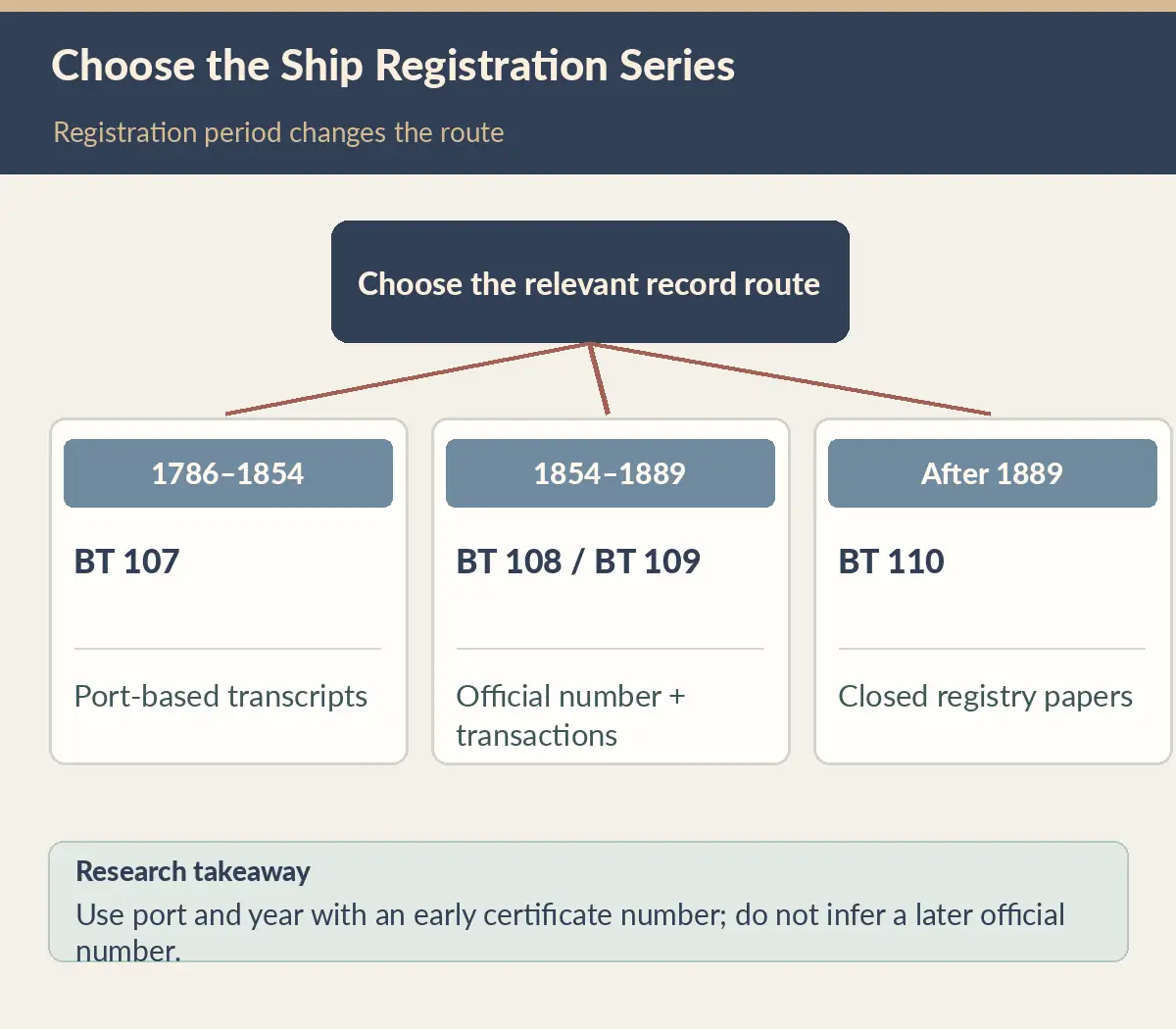
The first series of transcripts and transactions, covering 1786–1854, is preserved in BT 107. It includes information copied from port registration material, sometimes annotated as circumstances changed. Original home-port registers were usually created by customs officers and many are held at local record offices rather than at the central archive.
The first registration details may include the ship’s name, master, owner and home port; later notes can supply ownership transfers or changes of master. Keep the original dated entry separate from a later marginal change. A vessel entry is not the same as a contemporary voyage record, and a master’s appearance in a register does not prove he commanded the ship continuously.
Search BT 111 Without Treating It as the Transcript
The official guide identifies BT 111 as a source of indexes to BT 107 and the later BT 108 transcripts. Index descriptions and port headings help locate the registration record but may not themselves supply a complete history.
Record the index entry, its form, and the reference it gives; then go to the underlying transcript. Depending on catalogue description, browsing by port range or document sequence can be more successful than a broad keyword search for a vessel’s name. The digital microfilm guide lists these series but does not guarantee every vessel can be retrieved through a normal surname search.
Read Ownership Shares and Transactions Carefully
A nineteenth-century vessel could have several registered owners and changing fractional interests. The name of one owner on a transcript does not necessarily mean sole ownership; a broker, partner or institutional entity may also be recorded. From 1825 changes of ownership, known as transactions, had to be noted on relevant transcripts.
If the research question concerns a person’s business or investment, copy the share information and each change date rather than reporting that the person “owned the ship” without qualification. A home-port address may establish an owner’s recorded connection to that locality, not the place where the owner lived throughout the vessel’s working life. Consult commercial or probate records for wider context.
Identify the 1854 Change to Official Ship Numbers
The Merchant Shipping Act of 1854 introduced a distinct official numbering system for registered vessels. For ships in the later 1854–1889 period, registration transcripts are principally in BT 108 and related transactions in BT 109, with relevant indexes in BT 111. This is a record-series decision, not a simple change in how a number is written.
If a vessel was registered on both sides of 1854, capture each contemporary identifier and investigate continuity from the original certificate or detailed ship description. Never convert an earlier port number to a supposed official number by formula. After 1889 closed registry records follow a different arrangement in BT 110.
Account for the Customs House Fire and Local Gaps
The National Archives describes a fire that destroyed transcripts sent to the Customs House in London for 1786–1814, while London port registration books for that era survived within BT 107. Do not generalize this loss into destruction of every local vessel’s registration; the surviving route depends on the relevant port and document type.
Customs-house fires and incomplete survival affect other places too. The original port registers were often kept locally, so consult the relevant county archive or maritime collection if central transcripts cannot be found. A failed digital query might also be an arrangement or indexing limitation; document which port ranges and years were actually inspected.
Resolve Two Vessels Sharing One Familiar Name
Suppose a family letter mentions a vessel named Mary in Liverpool around 1830, and an index yields two vessels called Mary associated with different ports. Compare year, register or port number, master’s name, build date, tonnage, deck or mast description and owner details before choosing a candidate.
An owner who shares a surname with the letter writer may be relevant, but is not a substitute for matching the vessel’s distinctive particulars. Save a side-by-side candidate table and note exactly why one record fits or conflicts. If the first clue names a sailor, seek his crew record independently; a matching owner or ship name alone cannot prove the sailor was aboard.
How We Research BT 107 and Merchant Ship Ownership
We begin with a dated ship clue and the home port, then consult BT 111 and the appropriate BT 107 transcript, checking whether later registration law sends us instead to BT 108 or BT 109. We transcribe names, certificate number, date, location and ownership shares with the same precision as the register.
We separate registered owners and masters from seamen in crew records. Where a port transcript is missing, we test the local customs records and catalogue sequence before accepting negative evidence. The National Archives guidance supplies these boundaries; site relationships are documented in our affiliate disclosure.
More Records and Archives Guides
Cite Each Registration and Transfer as a Separate Event
A reproducible reference gives the vessel name as spelled, home port, registration or transaction date, certificate number and its port-and-year context, BT series and item reference, folio or image, and repository. If a name or number changed, maintain a small vessel identity timeline that explains the documentary link rather than silently combining data. Describe the recorded interest precisely, for example “one of the registered owners in a dated annotation,” and identify the original document supplying that statement. When connecting ship histories to an ancestor, distinguish the owner, master, crew member and correspondent roles until independent service or business evidence establishes the relationship.
No. It concerns ship registration and ownership, not complete crew lists.
Yes. Port registration numbers depended on the port and registration year.
The National Archives describes relevant transcript indexes in BT 111.
Official vessel numbering began and later transcripts are chiefly in BT 108, with transactions in BT 109.
A registered owner or master is not proof of a passenger or ordinary crew member’s voyage.