
A historic enclosure award can identify who received or held a particular allotment of land, while its associated map locates the allotment. Search the parish and possible “enclosure” or “inclosure” spelling first, determine whether the award survives at The National Archives or in a county record office, then match the map’s plot number to the corresponding award schedule. Names in an award describe a legal transaction in a specific place and time; they do not automatically identify the property’s resident family.
Begin with the Parish and the Date of Enclosure
Find the historical parish, township or manor and the approximate date when common fields or waste lands were allotted. Enclosure was not a single nationwide event; one locality could have several separate reorganizations and different surviving documents. Ask what land was actually covered rather than assuming an award for the parish included every cottage and field.
Search the place name with both “enclosure” and “inclosure,” and check bordering parish names when a farm straddled an old boundary. Keep a working location note, the earlier and later land description, and any named landowner. The place-and-period question is more productive than beginning with an ancestor’s surname.
Distinguish the Act from the Final Award
An enclosure Act could authorize commissioners and set out procedures, but it did not necessarily make the final allotments itself. The award usually records how land was redistributed and can include owners’ names, acreages, tenure, roads, rights of way and maintenance responsibilities. A surviving Act without a corresponding implemented award cannot show that a specific person actually received a plot.
Conversely, an award may be held separately from the legislative material. Cite the Act and award independently, and use the award’s date for the allotment decision. If a draft map, commissioners’ note or later certified copy conflicts, report each document’s status before deciding which text controls.
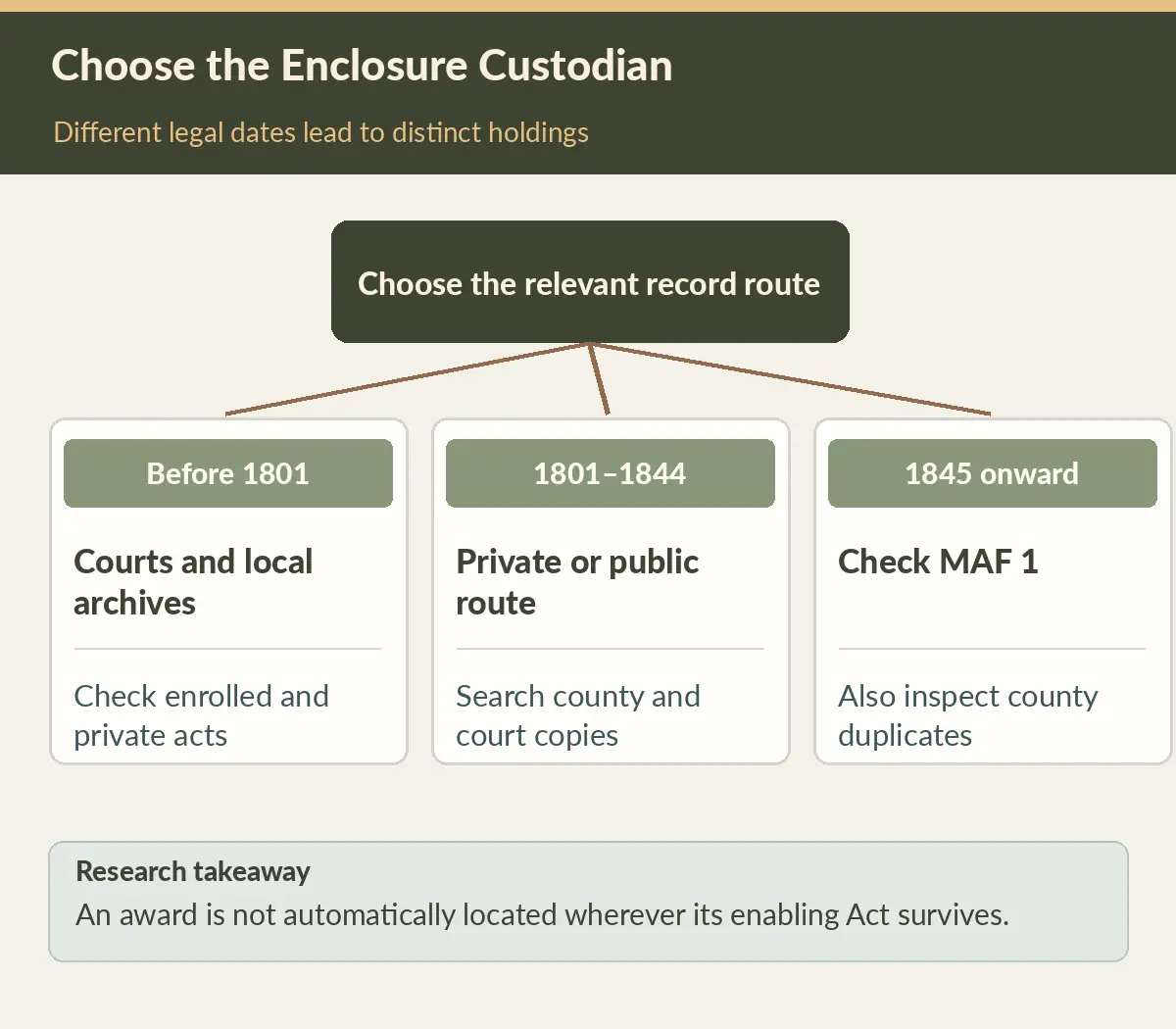
Use the 1845 Boundary to Choose an Archive
The National Archives states that its enclosure awards and maps are broadly most complete for the period after the General Enclosure Act of 1845. Records of the later Enclosure Commissioners are found principally in MAF 1, with related series for other land actions.
Many earlier awards were enrolled in court records or deposited with county clerks of the peace, and substantial collections are now held at local archives. Start by asking whether the award predates 1845, then inspect Discovery and the relevant county record office catalogue. Avoid treating MAF 1 as a complete national surname index for all enclosure periods.
Locate Court and County Copies for Earlier Awards
Before 1845, the likely repository varies with the legal route used to enclose the land. The official guide lists material among Chancery and Common Pleas records, other courts, duchy papers and county holdings. A seventeenth-century decree may not appear under a modern parish title, and a private eighteenth-century Act may have a manuscript form that is not online.
Try place names, manor names, historical county names and alternate spellings. A catalogue description might name only a volume or general court series; in that case, browsing rather than surname searching is necessary. When an award is missing from one repository, check for deposited local copies or surviving administrative correspondence.
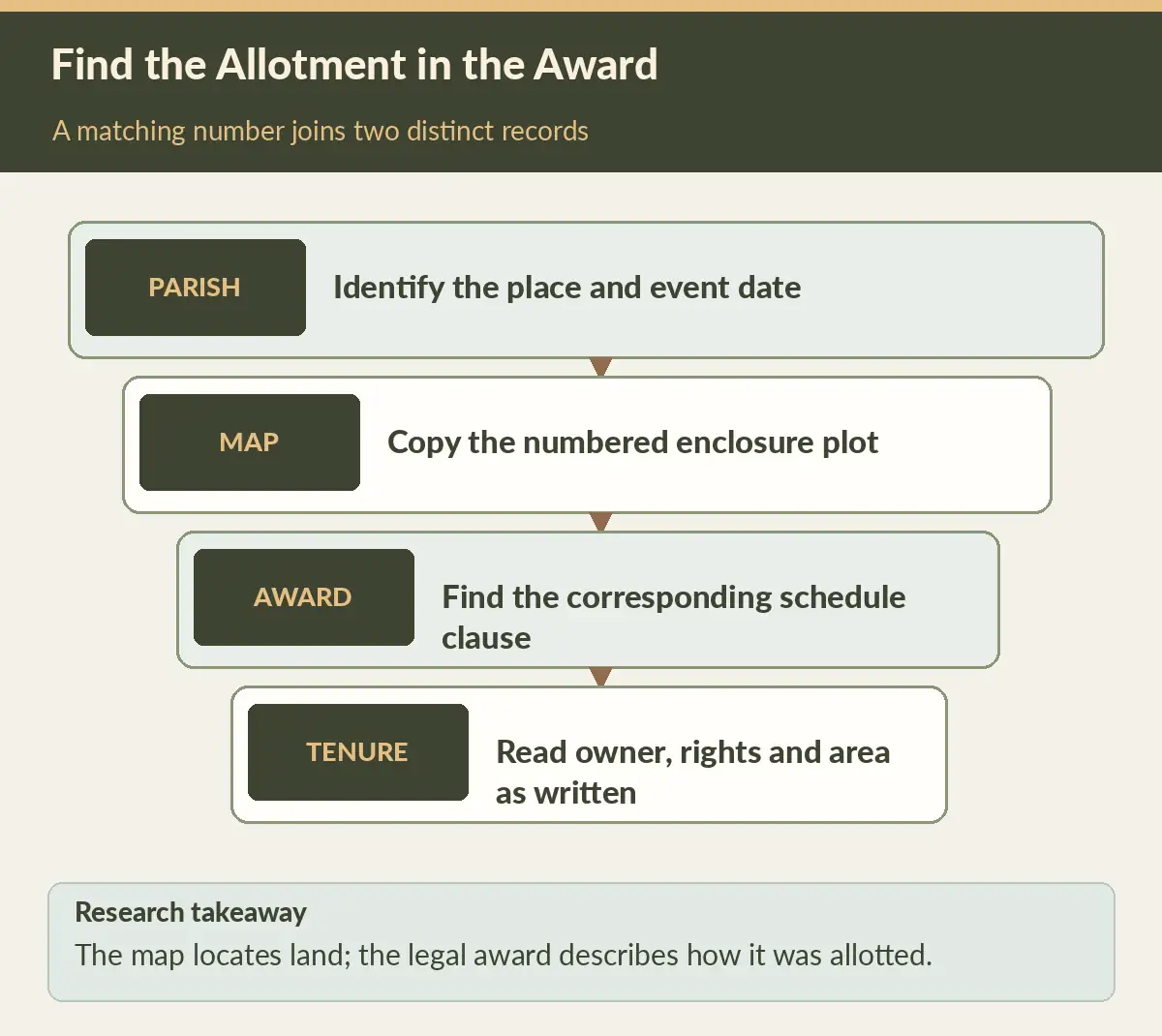
Match the Map Number to the Award Schedule
Many enclosure maps show numbered fields or allotments. The accompanying award provides the corresponding legal description, area and name, sometimes including rights of passage or obligations concerning fencing. Copy the complete plot identifier, map date, compass orientation and adjacent parcels before opening the schedule.
A handwritten numeral is easy to confuse with an adjacent one in a crowded map; compare boundary shape, roads, streams and acreage. Then transcribe the award clause and its actual wording of tenure. A bold name on a map may represent a landowner or allottee rather than an occupier, and an award’s allotment should not be equated automatically with an unchanged modern parcel.
Read Rights of Way and Commons Details Without Overclaiming
An enclosure document can establish rights and obligations that cannot be seen on an ordinary road map: private or public roads, access to water, drainage, hedges, fences, rent charges or rights involving a common. These passages may be central to a house-history question about why a lane moved or a boundary took an unexpected shape. Copy both the textual clause and the matching visual feature instead of paraphrasing “the family owned the path.” Ownership, use rights, and maintenance duties are different legal concepts. A named participant might also be a trustee or institutional owner, so identify the individual’s role from the award’s own language.
Allow for Early Maps That Never Survived
The archive cautions that enclosure maps are especially sparse for early periods, with few surviving before 1770 and a greater number dating after 1800. Some awards have no map, others have detached maps, and a copy may be separately held or available only in person.
Lack of a map therefore does not prove an allotment was never made. Search manuscript schedules, estate maps, later Ordnance Survey editions and associated parish records for independent location clues, but state clearly when a modern reconstruction is conjectural. Do not draw a precise boundary from an acreage description alone unless the source supplies adequate location information.
Test a Namesake Through Tenure and Neighboring Plots
Imagine an enclosure award listing two people named John Turner, one a freeholder and another a tenant named in a related schedule. First compare all plot numbers and adjacent landowners, then examine the exact tenure, parish and award date. Search parish registers, wills, rentals and deed abstracts for distinguishing evidence.
The existence of two same-name parties is a reason to preserve two separate identities, not to fuse their holdings into one family estate. Create a map-to-schedule worksheet that records the candidate person, plot number, acreage, role and source phrase, together with a column for unresolved interpretation. Treat a later taxpayer of that surname as independent evidence rather than automatic continuity.

How We Research an Enclosure Map and Award
We identify the actual enclosure event and governing date, check The National Archives award research guide for the relevant holding series, and locate the document through national or county catalogues. We read the award and its map together where both survive, keeping separate citations and recording the plot number, tenure and neighboring identifiers.
A claimed family connection is tested against parish, probate or conveyancing material. Incomplete map survival and unlocated county deposits remain explicit uncertainties. See our affiliate disclosure for editorial relationships.
More House and Local History Guides
Cite the Award, Map and Original Repository Separately
An archival citation should identify the historical place, enclosure year or effective award date, exact document title, repository, series and reference, map sheet or figure and allotment number. Cite a transcript as a transcript and the inspected manuscript as the original, noting material differences.
The National Archives maps guide can help route later cartographic checks, but it does not replace the legal award. In a published family history, describe the specific recorded ownership or right without declaring that the named individual lived in a particular building. State explicitly where the identification of a modern parcel is only probable.
No. Some places had several events, others different arrangements, and records survive unevenly.
No. The Act often authorizes a process; the award records the eventual allotments.
Start with MAF 1 and check related holdings and county archive copies.
Search the written award, court or local copies and later maps without inventing a precise boundary.
No. Legal ownership, tenure, rights and residence require separate interpretation.