
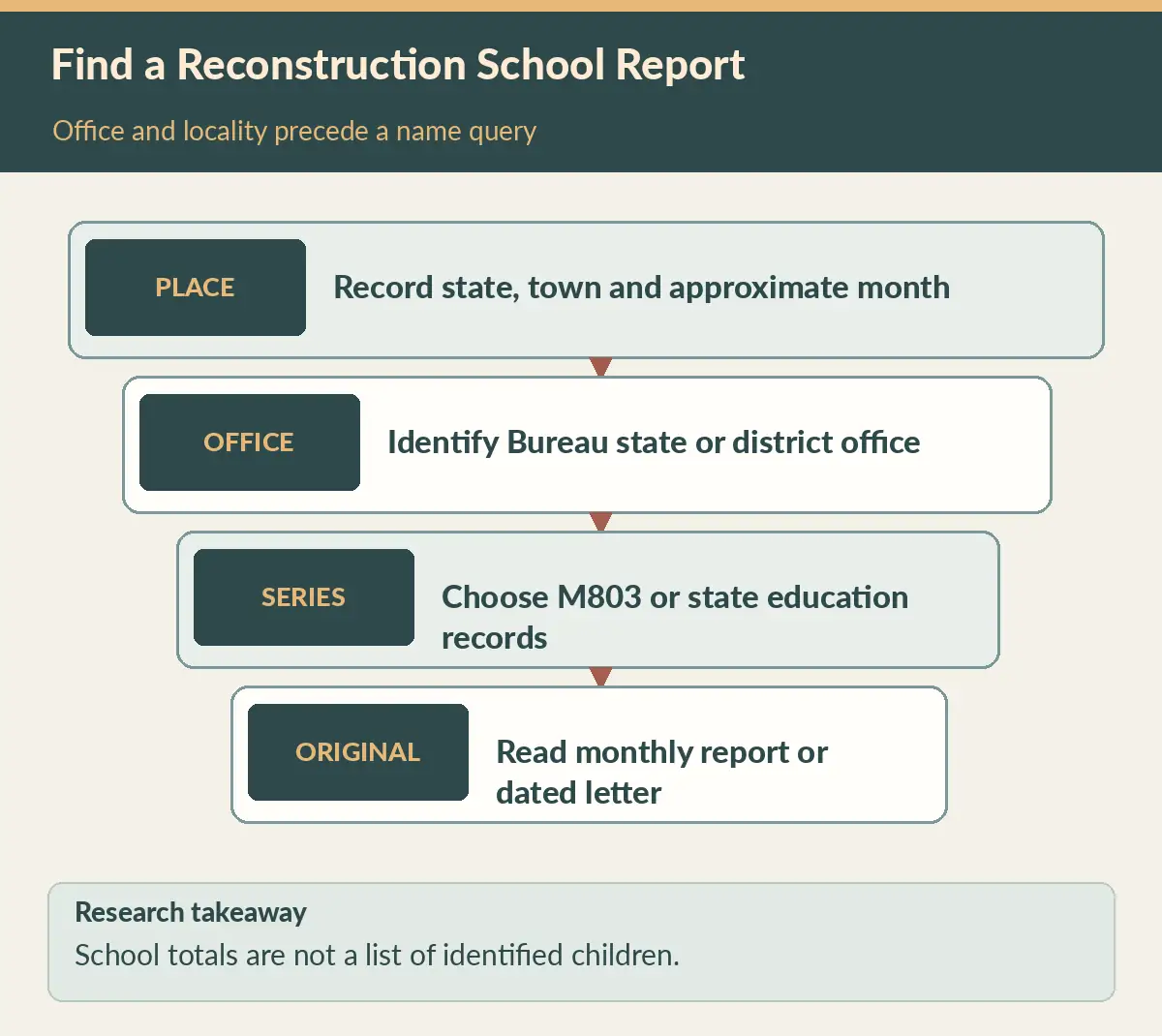
For a Reconstruction-era school, begin with the school’s state, town and approximate year, then search the Freedmen’s Bureau’s RG 105 education records. The National Archives research guide identifies central Education Division material in M803 and related state and field-office records. These sources may name teachers or describe school operations, but many pupil figures are statistical totals rather than complete enrollment rosters. A school’s existence in an official report is not proof that a particular child attended.
Start with a School Place and an Approximate Date
The Bureau of Refugees, Freedmen, and Abandoned Lands coordinated relief and education during Reconstruction, but its surviving papers were produced by many offices for different purposes. Begin by recording the historical state, county, locality, school name if documented, approximate term and the person or organization you are studying.
An official report might refer to a school by a mission sponsor, church, teacher or nearby town rather than its later name. Search alternative historic place descriptions before deciding a report is absent. Even when a family tradition recalls attendance, treat that recollection as a clue requiring a named, dated source; the existence of a school in the neighborhood does not by itself identify a pupil.
Understand Headquarters M803 Versus Local Files
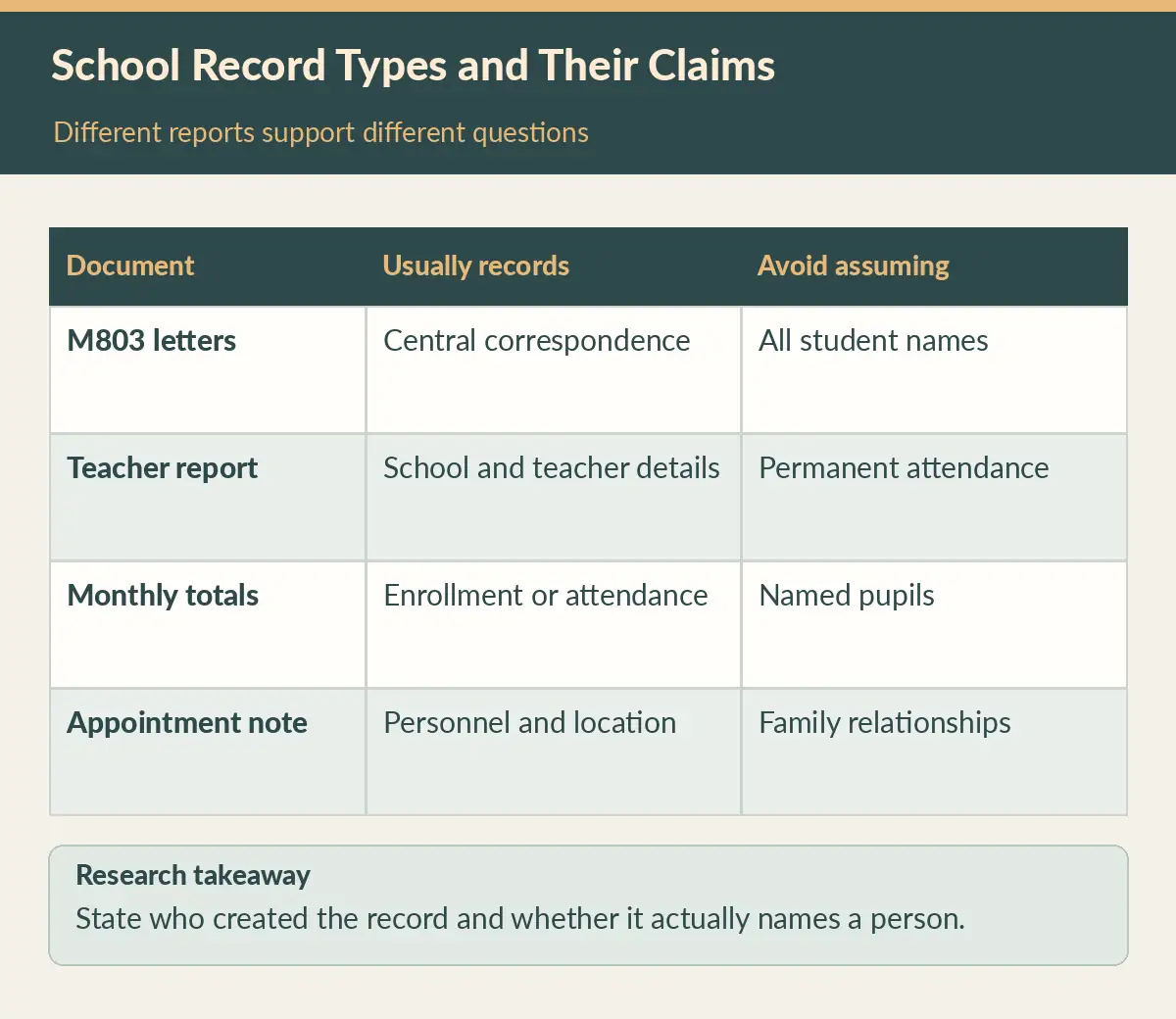
The National Archives describes education records within Record Group 105 and identifies the central Education Division microfilm publication M803. Central letters, indexes, reports and office correspondence concern system administration; they are not a nationwide name list of every schoolchild.
State superintendents and field offices created additional volumes with local monthly reports, teacher correspondence or school information. A reference to M803 can lead to the administrative framework, while a state-specific microfilm publication may provide more detailed information about a particular teacher or town. Search each level separately and cite the precise office; otherwise a summary copied from headquarters can be mistaken for evidence that an individual student appears in a local register.
Use Teacher Reports to Reconstruct a Specific School
Monthly or special teacher reports can give the school’s place, reporting month, identity of the teacher, enrollment totals, average attendance or conditions affecting classes. Their forms and survival vary across states and years.
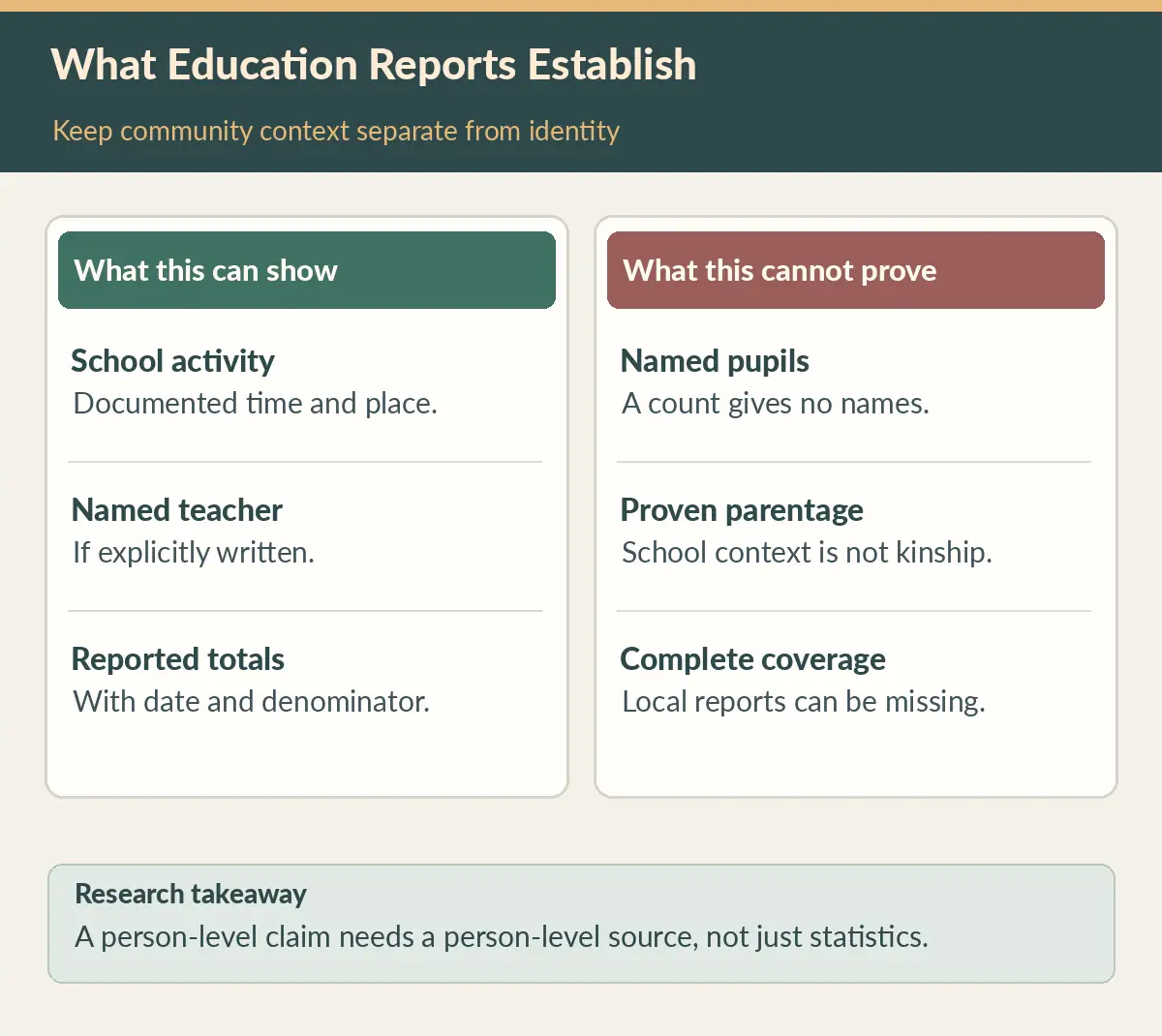
A report saying that a school taught one hundred and fifty children cannot identify one particular child without a separate named list. It may still help date the opening of a school, connect a teacher to a place or establish how many pupils were recorded in a particular period. Copy whether each number refers to enrollment, attendance, sex category, tuition payments or another printed field; do not assume those columns mean the same thing.
Distinguish Teachers, Supervisors and Local Agents
An education division file may mention a classroom teacher, district superintendent, civilian agency worker, denominational sponsor or Bureau official. Administrative correspondence sometimes reports on the behavior or performance of an employee but does not necessarily provide that person’s full employment file.
Record the official title and office as written, then test a namesake with date, place and organization. Names in an appointment letter, a payroll entry and a local school report might represent one person, but require a shared institution or consistent chronology. A teacher’s surname appearing in a county also cannot establish that pupils bearing the same surname were kin or lived in the teacher’s household.
Locate State Superintendents and Relevant Microfilm
NARA lists state education administrations and field-office collections within RG 105, so a school in Tennessee may require different records than one in Virginia or Texas. The date ranges and kinds of reports differ; using a nationwide name search can miss volumes organized by office and month.
First select the state and historical Bureau district, then consult the relevant microfilm pamphlet or archival description to identify volumes or rolls containing school reports. Record if the item is a letter book, incoming correspondence, teacher report, quarterly compilation or register. Search multiple office levels for one event but avoid assuming all copies survived or that a number reported to headquarters is a precise local census.
Read Aggregate Counts Without Naming Fictional Children
Enrollment columns were often created for administrative measurement. They can offer valuable evidence about the extent of schooling, reported attendance or resources, but figures are not individual pupil entries. Even if a teacher’s report specifies male and female pupil counts, those categories do not provide names, ages or family relationships.
Similarly, a yearly summary may aggregate multiple schools or months; do not add counts across months as if each report identified new pupils. Describe numbers with the denominator and period from the form. When investigating whether an ancestor attended, seek independent family letters, later educational records, county materials or a surviving genuinely named school register instead of converting a reported count into proof of enrollment.
Treat Reconstructions of School History as Contextual Evidence
The Bureau’s reports reflect its administrative perspective during Reconstruction and can omit local community initiatives, Indigenous and Black educational leadership, private schools or efforts outside its remit. Funding, politics, violence and changes in personnel could affect what was reported.
A complaint about a school or an allegation involving a teacher should be cited as someone’s report, not taken automatically as a verified event. Language applied to freedpeople in some documents reflects the administrative and racial assumptions of its time; quote original terms only when necessary and identify the source. Contextualize a school’s history with local community, denominational and independent archival evidence.
Work a School-and-Teacher Match Across Two Offices
Imagine a family memoir recalling a teacher named Mary Davis in a Tennessee town about 1868. A central report might list a school or a total number of pupils, while a state superintendent’s monthly record could name a teacher. First compare the actual month, district, sponsor and location.
Next search correspondence or appointment notices for the same teacher and check local newspapers or a census for another identity clue. Keep two Mary Davis candidates if the documents differ in time or place. If no named pupil register is found, report that the school and teacher were documented; do not conclude that the memoir writer attended merely because the school’s reported size makes it plausible.
How We Research Freedmen’s Bureau School Evidence
We use the official RG 105 description to distinguish Education Division and state administration material, then select the appropriate office, date and document type. We inspect the original headings and separate named people from aggregate counts.
When a narrative asserts attendance or a familial relationship, we require independent person-level evidence rather than a statistical school report. We record uncertain access or missing monthly returns and preserve the voices of the communities involved without asserting more than surviving sources support. Editorial disclosures are available at affiliate disclosure.
More Records and Archives Guides
Cite Reports by Office, Month, Series and Page
A citation should identify the original creating office, state or district, report type, school or locality, exact month or date, RG 105 series, microfilm publication and roll or digital image reference, and repository. If a headquarters letter restates a local number, cite both the summary and underlying monthly report when available; the copies may not be equally detailed. The NARA examples demonstrate that reports can preserve specific school statistics without supplying individual pupil names. Publish the strongest statement your evidence allows—such as a dated school operation or a named teacher—and clearly state when a proposed student identity remains unresolved.
No. Much of the central material is administrative and statistical, not a complete named enrollment roster.
Some reports and related letters name teachers and give their location and month of work.
No. A total cannot by itself identify any particular pupil or family relationship.
No. State superintendents and local field offices generated separate RG 105 series.
Use a historical school location, date, office and any documented teacher or sponsor name.