
The National Archives guide to Record Group 12, section 12.12, describes eight panorama photographs of Bureau of Education employees and education-related groups visiting Washington, DC, dated 1918–1935. The group designation is PN. These images can show a gathering, perhaps with a banner or recognizable building, but the collection description alone does not name the sitters. It also does not guarantee that all participants were federal employees, educators or permanent Washington residents.
Panoramic group pictures are tempting for family historians because they may contain many faces. A surname associated with a school convention or a relative’s Washington trip may suggest a candidate, yet visual resemblance is not enough. Ask what organization the image documents, when and where the photograph was taken, and whether a contemporary caption or attendee list exists. A panoramic photograph can be a powerful contextual source even when the identification remains incomplete.
Choose PN Panoramas Rather Than E Training Prints
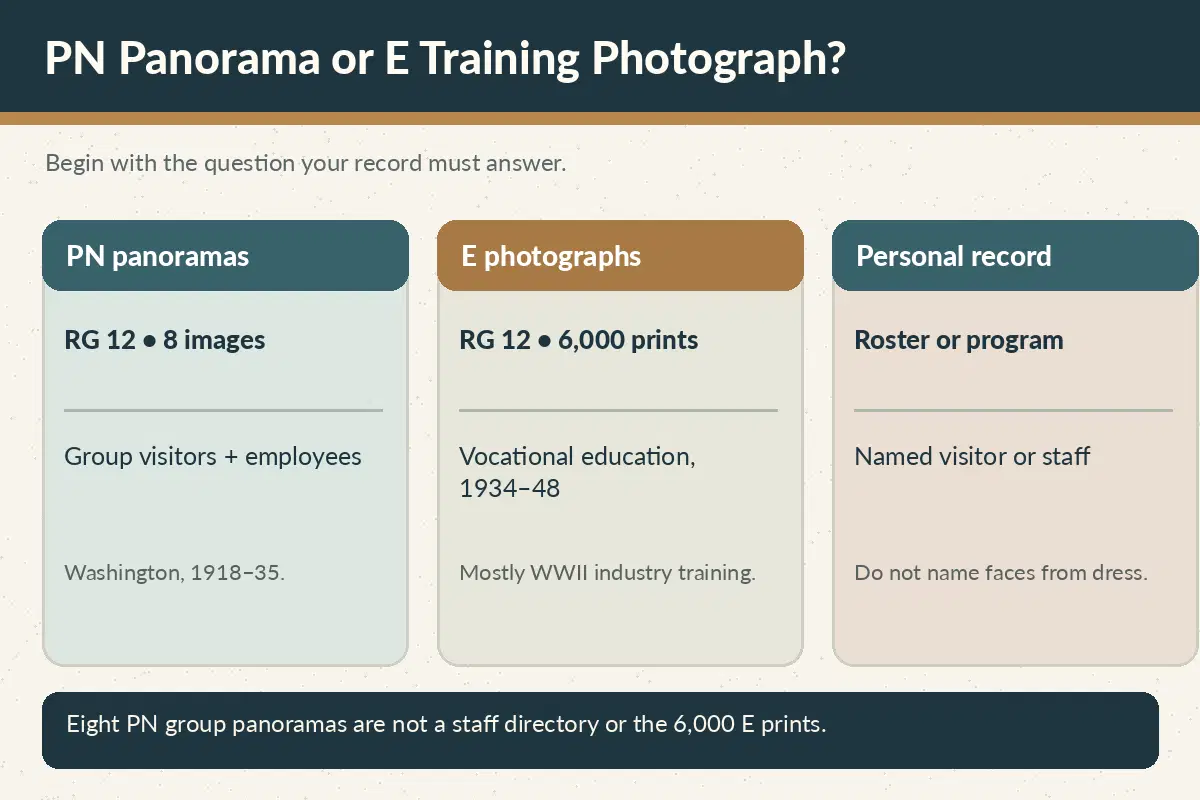
The same still-picture section lists another group labeled E: about 6,000 Federal Security Agency black-and-white prints relating mainly to vocational training for World War II industries and other educational topics, 1934–1948. That collection differs in size, subject and period from the eight PN panoramas. Searching “education photos RG 12” without a code can mix them. If your target is a 1924 visiting school group, start with PN; if it is an industrial training classroom in 1943, E may be the relevant lead.
Record the exact group designation, title, item identifier and image format as supplied by the catalog. An indexed thumbnail might be a crop from an extended panorama, while a related print could be in a local institution’s files. A photograph dated to a broad range is not automatically from the year of a particular family trip. Do not invent a direct connection between PN and E merely because both are included in RG 12.
Inspect the Entire Panoramic Image and Its Captions
A panorama can be so wide that a website preview obscures individual figures and signs. Look for the full frame, original print mount, photographer credit, number, banners and inscriptions. Some group portraits were assembled or labeled after the exposure; distinguish text on the photograph from a later database title. When possible read the reverse and note whether a caption is contemporary. Make a visual sketch of row positions only to organize a verified identification, never as a substitute for a name-bearing document.
Do not interpret the order of faces as a seating chart or official hierarchy without evidence. A person at the center need not be an agency chief; a person on the edge need not be a visitor. If a dated banner gives an event title, find its original program and compare the exact event date. Clothing, photography style and architecture can provide rough context, but their precision is usually insufficient to assign an individual name.
Match the Group to a Washington Visit

An education-related visiting group might appear in convention programs, professional journals, newspaper reports, correspondence or an institution’s annual report. Employees may appear in staff directories, official rosters or appointment papers. The federal guide does not specify which of these records accompany the eight panoramas, so search them as independent sources instead of assuming they are filed behind every photograph. Build a same-date, same-event match before investigating a possible attendee.
If a school principal attended a conference in Washington in 1927, confirm that the photograph actually relates to that conference and year. A relative’s travel letter might prove a visit but not participation in a particular photo session. Conversely, a person in a large gathering may not have been formally registered. Use name, institution, occupation, date and geographic context to evaluate candidates, keeping same-name visitors distinct. Absence from a printed attendee list is not definitive proof of absence from a crowd.
Avoid Turning a Group Photo Into an Employee List
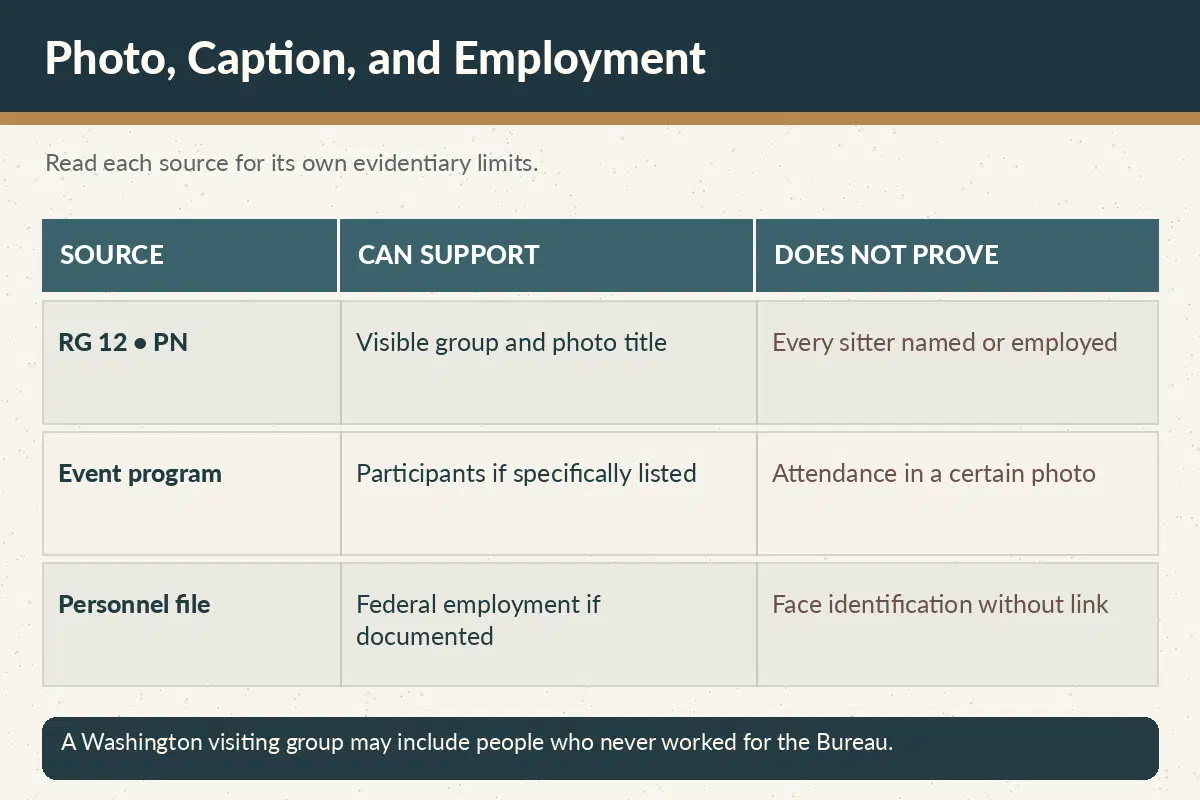
The archive explicitly mentions both Bureau employees and other education-related groups visiting Washington. These are alternative kinds of gatherings, not interchangeable employment categories. A teacher in a photograph might have been visiting, a clerk could have been employed at the bureau, and some attendees might represent organizations from outside the capital. A uniform pose or a government building backdrop does not establish an individual’s personnel status.
To prove federal employment, locate an appointment, staff directory, payroll, official correspondence or another record that actually places the person on the bureau’s rolls. To prove institutional participation, seek the association’s published membership or event record. Keep the event claim and the job claim separate. If you cannot identify every face, resist assigning names by row order based on a later family website. It is acceptable to describe unidentified attendees collectively.
Find the Photograph Without an Online Face Index
Start with the National Archives Catalog, using RG 12, PN, Bureau of Education, panoramic and the 1918–1935 span. Search descriptive item titles and Washington visits before trying names. The collection guide does not promise complete page-level indexing, portrait labels or downloadable high-resolution scans for every panorama. Keep catalog identifiers and note whether a record represents a series, a file unit or one image.
If a usable reproduction is absent, cite the eight-image PN description and ask for the item whose date or event matches your question. The National Archives reproduction guidance explains why precise identifiers matter. A cropped image found online should not be presented as the entire official panorama. If another institution holds a copy with a handwritten key, credit that institution and test when the key was created.
Record a Defensible Group-Identification Chain
The final evidence file should include the archival photograph citation, any original event caption, a separate program or office record, and your reason for matching a named individual. Quote only what the sources actually state: “photograph identifies an education-related group visiting Washington” is different from “every sitter was a federal employee.” A verifiable contemporary roster can strengthen an identification, but no roster should be presumed merely from the collection’s title.
Preserve the image’s unaltered version and, if useful, a separately marked research copy with face positions. Label tentative names as tentative and show readers the supporting document for each confirmed sitter. An honest unknown-face list is preferable to a fictitious complete caption. A panorama can still document the scale of a meeting, the organization’s public presence and the visual culture of federal education work during the period.
More Records and Archives Guides
How We Research These Federal Holdings
Our starting authority is the National Archives RG guide, especially section 12.12, which supports the specific dates and record categories described above. We then use NARA’s Catalog instructions to distinguish record-group, series, file-unit and item descriptions, and consult its reproduction guidance if an item is not available online. The guide is an inventory, not a complete transcript, digitization guarantee, individual name index or certification of a family connection. Each statement about a named person needs independent support and a traceable document citation. The site’s affiliate disclosure explains our editorial and relationship policy; the public archive links here are not claimed as paid partnerships.
The RG 12 guide lists eight panorama photographs, dated 1918–1935.
No. Those prints are the distinct E image group dated 1934–1948.
No. The description includes employees and education-related visiting groups.
No. Look for a reliable original caption plus independent event or personnel evidence.
Use RG 12, PN, Bureau of Education panoramas, 1918–1935, and any known group or Washington visit date.