
Read the Animal Activity Before Searching a Surname
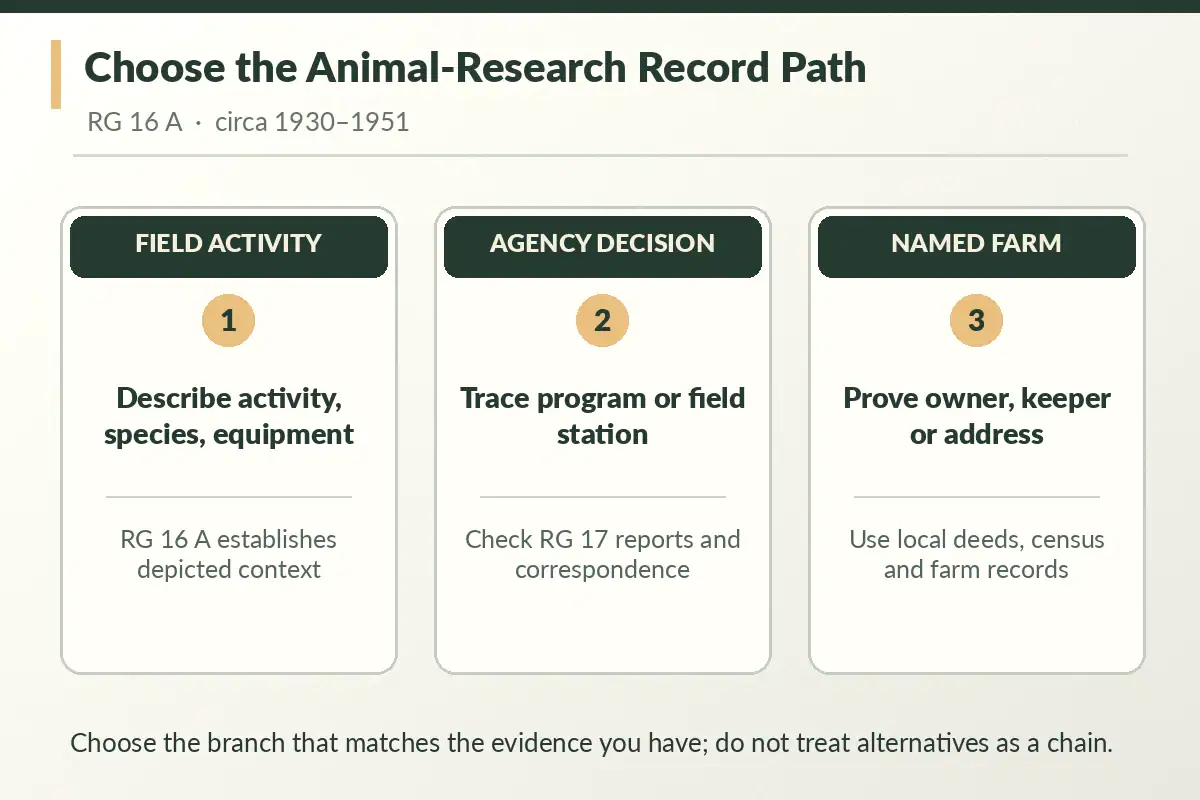
The National Archives describes approximately 2,240 images of Bureau of Animal Industry activities, dating roughly from 1930 to 1951, in RG 16 series A. The first research question is therefore what federal activity the scene represents, not who owned a cow, horse, poultry house or veterinary laboratory in the frame. A photograph of equipment or a herd may depict a demonstration, test, field station, exhibit or inspection. None of those categories automatically supplies a private farm address. Start by writing down the species, activity, visible equipment, setting and exact caption language.
Make a careful visual inventory. Are animals in pens or on open land? Are staff handling instruments, giving a demonstration or posing? Are there buildings, signs or license numbers that could identify an installation? Do not infer a disease diagnosis from an animal’s posture, a treatment from a syringe-like object, or an official inspection outcome from a posed scene. Those conclusions require an accompanying report or other dated administrative record. Even a legible sign should be recorded as text first and interpreted second.
Understand Why the Pictures Are in RG 16 Rather Than RG 17
The photographs are described within RG 16, Records of the Office of the Secretary of Agriculture, while records of the Bureau of Animal Industry itself form RG 17. This distinction matters when a caption hints at a named field station or study. Photographic compilation by a department office does not mean every operational report was filed in the same record group. NARA’s RG 17 guide outlines the bureau’s scientific and regulatory functions and points to correspondence, annual reports, field organizations and records of animal husbandry. Treat the two guides as complementary finding aids, not interchangeable labels.
A federal reorganization also complicates a simple date search. NARA notes that the bureau’s activities were transferred to the Agricultural Research Administration in 1942 and that the bureau was abolished in 1953. Consequently, a circa-1951 image can depict work associated with the older bureau label even when a particular administrative file is held under a successor context. Follow the date and subject of the activity before deciding which office controlled a specific program. Do not silently replace an original caption with the modern name of the agency.
Distinguish a Demonstration Farm From a Family Farm
For a house or family history investigation, a livestock photograph is often tempting evidence of a named farm. However, a research image can be taken on leased land, a university site, a cooperating private farm or a federal facility. Unless the caption names the location and owner, treat the setting as unknown. Search for location clues such as a station sign or experiment number, then compare them with RG 17 project statements, field correspondence or published annual reports. A match may place a research program at a site without identifying the photographed livestock as property of a particular individual.
To establish ownership or residence, use agricultural census schedules where available, county deeds, tax assessments, city or rural directories, lease agreements and farm account books. Check whether the address existed under the same name at the time. Rural route numbers changed, and stations could be referred to by nearby towns rather than a property address. Never assign a person’s labor, employment status or relationship to animals solely from clothing or proximity in the photograph. If a person is named in a caption, independently compare name, occupation, locality and date.

Build an Evidence Table Around the Animal and Program
Use four rows for every candidate identification: the photograph’s local identifier, the transcribed caption, a relevant RG 17 administrative reference, and an external property or personnel document. In a separate column record what each source explicitly states and what it leaves open. For example, an official annual report might confirm that a disease-control demonstration was conducted in one county in a particular year; the photograph might show a vaccination scene. Without an item-level date and a linked report, those facts do not demonstrate that this is the same demonstration.
Also keep the date of the photograph separate from any dates printed on an exhibit placard. The range “circa 1930–1951” is an archival description of the series, not an exact date for every image. Equipment design can narrow a period but is not a secure timestamp. If the picture was copied for a publicity collection, its current format may be younger than the original exposure. Make each date source explicit, especially when comparing a facility that changed use or name over several decades.

Request a Complete Image Reference, Not a Generic Subject Match
In a NARA catalog search, combine RG 16 with the A series and the terms actually visible in the picture: species, apparatus, place, and activity. Search related words rather than treating one crop or breed as the only keyword. Preserve the full local identifier and retain any item-level title exactly as cataloged. NARA’s still-picture reference guidance explains that staff need the record group, series, and item identifiers to locate a particular image. The absence of a digital image does not demonstrate that the photograph was lost or never taken.
A sound final family note might say that a federal image documents a kind of animal-health work in a specified period and that a separate farm record places a family in the same locality. Unless there is a direct match, leave their participation unproven. This is still useful: you can illustrate what the agricultural work environment looked like, while keeping biographical claims anchored to records created for named people.
If two photographs show a similar animal or instrument, do not assume they are from the same federal experiment. Compare background structures, sequence numbers, equipment labels and negative markings before linking them. The distinction is particularly important for publicity images later filed in a centralized departmental collection. A farmer’s surname in an annual report, a caption naming a station, and a picture of cattle in that county may all be genuine clues while representing three separate events. Write the connection as a question until an identifiable report, farm ledger or explicit caption supplies the missing link. A useful article can describe agricultural practice without overstating a family’s participation.
More Records and Archives Guides
How We Research This Evidence
This guide is based on the National Archives record-group description and a second official source, checked November 16, 2026. We checked the exact series labels and collection dates against the custodian rather than guessing from a generic subject search. For item-level inquiries, follow NARA’s still-picture reference guidance: retain the full local identifier, including series and divider information where applicable. The series description does not establish that every item is digitized, that an individual photograph has an exact date, or that any pictured person is identified. There are no paid links or unverified products in this guide; see our affiliate disclosure.
NARA describes about 2,240 photographs of Bureau of Animal Industry activities, roughly dated 1930–1951.
RG 17 is the distinct record group for the bureau’s operating records, including administrative and field series.
Not by itself. Look for a reliable caption and independent property records.
Yes. Search the bureau name and successor administrative contexts appropriate to the date.
No. A photo may illustrate research or publicity without an item-level case file.