
Search the Facility Before a Controller’s Name
NARA describes 2,826 photographs of air traffic control installations, facilities and equipment, dated 1934–1946, in RG 237 series A, R and RTAT. This is an equipment-and-facility collection, not a comprehensive named roster of controllers. Begin by identifying whether a scene depicts a tower, radio equipment, antenna, airport communications office or other installation. Record the local image identifier and the exact airport or town language from the original catalog caption. Only after establishing a facility should you investigate who staffed it and when.
A photographed microphone, panel, switchboard or antenna can be identified in general terms without claiming a particular technical configuration unless a manufacturer plate or contemporaneous technical manual supports it. Many instruments were installed, upgraded or reused. A piece of equipment may have been photographed for demonstration rather than in normal service. Avoid saying a pictured console controlled a specific flight or shift. Even a controller at a desk is not automatically identifiable from a later list of employees at the same station.
Keep Agency Name and Facility Date Apart
The records belong to RG 237, which includes the Civil Aeronautics Administration and later Federal Aviation Administration material. NARA’s institutional guide sets out multiple administrative eras and regional offices; it also lists CAA operations before the modern FAA existed. Do not retroactively call every 1930s tower an FAA tower. Use the historically correct office name when possible, and distinguish a contemporary photograph label from a modern record-group heading. This small choice prevents errors in both aviation history and genealogy.
A 1934–1946 series range does not specify the construction year of an airport building, the installation date of a radio set, or the exposure date of a particular negative. Search dated airport plans, engineering reports, civil aviation directories and contemporary news reports. List separately the date the airport opened, the building existed, equipment was commissioned and the photograph was made. If these dates disagree, do not force them into a single milestone. A photograph could document an upgrade, survey or closure as well as a functioning facility.

Use the Regional Office as a Second Search Key
NARA identifies CAA/FAA regional offices with changing headquarters and jurisdictions. That makes the region a useful finding aid after the airport itself has been located. Look for the locality in the appropriate historic region, paying attention to the dates and states under its responsibility. A region’s later boundaries do not establish which office kept records during an earlier decade. For an airport near a jurisdictional border, retain alternative routes until a dated administrative file confirms the responsible office.
A regional annual report might discuss a transmitter, flight service site or construction project without reproducing its photographic record. Match by facility name, date and technical feature; do not claim the two files are companion records merely because they concern the same state. Where a technical drawing or aerial image is available, compare the layout of buildings and runway orientation. Keep compass directions and any later airport renaming in separate fields. The site match must be intelligible without a guessed aerial-photo caption.
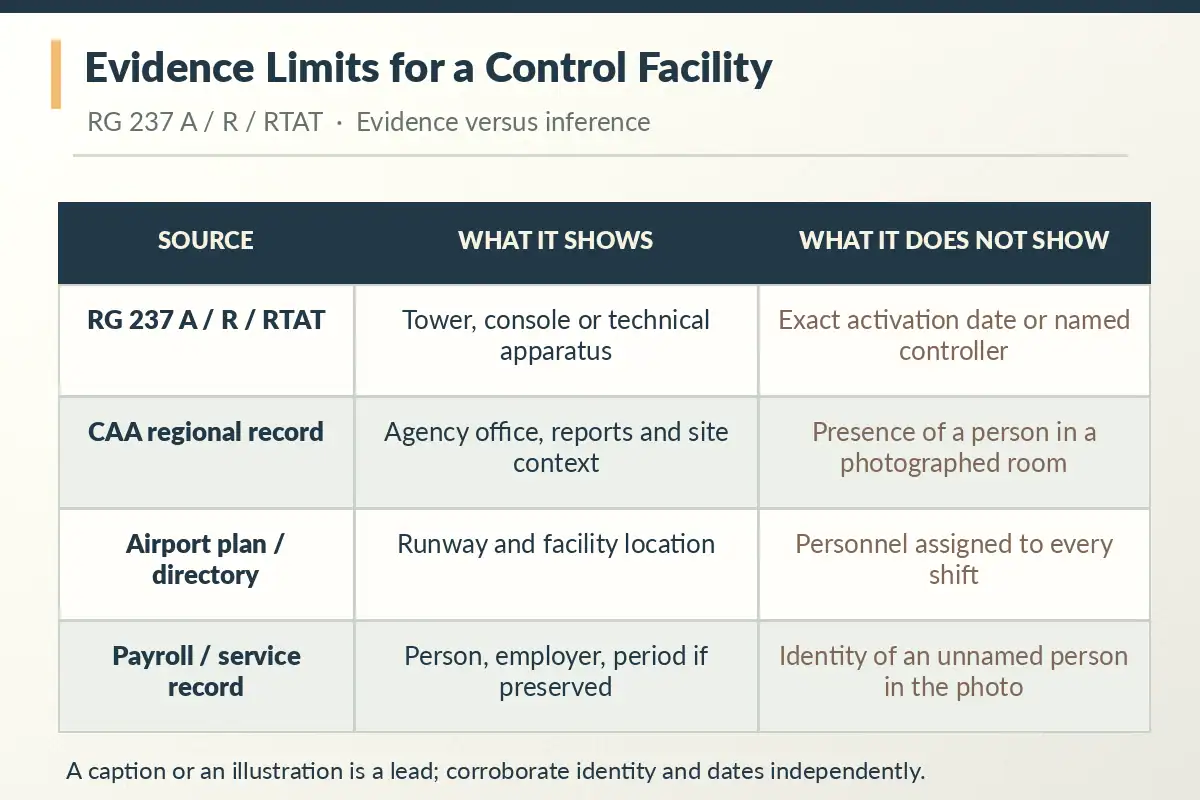
Prove a Worker’s Service With Personnel Evidence
For family history, the most consequential mistake is turning a photograph of a control tower into evidence of a relative’s employment there. A desk or headset is not a personnel file. Search service records, payroll documents, official staff directories, correspondence signed by the worker, union records when relevant, and contemporary city directories. Check full name, initials, role, employing organization and the time period. A person may have worked for an airline, the airport operator or the federal agency, and those employers should not be conflated.
If a caption names an individual, keep its wording exactly and test it against a second record. A named person pictured at an installation could be an inspector, visiting official, photographer or technician rather than a regularly assigned controller. A staff roster proves an assignment when it is specific enough, but it may not identify an otherwise unnamed figure. For an airport worker, compare an employment record with the building’s location before writing a narrative about daily duties.

Build a Reproducible Technical and Biographical Citation
Create a ledger with RG 237 series, local identifier, original image title, suspected airport, pictured equipment, date as described, and competing explanations. If equipment labeling is visible, transcribe it faithfully rather than trying to improve it with modern terminology. NARA’s reference guidance explains why the full local identifier and series are required for a still-picture inquiry. Ask whether mounts, index cards or related negatives contain a more precise date or caption, and do not assume that absence from the online catalog means an item is not held.
Your conclusion should remain bounded: “This RG 237 photograph depicts an installation associated with the identified airport; independent records establish that the named person worked for the relevant agency during a specified period.” Unless the photograph or another source directly connects the worker to the room, avoid the stronger claim that the image shows their workstation. This preserves both the machinery history and the person’s documented career.
For a proposed equipment identification, take care not to read modern radio or radar features into a prewar photograph. Some communications equipment resembles later systems despite operating on different principles. Use only markings and layout supported by a dated technical drawing, training manual or inventory. If the pictured facility cannot be securely placed, a conservative classification such as ‘CAA-era control or communications installation’ is better than a confident airport name. Family historians should also allow for transfers: employment at a regional office in a given year is weaker evidence of daily duty at a particular tower. Keep work location and employer records independent until the connection is documented.
More Genealogy Tool Guides
How We Research This Evidence
This guide is based on the National Archives record-group description and a second official source, checked November 16, 2026. We checked the exact series labels and collection dates against the custodian rather than guessing from a generic subject search. For item-level inquiries, follow NARA’s still-picture reference guidance: retain the full local identifier, including series and divider information where applicable. The series description does not establish that every item is digitized, that an individual photograph has an exact date, or that any pictured person is identified. There are no paid links or unverified products in this guide; see our affiliate disclosure.
NARA groups these series as 2,826 photos of air traffic control facilities and equipment, dated 1934–1946.
No. The photos include the earlier CAA period; agency names and responsibilities changed over time.
No. A separate personnel or duty record is necessary for employment and assignment.
Compare historic airport plans, period directories, location details and regional administrative records.
Not necessarily. Exposure, installation, commissioning and later reuse are distinct events.