
Begin With the Venue, Not a Family Name
The National Archives lists 3,300 Frank Lamson-Scribner photographs in RG 16 FLS, made or collected across 1901–1934. Its description includes the Louisiana Purchase Exposition of 1904, the Panama-Pacific International Exposition of 1915, Rio de Janeiro in 1922, other fairs, botanical gardens, landscapes, and varieties of plants. That mix makes the series useful for reconstructing how agricultural knowledge was presented. It does not turn the photographs into a registration book. Start with what is visible: pavilion, display case, specimen, structure, or garden feature; only then ask whether a family member was connected to it.
Write the place name as it appears in the catalog record, including an older form or foreign-language wording. Record the apparent event, its known dates, the physical object in the scene, and the item identifier separately. A fair lasted days or months, and photographs may have been made while displays were assembled or dismantled. A photograph filed under an exposition theme therefore should not be assigned a particular opening-day date without additional item-level evidence.
Separate the Photograph From the Exhibition History
The FLS label tells you where the National Archives places the image, not who must have been present. Compare a catalog caption with the visual evidence in the frame: a sign may establish a pavilion name, a botanical placard a plant classification, or a distinctive dome a likely exhibition site. Those are useful leads, but a later caption can also summarize a collection rather than an original negative. If the lettering is illegible, retain the uncertain transcription rather than silently inserting a familiar place name.
Establish a three-column event timeline: documented event year, date claimed by the image description, and independently supported exposure date. Never collapse these into a single date. At the same time distinguish the exposition’s host city from Lamson-Scribner’s own itinerary. A photograph associated with Rio does not by itself prove he traveled there on the date depicted, much less that a relative attended. A borrowed photograph or later reproduction can sit within an individual’s collection.

Find a Second Trail in the Library of Congress Papers
The Library of Congress holds the F. Lamson-Scribner Papers, with correspondence, letterbooks, memoranda, reports, scrapbooks and photographs spanning 1885–1938. Its finding aid emphasizes USDA exhibit work and mentions Brazil’s centennial exposition in 1922–1923, Philadelphia’s sesquicentennial in 1926, and the Chicago Century of Progress in 1933–1934. This is a valuable second custodian for understanding an exhibit’s organization. It is not a duplicate image index for every FLS photograph, and its series arrangement must be consulted rather than assumed.
When a photograph seems to show a booth or a staff group, search the corresponding event name in correspondence and subject files. A letter may identify shipment of materials, exhibit committee members, or an official invitation; a fair program may name a demonstrator. Even if two sources mention the same person and event, ask what each actually proves. Preparation correspondence is evidence of involvement in organizing a display, while a travel receipt or dated diary is stronger for personal attendance. A named exhibitor is not necessarily one of the small figures visible behind the counter.
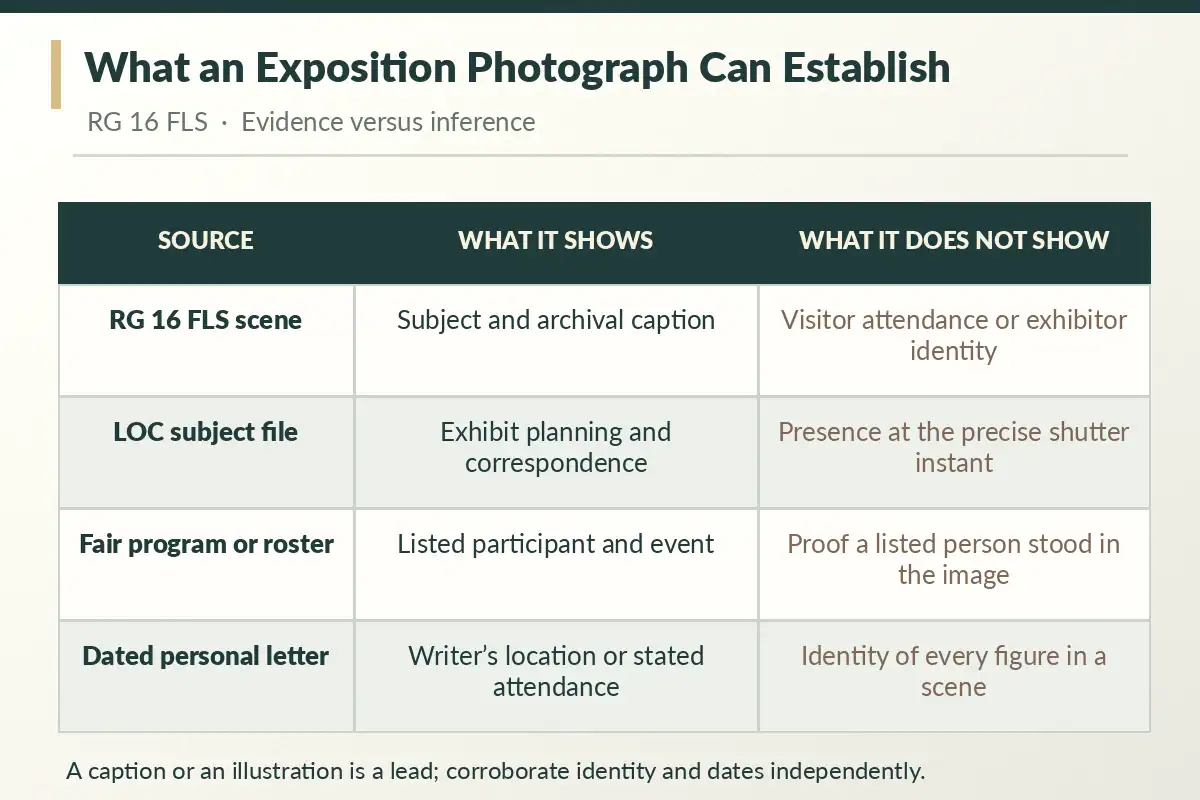
Use Botanical Clues Without Guessing a Garden Owner
FLS also includes botanical gardens, landscapes and plant varieties. For these subjects the search path starts with a plant label or a unique physical setting rather than an exposition. A species name can help recognize what was intended for public education, but older taxonomy may differ from today’s preferred name. Verify historical botanical nomenclature with a period USDA publication before substituting a modern name. Avoid claiming that an ornamental plant came from a particular family property unless a separate accession ledger, garden inventory or correspondence supplies that provenance.
A greenhouse, landscape path or agricultural plot may be visually recognizable but difficult to date. Construction phases, seasonal foliage, photographic processes, and reused exhibition displays can be misleading. A matched historic plan or dated guidebook may establish where a feature stood; it still does not prove who lived nearby or maintained it. For house history, the image is best used to describe surroundings and horticultural practice, with deeds, directories and land records reserved for owner and resident identification.
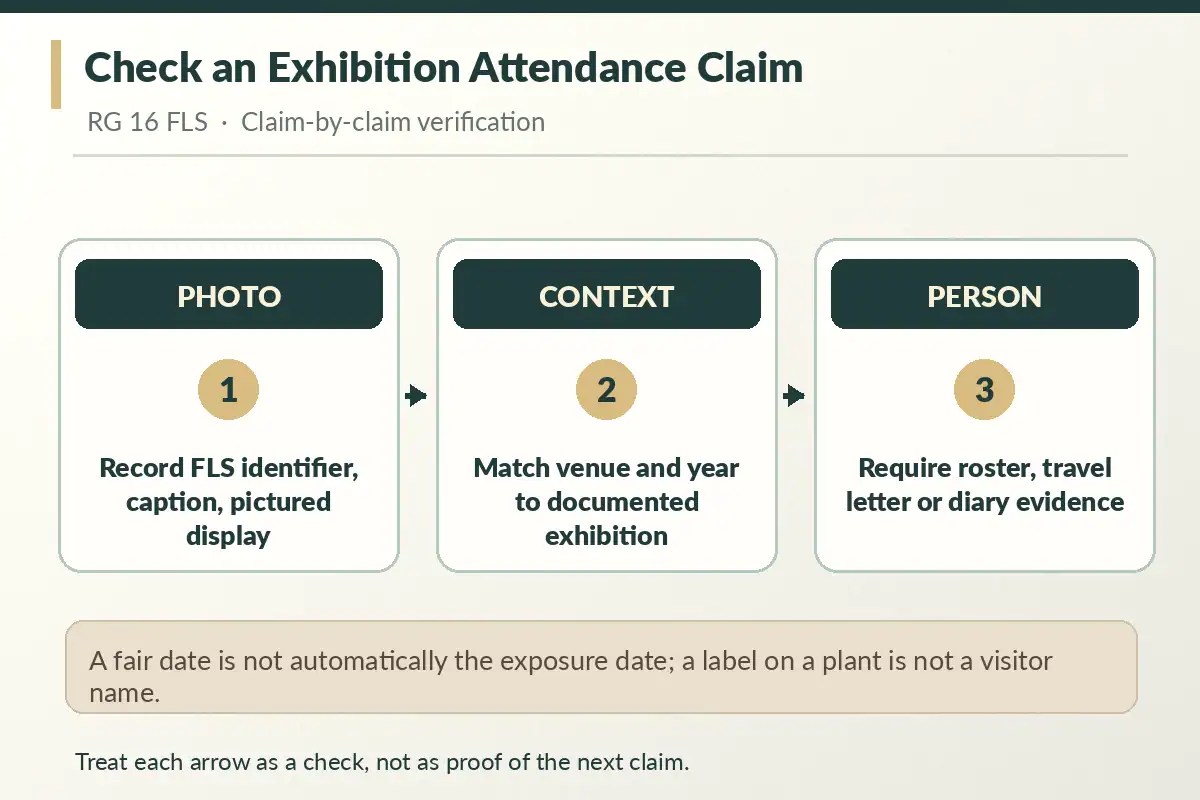
Request the Original Citation and Preserve Uncertainty
NARA instructs still-picture researchers to note the record group, series, box or divider when applicable, and the unique item number; a local identifier is especially useful in catalog inquiries. Save the exact RG 16 FLS reference and the original description along with any downloaded derivative. An online thumbnail is enough to test a possible visual match, but it may omit the reverse, mounts, annotations, original caption card or neighboring sequence. Ask reference staff whether those pieces survive before asserting an exact date or a photographer.
Make your final note conditional and reproducible: “The FLS item appears to show a named exhibition display; correspondence establishes that the person worked on that exhibition, but this photograph does not independently identify them.” Put the rejected alternatives next to the accepted one—different fairs, different years, a botanical garden with similar architecture. This prevents a later researcher from converting your cautious identification into an inherited family fact.
A concise research request should ask for the specific FLS item and any original mount, negative envelope, or caption register, not for every picture at a named fair. Include the proposed exhibit year and the competing year you rejected. If a person appears to be credited on a plant label or program, state precisely whether the writing identifies a donor, botanical authority, maker of the display, or event participant. Those roles are not interchangeable. For publication, pair the image citation with a separate citation to the document proving the person’s role. This preserves useful links between agricultural exhibition history and family history without inventing a crowd identification.
More Family Story and Preservation Guides
How We Research This Evidence
This guide is based on the National Archives record-group description and a second official source, checked November 16, 2026. We checked the exact series labels and collection dates against the custodian rather than guessing from a generic subject search. For item-level inquiries, follow NARA’s still-picture reference guidance: retain the full local identifier, including series and divider information where applicable. The series description does not establish that every item is digitized, that an individual photograph has an exact date, or that any pictured person is identified. There are no paid links or unverified products in this guide; see our affiliate disclosure.
NARA describes about 3,300 photographs dated 1901–1934; that description is collection scope, not a count of online downloads.
No. Use an independent visitor record, diary, letter or other dated evidence for the person.
No. The LOC holds related Lamson-Scribner papers arranged in its own series, useful for contextual verification.
Only provisionally. The item could show setup, later use or a reproduction; inspect the item description and original evidence.
Record group 16, series FLS, the complete local item identifier and any available box or folder details.