
The late-1970s farmers’ demonstrations in Washington, DC, are represented in a specific U.S. Department of Agriculture photographic series. NARA lists 267 photographs of the 1978–1979 marches as RG 16 FM. Because the holdings description covers two years, a tractor, protest placard, or Capitol-area crowd should not be given a specific day on appearance alone. A second record type can help: the same RG 16 guide describes 1971–1981 recordings of USDA officials discussing farm prices, the American Agriculture Movement, and the farmers’ strike.
The key research question is whether you are documenting the demonstrations, a particular sign or vehicle, or a named family member who says they attended. The photograph may answer the first question and partly answer the second, but not automatically the third. Start with the exact FM image and its original caption. Then compare contemporary written or recorded accounts, and reserve family-specific claims for independent, attributable testimony or person-named records.
Distinguish the 1978 and 1979 Washington Demonstrations

NARA identifies 267 images, filed under FM, of farmers’ marches on Washington in 1978–1979. That span matters because visually similar demonstrations and repeated slogans may appear in both years. Do not date a vehicle from its model alone, assume the crowd was at a particular event because the Capitol appears behind it, or label all FM photographs as a single march. Transcribe any individual photo caption and verify whether it states an exact day, month, or only a broad year.
Look for stable geographic cues: street signs, buildings, intersections, federal landmarks, weather, banners, and camera viewpoint. A sign may identify an organization or demand, but it does not confirm membership of every person standing next to it. A convoy may have arrived from elsewhere, while an image in Washington documents only the pictured location. Keep separate columns for location stated by the archive, location inferred visually, and place verified through a contemporary source.
If a website displays only a thumbnail with no archival number, do not build a detailed narrative around it. Use the NARA Catalog and the Still Picture Branch resources to find the full description. Retain a record of any uncertainty. A correct “Farmers’ march, Washington, DC, 1978 or 1979; exact date unverified” caption is preferable to an attractive but invented chronology.
Compare FM Photography With Public Statements and Reports
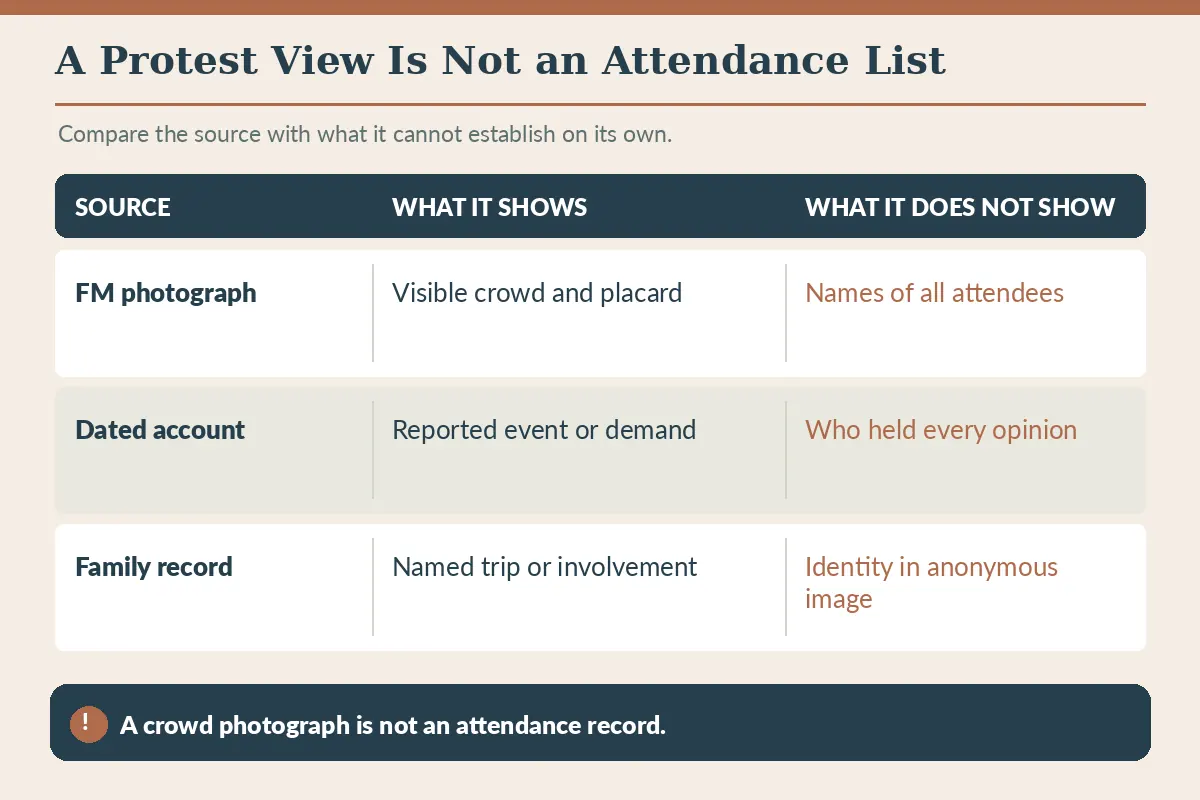
The photographs show what the camera selected: a roadway, rally, placard, tractor, interaction, or crowd. They do not prove the number of participants, how broadly a demand was supported, or what organizers and government officials privately believed. NARA’s RG 16 description also lists sound recordings from 1971–1981 involving farm prices, grain sales, the American Agriculture Movement, and farmers’ strikes. Those materials may supply useful policy context when a recording can be dated and directly tied to the same event.
Keep the media distinct. A USDA press statement is an agency position, a demonstrator’s placard is a public claim, a reporter’s caption is a separate description, and a photograph is visual evidence of a scene. None should be treated as the only authoritative account of the protest’s meaning. Read contemporary local or national coverage with its source and date visible. Avoid treating a speech from a later year as the words heard by people in an earlier FM image.
When a family story names a particular demand, compare that wording with dated printed or recorded evidence rather than silently modernizing slogans. If conflicting descriptions survive, explain the conflict and cite each source. The result can document a contested historical episode fairly without claiming that every person in a crowd held the same opinion.
Check a Claimed Attendee Against More Than a Sign

Farm families may remember a truck trip, a tractor convoy, or a rally in the capital. Memory is a valuable starting point, especially if supported by family letters, dated photographs, diaries, expense receipts, local newspaper interviews, or other contemporaneous material. But a photo of a vehicle decorated with a county name cannot by itself identify its driver. A photograph of someone holding a sign cannot prove that they wrote the sign or belonged to the organization named on it.
Compare each asserted participant with independently dated documents. Record full name, hometown, travel dates, event date, source creator, and the exact relationship of the person to the image. Family oral history should be attributed as oral history; a newspaper quote may be inaccurate or abbreviated, so keep the original clipping. If there are multiple similar surnames or faces, resist matching by resemblance alone. A specific photo identification can be tentative even when the family’s trip to Washington is well supported.
Do not attach partisan or organizational beliefs to anonymous bystanders. Distinguish demonstrators, police, journalists, passersby, USDA staff, and visitors when the source permits. When the identity remains uncertain, publish the image as event context with an accurate caption, not as a verified portrait of an ancestor.
Preserve Provenance When Publishing Protest Images
Cite the National Archives, RG 16 FM, the individual image number and original title, and the catalog URL if available. Record any photographed sign wording exactly without creating a new quotation. If an image has a later reproduction caption, document that layer separately. Avoid cropping out date cards, vehicle plates, or other clues needed to assess the location; protect personal information where appropriate for living people shown in late-twentieth-century material.
For an illustrated family-history article, a short evidence note can do three jobs: state what the official series establishes, identify what additional source dates the specific protest, and disclose whether a proposed attendee remains unverified. A sequence of several photographs should not imply an itinerary unless their item information and dates genuinely support one. A visual flow can still show a route hypothesis, but a hypothesis is not a confirmed travel record.
Before reuse, request clarification about scans and reproduction requirements where necessary. The federal group guide confirms a series and count, not that each photograph is digitized or immediately usable. Separately credit contemporary accounts and personal testimony. Honest uncertainty keeps a valuable civic-history story from becoming an invented personal biography.
More Family Story and Preservation Guides
How We Research These Archival Photographs and Claims
We checked NARA RG 16, sections 16.7.1 and 16.7.3 for FM photographs and the separate sound-recording context. We also reviewed the Still Picture Branch guide and NARA photo-research instructions. The archival description does not prove a specific named family attended; the examples are illustrative. Our affiliate disclosure provides transparency.
The RG 16 guide lists 267 photographs of farmers’ marches on Washington, DC, in 1978–1979.
Not reliably. Use an item-level caption and dated external evidence for an exact demonstration date.
RG 16 describes USDA recordings from 1971–1981 on topics including the American Agriculture Movement and farmers’ strike.
No. Attribute the sign or public statement to its reliable source rather than an unnamed crowd.
Compare attributed oral history, dated letters, contemporary newspaper reports and other named records with the photograph.