
The National Archives guide for Record Group 54 describes 245 photographs labeled FF concerning the cultivation and marketing of apples, peaches, pears, and citrus fruits in the United States, dated 1889–1924. The description is a practical lead for agricultural and local history, not an inventory of 245 farms or a roll of named orchard workers. Use the series label, format, place, and date to locate an individual print before making claims about a business or a family.
Photographs can show trees, containers, harvesting practices, buildings, machinery, and people in a particular setting. An archive caption may supply additional details, but visual appearance alone does not prove who owned the land, what crop was sold, or whether a photographed worker was a permanent resident. The research task is to connect an identifiable image and its contemporary caption to dated, place-specific records. Keep what is visible apart from what is inferred.
Choose FF Rather Than a Nearby Fruit or Landscape Set
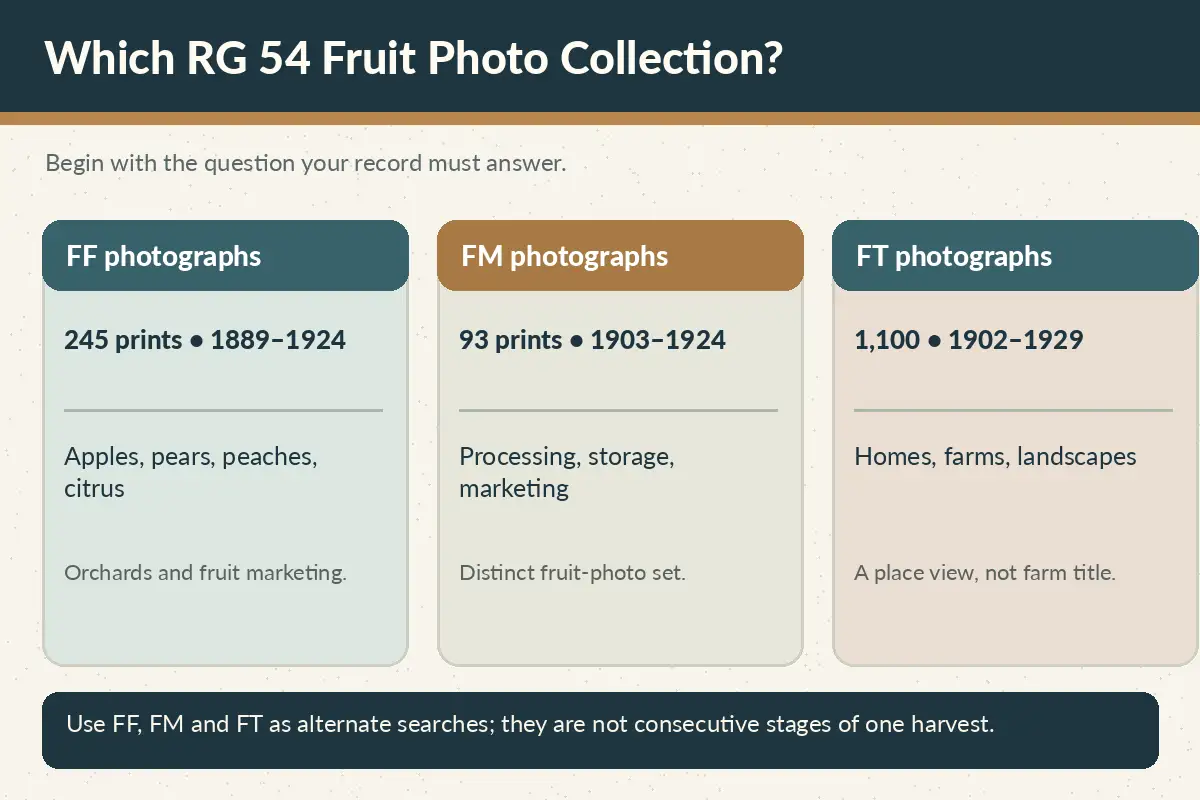
The same RG 54 still-picture description distinguishes the FF group from FM, a smaller 93-print collection on cultivation, processing, storage, and marketing of fruit dated 1903–1924. It also lists FT, about 1,100 images of homes, landscaped land, farms, and public buildings dating 1902–1929. These codes are archival group identifiers, not interchangeable labels for a subject search. If the question involves a particular packing process, search FF and FM as alternatives; if it concerns the grounds of a property, check FT without assuming it includes that orchard.
A broad query for “old orchard photographs” can return government photographs, private postcards, modern scans, and unrelated illustrations. Work from RG 54 and the FF code toward a captioned item. Record the identifier exactly, including any series or item number supplied by the Catalog. Note that the 1889–1924 date range belongs to the described group, not necessarily to every unlabeled online copy. A 1920 photograph of a grower is not automatically proof of an 1890 family farm.
Read the Picture and the Caption as Separate Evidence
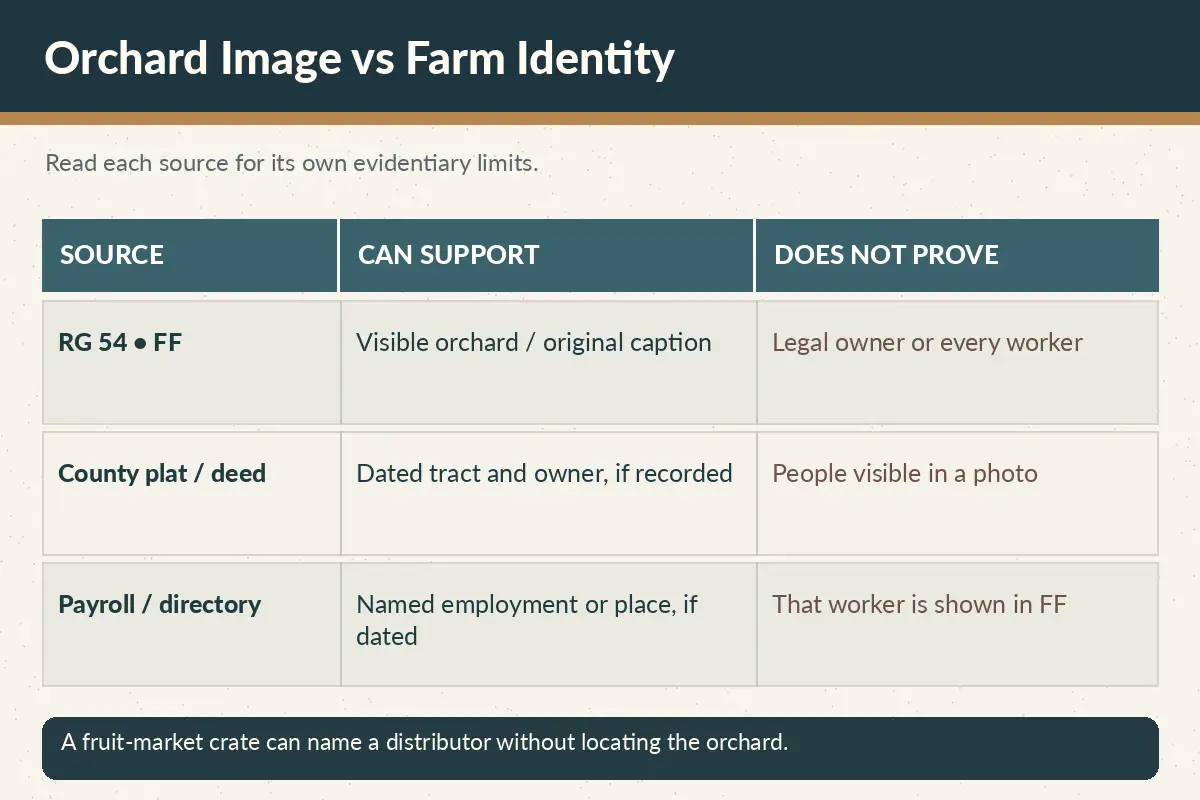
Begin with observable features: fruit type if identifiable, planting pattern, ladders, packing crates, carts, market stand, terrain, building shape, and signs. Then transcribe the original caption, photographer credit, backstamp, or attached note, if present. A catalog caption may name a county or operation even when the visible image does not. Determine whether the wording is contemporary or added later, and preserve the difference in the citation. An image depicting sorting equipment cannot by itself establish its manufacturer, hourly capacity, or actual commercial use.
Treat photographic negatives, prints, scanned surrogates, and later publication reproductions as separate manifestations when the repository identifies them. A newspaper crop may remove a business sign or leave out a second worker. If an identifying detail is unclear, mark it uncertain instead of enlarging and guessing a name. The group guide gives total print counts but does not promise that every photograph is digitized, captioned, or searchable by an owner’s surname. Inspect the full item or ask for an archival reference where possible.
Connect an Orchard to an Actual Place and Date

Use a photo’s stated county, railroad station, or orchard name as a lead, not a completed geographic identification. A fruit-growing district may contain dozens of visually similar properties. Compare dated county atlases, agricultural censuses where available, local crop reports, land maps, and business directories. A named company appearing on a crate may have packed or shipped fruit produced elsewhere. Match both the physical location and its contemporaneous name before marking a farmstead on a modern map.
When comparing different years, distinguish a landscape change from a changed camera angle or season. Bare branches may indicate winter rather than abandonment. The presence of irrigation infrastructure does not establish that a specific parcel held water rights. If the photo shows a packing house, seek a dated directory, permit, assessment, or company notice to confirm where it operated. A location identification is stronger when multiple independent landmarks fit, rather than one suggestive barn or hillside.
Identify Workers Without Reading a Roster Into the Image
The described FF photographs concern fruit cultivation and marketing, so workers may appear. That does not make the set an employee directory. A printed caption may identify a manager, photographer, or company representative rather than every person visible. For a possible family member, compare age, date, employer, residence, and occupation with name-bearing records such as census schedules, local directories, payroll or family letters where they survive. Facial resemblance and clothing alone remain tentative visual clues, not proof of identity.
Employment can be seasonal, and a person photographed picking fruit might have worked for a short period, visited the farm, or been staged for an educational image. Do not infer wages, citizenship, migration status, or a full career from the scene. If the photograph’s credit mentions a federal scientist or photographer, do not confuse that person with the farmer or subject. Maintain a table separating who made the image, who supplied the caption, who is named, and whose identity was independently verified.
Find the Original Description and Request a Precise Copy
Search the National Archives Catalog using RG 54, FF, a fruit name, a known place, and the dates 1889–1924. The Catalog hierarchy can lead from record group to series, file unit, or item, but results may be descriptions rather than digital images. Save the exact archival title and any item numbers. A search failure at item level is not evidence that the described 245 prints were never made or that the family’s orchard did not exist.
For an undigitized image, follow NARA’s copy and reference guidance, supplying as much identifying information as possible. Ask about full-front and reverse reproductions if captions or stamps matter, rather than ordering a decorative crop. Record what version you received. Before publishing an edited photograph, retain an unaltered reference copy and distinguish your own annotations or colorization from the archival image. Cite both the repository holding and the specific object, not only the web guide.
Publish the Farm Story at the Strength of Its Sources
A careful caption can state that an RG 54 FF photograph documents a described fruit-growing scene during its verified date and location, while identifying the pictured people only when supported by the original print or independent records. If no caption supplies a farm name, say that the orchard remains unidentified. A region-specific family account can still use the image as context, provided the reader knows it is an illustration of practices rather than a portrait of the ancestral property.
Build the final evidence ledger with columns for image identifier, original caption, visible features, dating evidence, geographic match, and independent ownership or employment source. If two candidate farms match the landscape, preserve both alternatives. If a county map lists a later owner, do not backdate that title to the moment of the photograph. This method makes the research useful even when the most appealing personal identification cannot yet be proved.
More Family Story and Preservation Guides
How We Research These Federal Holdings
Our starting authority is the National Archives RG guide, especially section 54.3.15, which supports the specific dates and record categories described above. We then use NARA’s Catalog instructions to distinguish record-group, series, file-unit and item descriptions, and consult its reproduction guidance if an item is not available online. The guide is an inventory, not a complete transcript, digitization guarantee, individual name index or certification of a family connection. Each statement about a named person needs independent support and a traceable document citation. The site’s affiliate disclosure explains our editorial and relationship policy; the public archive links here are not claimed as paid partnerships.
NARA describes 245 FF prints about apples, peaches, pears, and citrus fruit cultivation and marketing, dated 1889–1924.
No. The guide separately describes FM as 93 fruit cultivation, processing, storage, and marketing prints from 1903–1924.
No. Check a parcel-specific deed, assessment, land record, or other independent source.
Not reliably. A named original caption and independent records matching person, time, and place are needed.
The record-group guide does not promise complete digitization, captions, or a name index; inspect the Catalog and ask about individual holdings.