
The National Archives guide to Record Group 59 identifies a set of 1,600 U.S. housing-project photographs dated 1938–1950, labeled HP. The Office of International Information assembled the pictures for distribution at foreign information centers. These records can help identify how housing developments were photographed and presented, but the group description is not a register of the developments’ residents or proof of when each building first opened. Start with the individual image and its original caption.
A photo of an apartment block, courtyard, or construction site may be invaluable for local and family history. Yet a building’s appearance does not establish legal ownership, tenancy, rent, occupancy date, or the identity of people photographed outside it. The international information purpose also matters: a selected image may illustrate a government narrative rather than document the full range of living conditions. Research the development as a place and the family as a separate evidentiary question.
Find HP Without Mixing It With FNL Images

The same RG 59 guide lists FNL, 500 photographs of American life and notable Americans from 1946–1951, separately from the 1,600 HP housing-project pictures from 1938–1950. Both were used for foreign information purposes, but their codes, size, dates, and subjects differ. If your question concerns a specific housing development, begin with HP. A broad search for State Department American life photographs may find FNL images that do not document housing-project locations or dates.
These codes identify described archival groups; they are not addresses or individual photograph numbers. Record the item-level title and any image identifier. The guide places these holdings under the Office of International Information and its broader administrative context, not under a municipal housing authority. A federal publicity copy can be a valuable witness to appearance and messaging even when the development’s permits and tenant records were created by entirely different government bodies.
Read the Original Caption, Not a Reposted Label

Inspect the full photograph, border, reverse, photographer notes, distribution captions, and any date stamps when available. Identify what the image actually shows—facade, number of floors, landscaping, playground, streetscape, or construction activity. A caption claiming a building is “new” should be dated and attributed; it may describe a publicity theme, not the final inspection or first occupancy. A later web upload may have replaced a specific address with a generalized location, so copy the original text and note later captions separately.
The collection’s 1938–1950 date span does not say whether a particular photograph was exposed, copied, or distributed in a specific year. An older image may have been compiled later for overseas use. Try to establish an item-specific date through visible signs, matching dated issues, or original inventory data. If several prints depict a development under different names, compare street alignments and building plans before treating them as the same project. Similar architectural styles are not proof of a match.
Separate a Design, a Building, and an Occupied Home
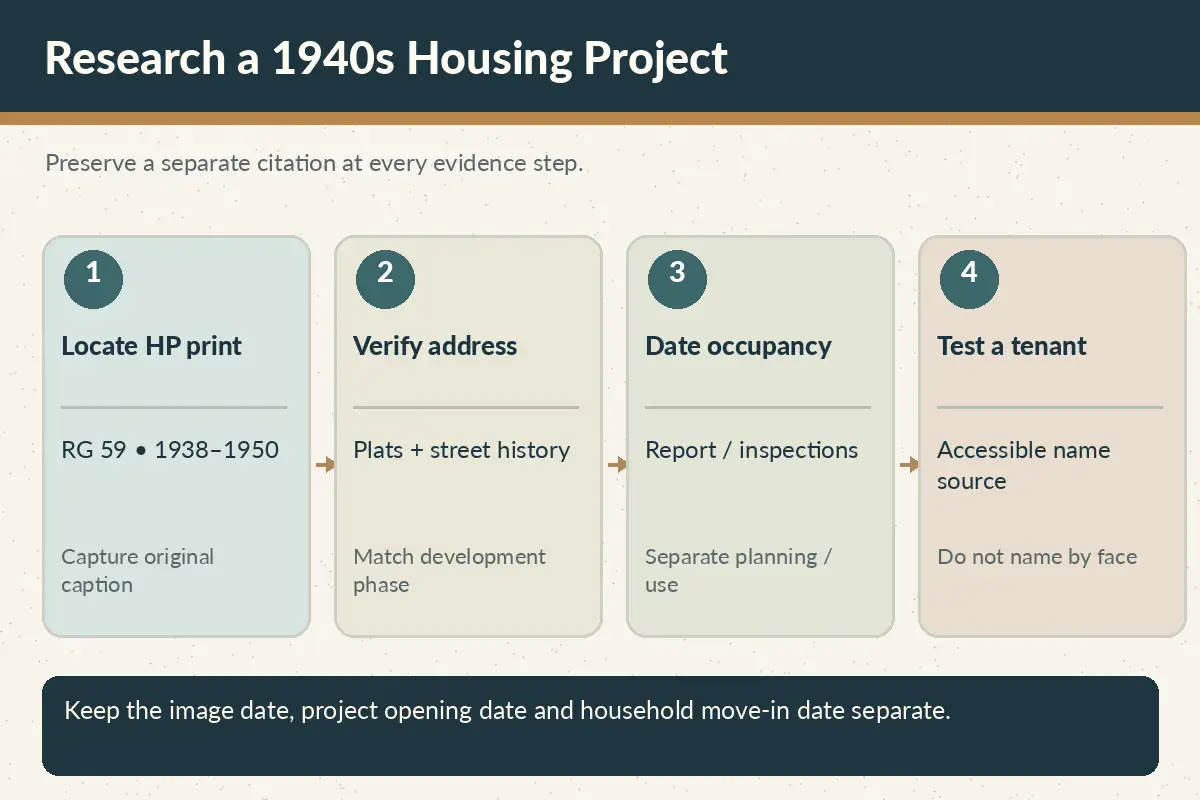
A polished exterior photograph may show a completed building but cannot reveal whether the units had opened, whether utilities were operational, or how occupancy was allocated. Conversely, a construction photo may document a stage of work without establishing final project cost. To test development chronology, seek dated building permits, housing-authority reports, inspection records, and contemporary news or municipal minutes. Match the exact project title, location, and phase: large developments were sometimes built in sections.
Land acquisition, planning approval, building completion, and first tenancy are different events. Do not convert a caption’s completion claim into proof of legal title or a resident’s move-in date. Some project names changed, streets were renumbered, and buildings were demolished or remodeled. Build a time-indexed place crosswalk using original addresses, plat maps, and stable geographic landmarks. Note when a modern map only approximates a historic site.
Verify a Tenant Without Guessing From a Courtyard Scene
People appearing in a housing photograph may be residents, visitors, employees, or posed subjects. Unless a contemporary credible caption names them, leave them unidentified. Even a named resident in a publication should be checked against a dated housing application, city directory, census, lease, or other properly accessible source when appropriate. A project-level housing statistic cannot identify an individual household, and a family with the same surname elsewhere in the city is not automatically a match.
Carefully handle personal records: tenancy and housing files may carry access restrictions, especially for later records or living people. Do not infer income, ethnicity, marital status, or social assistance from the architecture or a publicity pose. When a family story alleges relocation or displacement, look for direct records tying the household to an actual address and event. A photograph can show a neighborhood but not explain why someone moved away.
Trace Distribution and the Image’s Audience
Because the photographs were assembled for foreign information centers, ask what the distributing office selected, how the captions framed the scene, and whether a specific image was used in a brochure, exhibit, or article. Compilation for potential distribution does not prove that a particular embassy displayed it or that readers abroad saw it. An image with a publication credit can help trace use only when the published issue is identified and dated.
Compare any reproduced crop to the original print. A publication may omit nearby demolition, construction debris, or other context visible at the edges. If the scene was selected to illustrate housing policy, distinguish the policy’s promotional claim from verified conditions at a named development. A contemporaneous local newspaper or municipal report may provide valuable, independently produced detail, but it should be cited on its own rather than treated as a supplement that the RG 59 photograph automatically confirms.
Cite the Project and the Household on Separate Lines
Search the National Archives Catalog with RG 59, HP, the development’s historic name, address, and approximate dates. Follow the description hierarchy to the precise photo; not every holding necessarily has a searchable digital object. NARA’s copy guidance explains how exact identifiers improve a request. Ask for the uncropped image and original caption when these survive.
In your finished local history, label the federal picture as a State Department international information photograph, then cite separately the municipal building chronology and any named occupant evidence. If only the photograph’s context is known, describe the development and acknowledge the lack of household identification. A visually persuasive image should make research questions clearer, not cause unverified claims about tenants, displacement, or policy outcomes to enter a family tree.
More House and Local History Guides
How We Research These Federal Holdings
Our starting authority is the National Archives RG guide, especially section 59.3.9, which supports the specific dates and record categories described above. We then use NARA’s Catalog instructions to distinguish record-group, series, file-unit and item descriptions, and consult its reproduction guidance if an item is not available online. The guide is an inventory, not a complete transcript, digitization guarantee, individual name index or certification of a family connection. Each statement about a named person needs independent support and a traceable document citation. The site’s affiliate disclosure explains our editorial and relationship policy; the public archive links here are not claimed as paid partnerships.
HP is the described group of 1,600 U.S. housing-project photographs, 1938–1950, assembled for the Office of International Information.
No. FNL is a distinct 500-image group showing American life and notable Americans, dated 1946–1951.
No. Consult opening, inspection, housing-authority, or other dated records for occupancy.
Not by itself. Seek reliable item captions and independent, appropriately accessible person-specific evidence.
No. The stated purpose does not prove a specific display or publication; look for a dated issue or distribution record.