
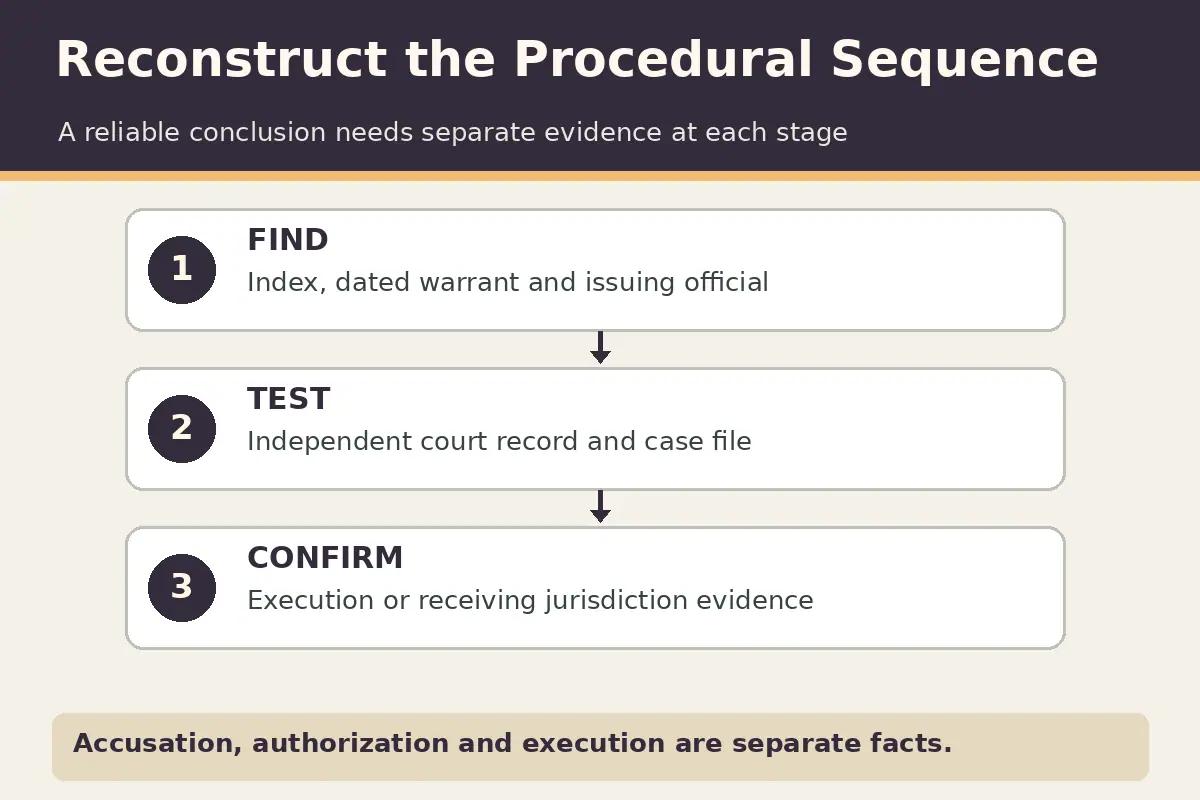
A person named in a historical extradition warrant was not necessarily convicted, surrendered to foreign custody or even ultimately removed from the country. NARA identifies State Department extradition case files and related warrants in Record Group 59 for 1836–1930, and its detailed inventory distinguishes arrest and surrender warrant books. The strongest genealogical approach begins by identifying which warrant stage the document represents, checking its date and country, and locating a separate court or transfer record before making any statement about the person’s fate.
The RG 59 Guide provides the broad period. NARA’s Inventory 15, Part III, entries 859–861, gives a much more useful starting point: a general warrant series for 1843–1930, a narrower arrest-warrant series for 1886–1910 and a surrender-warrant series covering the same narrower span. A name index may take the researcher to a volume, but the index itself is not the underlying legal instrument.
Determine Which Warrant Stage You Found

Entry 859 identifies five volumes of warrants of arrest and extradition from 1843 to 1930, arranged chronologically with alphabetical indexes. The inventory says they contain mainly copies of State Department warrants concerning the arrest and surrender of fugitives, plus some presidential authorizations for receiving prisoners from other countries. That mixed content matters: a book title alone does not identify whether an entry concerns a person sought by a foreign government or someone sought by a U.S. jurisdiction. Read the direction of transfer and the recipient named in the actual warrant.
Entries 860 and 861 distinguish warrants for arrest for extradition from warrants for surrender for extradition, 1886–1910. The arrest stage typically authorizes action toward apprehension, while the surrender-stage description refers to orders involving the requested transfer. Neither category automatically proves the person was physically delivered. Use the document’s exact title and date to construct a sequence; do not label every “extradition warrant” as the final, executed outcome.
Search by Person, Country and Date Together
The detailed NARA inventory states that the warrant volumes contain alphabetic indexes by name, while their entries are arranged chronologically. Begin with a reliable name spelling, but add alternate spellings, aliases if documented, the country involved and an approximate date. International correspondence may represent names in several languages. A matching surname without the relevant country and timeline is dangerous in legal family history, especially where the record describes an allegation that carries lasting reputational consequences.
When you locate an index reference, obtain the full corresponding entry, not only the name. Inventory 15 describes common fields including the fugitive’s name, nature of the alleged crime and requesting country. The word “crime” in the descriptive inventory does not itself establish a conviction in the case being researched. Preserve the warrant’s own procedural wording and identify the official who issued it. Names found elsewhere on the page may belong to officials or agents rather than the person sought.
Distinguish an Allegation From a Judicial Finding

A warrant may recite a charge or the asserted basis for a request. That is evidence that a government sought an action, not independent proof that the underlying conduct occurred. Find the relevant judicial examination, hearing, court order or other legal record before describing what a court decided. The inventory’s description of surrender warrants notes a statement that a U.S. court examination had been made; this should be tested against the actual court file, not converted into an assertion that a person was convicted.
Use cautious and historically accurate wording: “named in a warrant seeking arrest for extradition” preserves the state of the available evidence. “Convicted criminal” goes much further and ordinarily requires a court judgment. A record of alleged conduct may also have later been rejected, withdrawn or resolved by another legal route. Do not assume that the absence of an outcome in a State Department file means the alleged charge was sustained, dismissed or otherwise decided.
Follow Transfer Evidence Beyond the Warrant Book
To establish surrender, search for evidence that the order was executed: correspondence acknowledging delivery, court records, an officer’s return, or records from the receiving jurisdiction when available. Dates should be tracked separately for complaint, warrant, court examination, authorization, movement and reception. A presidential authorization to receive a prisoner from abroad has a different direction of custody than an order surrendering someone from the United States. Recording those roles protects against reversing a family migration story.
Check the case file as well as the warrant books. NARA explicitly groups extradition case files and related material in RG 59, but a case file’s existence or contents must be established individually. Requests involving former country names, boundary changes or changes in diplomatic relations require period-accurate jurisdiction labels. If the original foreign legal materials are not present, distinguish what the U.S. State Department knew or recorded from what the foreign tribunal actually ruled.
Cite the Exact Volume and Preserve Privacy
Write a research log with RG 59, Inventory 15, the entry number (859, 860 or 861), the volume and page, the indexed spelling, the warrant date, and the parties and countries named. If you cannot inspect the entry, cite the inventory as a description of holdings rather than implying that an individual has been found. A source-grounded account might state that NARA holds a relevant type of warrant and that further examination is needed to identify whether a named person appears.
Treat sensitive allegations and family relationships responsibly even when documents are old. Avoid identifying modern descendants by association with an unverified charge or publishing speculation about living people. When sharing a historical finding, distinguish an exact quotation from a paraphrase and give its source. A well-supported legal-history narrative is often a timeline of documented procedural acts, not a simple morality tale about guilt, flight or escape.
More Records and Archives Guides
How We Research This Archival Evidence
We compared the general RG 59 description with Inventory 15, Part III, entries 859 through 861. The latter distinguishes chronologically arranged warrant volumes and name indexes from the procedural purposes of arrest and surrender records. We did not inspect a named person’s file, infer guilt from a warrant, or assume execution of a transfer. Researchers should verify each case in its original record and in relevant court or receiving-jurisdiction records. Affiliate disclosure.
No. A warrant identifies an official procedural act involving an allegation or request; a judgment requires separate judicial evidence.
Entries 859, 860 and 861 all potentially overlap 1895, but they have different purposes. Select the relevant procedural stage and consult the index and volume.
Inventory 15 describes an alphabetical index within each relevant volume. That does not necessarily mean a searchable online index exists.
Not on its own. Seek execution evidence, a return, correspondence or receiving-jurisdiction records to demonstrate that transfer occurred.
Yes. Compare name spellings, country, date, associated officers, court records and any independently verified personal identifiers before making a match.