
Start With the Archival Series and a Specific Question
NARA describes 385 photographs in RG 59 RAG, dated 1943–1949, concerning Japanese repatriation activities and the Swedish vessel SS Gripsholm. An older Still Picture Branch guide emphasizes 1943–1944 images of repatriates on the ship and related photographs of Japanese internees at Camp Kenedy, Texas. The date ranges are descriptions of differently scoped archival summaries, not proof that a single voyage lasted years. Treat the exact frame, voyage, location, and people as separate research questions.
A ship with a recognized name may appear in many photographs and events. Neither the name Gripsholm nor the presence of a queue at a gangway establishes who was on board, why they traveled, or their citizenship. The State Department preserved these pictures as part of administrative work, not as exhaustive passenger identification. A precise family-history question asks which sailing a relative took, supported by a named manifest or case record, and then asks whether a photograph belongs to the same event.
Understand What the RAG Series Actually Covers
The federal records guide places RAG within general State Department records and describes photographs acquired from the Office of Controls. It gives a total of 385 photographs and a 1943–1949 range. The Still Picture Branch guide uses a narrower descriptive emphasis on a ship carrying repatriates and the Camp Kenedy holding area in Texas during 1943–1944. This does not authorize treating every frame as a Gripsholm voyage view or every person as a ship passenger.
Create a subject column for onboard activity, port departure, exchange procedures, reception areas, and any separate camp scene. Keep original series designator RAG and the local print number. Record when a description comes from NARA’s federal records guide and when from the older still-picture finding aid. Different guide summaries can coexist without one being a reliable date for every exposure. Review the item itself before assigning a scene to a named port.

Distinguish Exchange, Repatriation, and Internment
These words describe different administrative and personal circumstances. Repatriation, civilian exchange, a holding facility, and an international transit do not necessarily imply the same legal status or destination. Do not infer that a person pictured at Camp Kenedy boarded Gripsholm, nor that someone pictured on the ship was held at that camp. The broader context includes sensitive histories of detention and wartime nationality rules that demand evidence more precise than a group portrait.
Describe an image in neutral, observable terms unless an original caption or dated file establishes more. Clothing, age, ancestry, facial appearance, or nationality guessed from a photograph are not reliable person-level evidence. An administrative caption may reflect the vocabulary of its own era and office; quote that vocabulary when needed and explain it rather than assigning categories to otherwise unidentified people. In family-history writing, avoid both romanticizing a voyage and assuming coercion without a source.
Fix the Voyage Before Searching for a Passenger
Identify the specific sailing from a dated port announcement, ship record, diplomatic file, or contemporary press account before using the ship’s name as a search key. A vessel may transport different groups on separate journeys. Ports of departure, exchange, and arrival are distinct places and should not be merged into a single itinerary simply because they appear in a narrative summary. A photograph of a crowded deck cannot determine whether the ship was departing, arriving, or awaiting an exchange without stronger evidence.
A research worksheet should state ship, port, event date, any intermediate stop, and source of the chronology. If only a later article provides a date, flag that limitation. For an identified relative, search voyage-specific passenger or diplomatic papers and compare name variants, date of birth, family group, and residency. The existence of an official sailing does not prove that an unlisted person was aboard; a spelling mismatch may require careful review of original documents.
Keep Photographs and Film Descriptions Separate
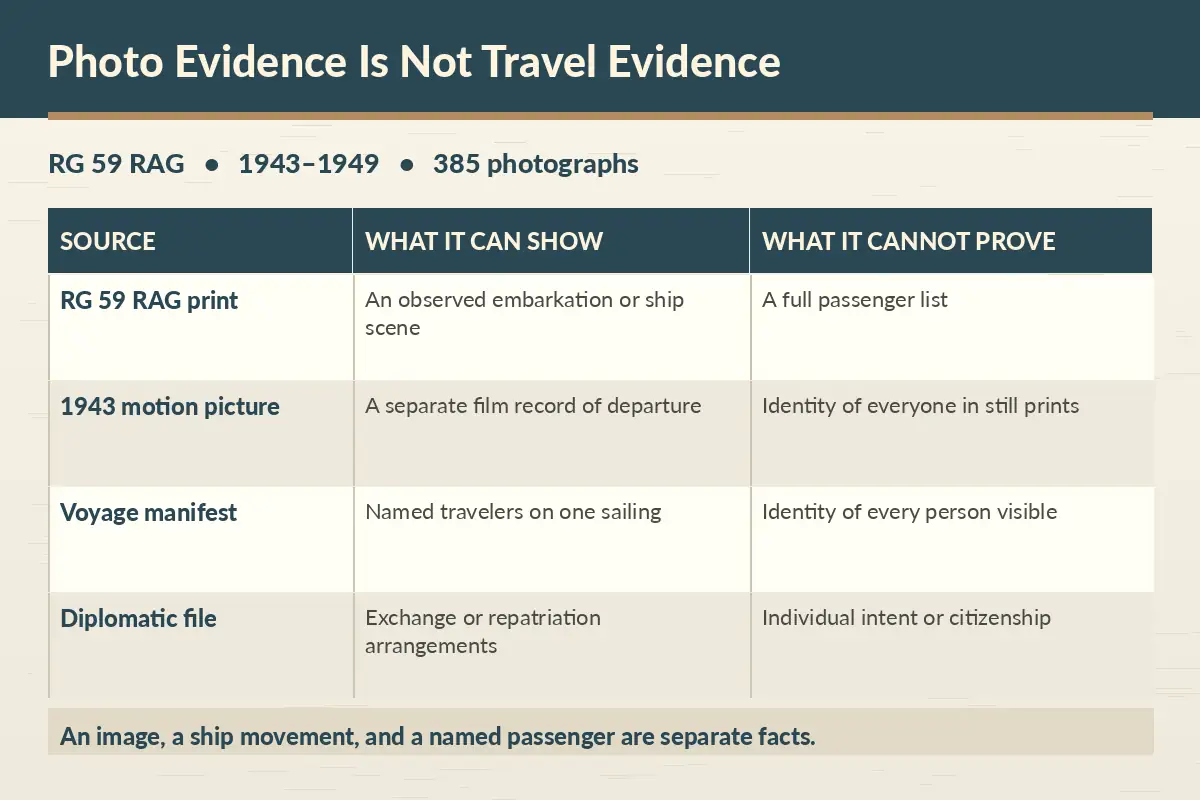
NARA’s RG 59 overview also mentions motion pictures of Japanese repatriates embarking on Gripsholm and Red Cross supplies. That film record is not the same object as an RAG photographic print even if it depicts related events. Do not cite a video description as the proven provenance of a still image, and do not claim that a still print was extracted from a film without technical documentation. Preserve medium, repository section, and identifier for each record.
If a moving-image sequence and a photograph appear to capture the same setting, compare vessel features, banners, weather, crowd arrangement, and port structures, but avoid using likeness alone to assign a date or a person. These records could have been created at different stages of a publicized event or reused in later information materials. An authentic editorial caption should describe what is visible and what the original archive specifically states, with uncertain identifications marked.
Find Named Travelers Through Independent Files
An identified passenger needs documentary support beyond appearing in a group shot. Search ship passenger lists, passports, diplomatic correspondence, individual repatriation or exchange case records, and applicable arrival documents. Evidence of a ship’s use in an exchange program is not a list of every person who traveled. Names may have been recorded in multiple languages or romanizations; preserve variants and compare dates and relatives before deciding two records describe the same individual.
Sensitive family information requires context. Some people were civilians, internees, or nationals of countries with changing wartime statuses, and their experiences must not be flattened into a single category. Government administrative language may not reflect a person’s own identity or wishes. A document documenting transport cannot establish a traveler’s motives, political views, consent, or private experiences. Distinguish legal records from oral family testimony and avoid attributing sentiments to unidentified faces.
Write a Reproducible RG 59 RAG Citation
Cite the National Archives, RG 59, RAG, exact local photograph number, original caption, any date annotation, and custody context. Give a separate citation for the named-voyage document and any independent contemporary news account. The source guide identifies the series, but does not guarantee online access to every image or item-level identification. If only a derivative scan is available, record its online identifier and do not claim to have examined unseen reverse-side notes.
A careful result might say that a photograph shows a repatriation scene associated by its NARA caption with Gripsholm, while a named manifest independently records a relative on a particular voyage. That alone still does not identify the relative in the picture. The difference between visual event evidence and individual identity is central to using the collection responsibly, especially when the narrative concerns displacement and confinement during wartime.

More Records and Archives Guides
How We Research This Collection and Its Limits
The series description, dates, and record designation were checked against the official National Archives research guide on November 16, 2026. Independent context was compared with a second official research source, while NARA still-picture citation guidance establishes the information needed to locate an exact image. The site topic list and earlier production titles were compared for duplication. A series description does not identify every subject, date, or object in every frame, and access to a fully digitized item cannot be assumed. The figures in this guide are newly drawn explanatory editorial illustrations, not historical negatives or genuine reproductions. We make no unverified claims of commercial endorsements. See the affiliate disclosure for site policy.
NARA lists 385 photographs in the RAG series.
The older still-picture guide describes a narrower subject emphasis; the federal records guide dates RAG 1943–1949.
No. The series also includes Japanese repatriation and related holding-area scenes.
Not without a reliable individual identification and independent named travel records.
No. They are different archival media with distinct identifiers.