
The Treasury Department’s lists of bonded employees are a promising route to a historical federal worker, but a name on such a list is not a complete personnel file. NARA identifies two distinct stretches of RG 56 listings, 1829–1856 and 1868–1908. The first research task is to determine which span covers the person’s claimed appointment, which office was involved, and how a surviving entry is described. The second is to test any apparent match against independent appointment or employment records rather than infer the length and nature of a career from a single list.
The RG 56 guide places the lists in records of the Treasury Division of Appointments, alongside registers of personnel actions, appointment correspondence, employee lists, biographies and other series with different purposes. The guide does not promise a uniform field layout or digitized name index for every volume. Treat the record-group description as a route to the archival material, not as a transcription of the name you hope to find.
Choose the Correct Bonded-Employee Date Range

Start from a known date: a dated family letter, city directory, federal appointment, payroll reference, or newspaper notice. For a candidate employee active in 1848, inspect the 1829–1856 portion; for someone active in 1894, inspect 1868–1908. The gap between those stated spans is real in the guide and should not be explained away as if the listing were continuous. Nor does the existence of a later section guarantee that every year, agency office, or worker appears with equal detail.
Write down the exact description of any volume or file unit before requesting it. Record the starting and ending years as printed on that unit rather than borrowing the broad dates of the series. If a title uses the word “bonded,” preserve it; changing the label to “civil service roster” can shift the research question and conceal how the list was created. If no entry appears, explore spelling variants, office names and alternative record types before concluding that the person never served.
Match the Office Before Matching the Surname
A common surname is weak evidence without administrative context. A Treasury official in a customs office and a person employed at the central department could have very different records, despite both being described under federal Treasury administration. Compare any listed office, place, initials, occupation or date against a second source created closer to the claimed event. A family recollection that someone “worked for Treasury” is not enough to distinguish a clerk from a collector, a surety or another person named in the paperwork.
Do not assume every person connected to a bond was the principal employee. Historical security instruments can involve officials, obligors and guarantors; the precise role must be read from the actual document. The RG 56 summary calls the material lists of bonded employees, but does not specify every column, signature or legal role. When the source is examined, copy the exact wording next to each name. This makes it possible to distinguish a genuine employee identification from a name mentioned only in a supporting transaction.
Compare Bond Lists With Appointments and Payroll
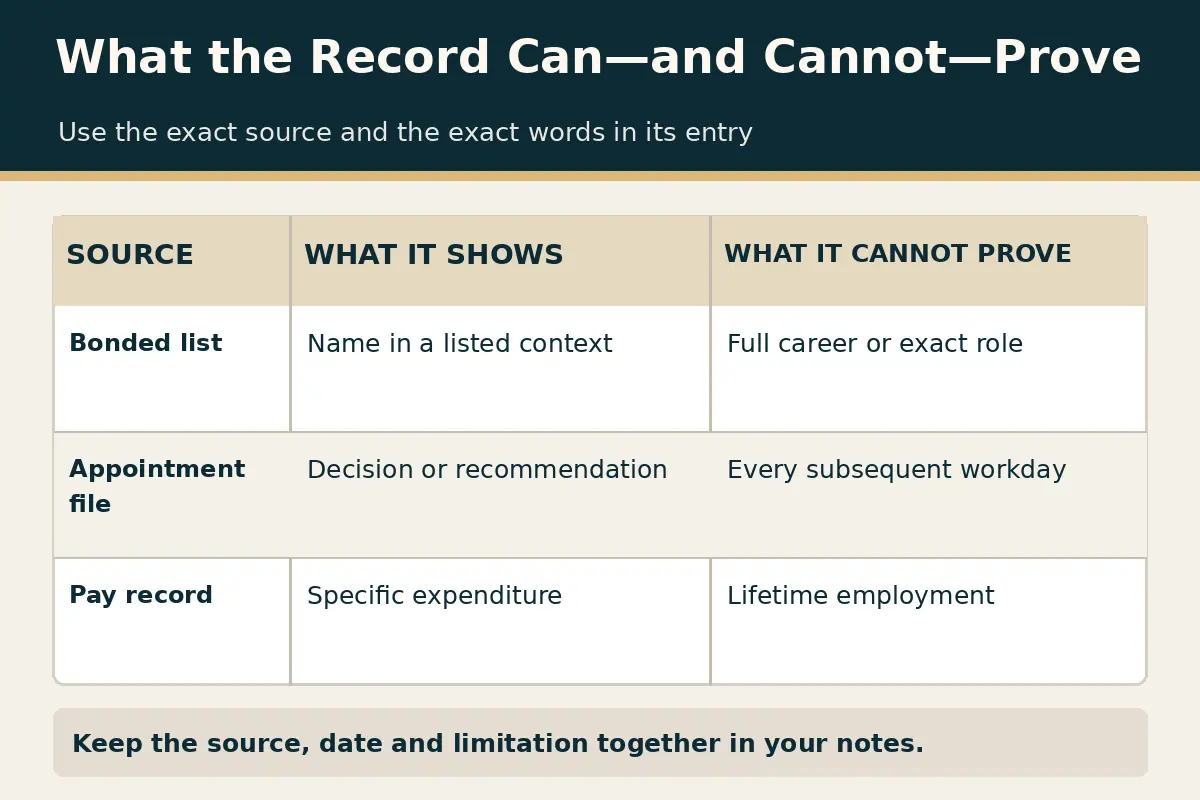
NARA separately lists registers of personnel actions for 1881–1917, salary-related disbursements for 1889–1912 and correspondence on appointments. Those records are not interchangeable. A personnel action may establish a change on a dated administrative record; a payment may support a pay period or account; a bond-related listing may establish participation in a security or administrative requirement. None automatically supplies the dates of every preceding or subsequent job, or proves why a person left an office.
Build a timeline with a source column: a bond-related listing, an appointment letter, an Official Register entry, a personnel action or a newspaper notice. Note which dates are written in the records and which are inferred. The NARA civilian federal employees guide explains why nineteenth-century personnel evidence is dispersed among agency files. A missing modern personnel folder therefore does not by itself disprove historical government employment.
Use a Negative Search Result With Care
A search that produces no name may mean the wrong period was searched, the list is arranged by office rather than surname, the name is spelled differently or the relevant material is absent. The published series dates do not promise a continuously surviving set of names, and they do not guarantee that the list covered all Treasury jobs. Note what was searched: the exact volume, indexes checked, date span and how each spelling variant was handled. “Not found in this volume” is substantially more useful than “not a federal employee.”
If the suspected worker was in a subsidiary bureau, compare the relevant bureau record group, the federal Official Register when a suitable year exists and contemporary local sources. Where offices changed names or jurisdiction, record the date of that change rather than retroactively applying a later agency label to earlier service. This step protects against a subtle kind of false certainty: matching an ancestor to a government organization that did not yet operate under the same name.
Create a Citation That Can Be Rechecked

For every candidate entry retain the record group, Division of Appointments context, archival series title, volume or file notation, page or folio, entry date, and where the record is held. Photograph or transcribe adjacent headings and explanatory notes when permitted. The surrounding heading may be essential to interpreting why a person was listed. A cropped surname without the column labels is often insufficient to distinguish a principal officer from somebody named in a bond obligation.
Before presenting a finding in a family history, phrase it at the level actually supported: “appears on a Treasury bonded-employee list for the stated period” is different from “was appointed on this date” or “worked continuously for thirty years.” Cross-reference the exact source citations for appointment and pay claims. A compact evidence ledger preserves uncertainty and makes later corrections possible without rewriting a whole biography.
More Records and Archives Guides
How We Research This Archival Evidence
We checked NARA’s RG 56 description against its separate civilian federal employee research guidance, then defined the research workflow around the two published bonded-list periods and the independently described appointment and payment series. We do not infer document columns, online coverage, occupational status or tenure from a series summary. Confirm present-day access and item identifiers in the National Archives Catalog; the Guide is not a real-time inventory. Affiliate disclosure.
No. NARA identifies a series of bonded employees for two period ranges; it does not describe a census of every Treasury employee or guarantee complete annual coverage.
Not automatically. Inspect the entry and its headings to establish whether the person was an employee, principal, surety or named for another reason.
The RG 56 description gives 1829–1856 and 1868–1908. That gap is a limit of the described lists, not proof that all Treasury employment or bonding stopped.
No. The last observed listing is only a latest documented appearance in the materials consulted. Look for a dated separation or other contemporaneous proof.
Use appointment correspondence, personnel-action registers or the Official Register, selected according to the agency, place and year of the candidate worker.