
The National Archives RG 56 guide, section 56.3.6, gives a precise route for researching people who cleaned, guarded or maintained federally operated public buildings. The Office of the Supervising Architect left applications for custodians and janitors dated 1878–1910, and for charwomen, laborers and messengers dated 1880–1902. That is evidence of distinct kinds of employment paperwork, not proof that every applicant was hired. Start with the claimed role and period, then ask which class of record can actually answer the family question.
The same guide identifies lists of custodians, janitors and other employees dated 1882–1909, payment ledgers for custodians and janitors dated 1871–1907, and maintenance personnel oaths dated 1875–1909. Those overlapping but unequal ranges create a useful comparison. A named application may establish that a person sought a position; an employee list might independently establish a recorded role; a properly identified payment entry may document compensation. Never turn one document into a complete employment history without seeing what it says.
Route the Search by Job Title and Date

Record the worker’s reported title before searching. “Charwoman” is a historic occupational label found in the archival guide, not a reason to impose a modern job classification. An inquiry about a woman applying in 1894 should examine the 1880–1902 charwomen category. A janitor application in 1906 fits the 1878–1910 janitor range but falls after the listed 1902 endpoint for the separate charwomen, laborers and messengers category. Keep these ranges separate when using NARA’s Catalog and when asking staff for an archival reference.
A custodian, janitor, laborer, messenger and charwoman may have performed different duties or may appear under changing terminology. Do not infer job grade, wages or civil-service standing from a generic label. Note the exact building, city and department whenever a document identifies them. A federal building could house several offices, and a person’s presence in a city directory near the building is not proof of government service there. Your initial worksheet needs name variants, role, date, building and the record type likely to supply the missing fact.
Read an Application Without Inventing a Hiring Decision
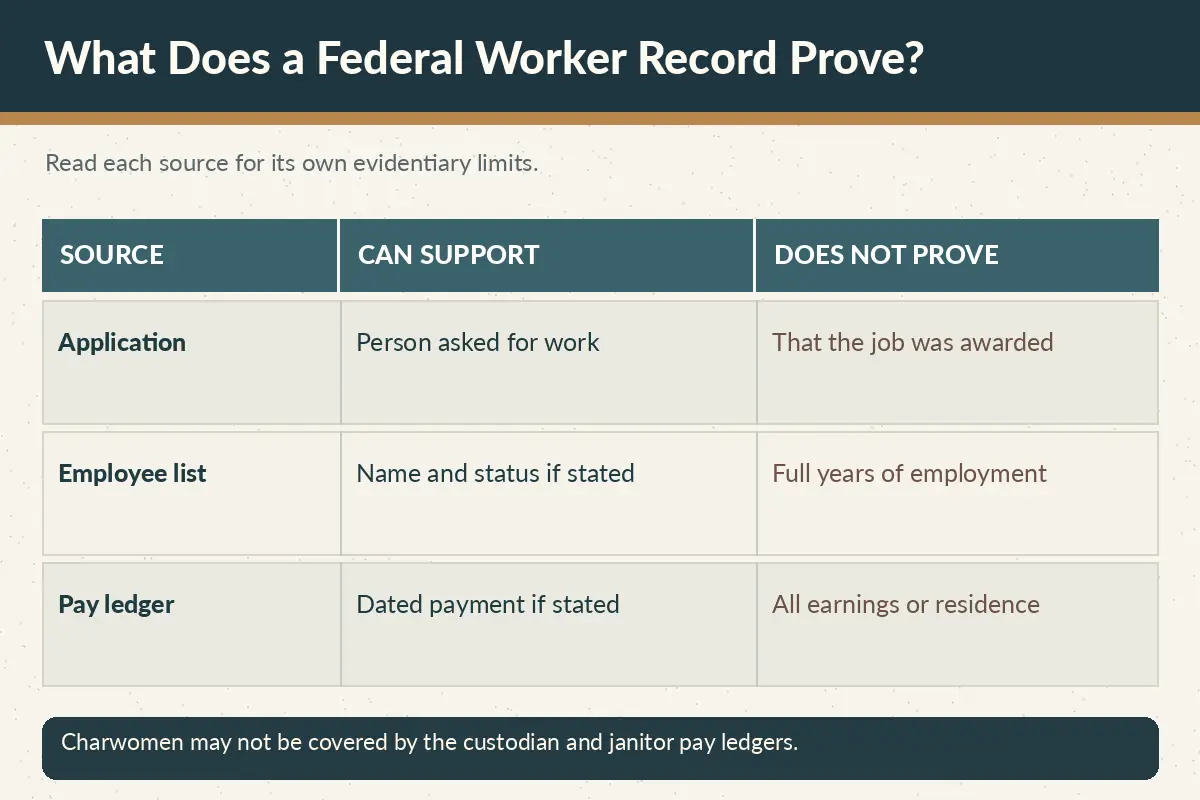
An application file can reveal what the applicant or recommending writer said if an original is located. Inspect the writer, addressee, date, position, associated building and any endorsement rather than assuming a standard preprinted form. A favorable recommendation is a claim made by its author. Even a received or forwarded notation does not necessarily mean appointment. Preserve quoted wording in a transcript and mark unclear names rather than silently normalizing a difficult signature to a preferred family spelling.
To test a hiring claim, look separately for a signed oath, employee list, later correspondence or a dated payment line, where available. NARA’s section also identifies letters received from custodians during 1878–1910 and oaths dated 1875–1909; either may offer context, but the guide does not promise that all workers appear. A missing entry may result from incomplete holdings, unexamined volumes or a differently filed office. It should be recorded as an unsuccessful search of specified material, not a confirmed rejected application.
Compare Employee Lists, Oaths, and Payment Ledgers

Employee lists dated 1882–1909 can be a stronger test of a recorded appointment than a recommendation, but first examine their column headings and the exact dates represented. If a name appears, ask whether the list shows a place, title, salary or only an administrative grouping. An oath documents a formal declaration on the date stated; it may not establish uninterrupted employment before or after that date. Avoid describing an entire tenure from a single year or office-level record.
The 1871–1907 ledgers concern payments to custodians and janitors. Do not assume that their coverage includes every charwoman or laborer named in applications, or that a line records monthly wages without checking the book. Transcribe payee, account, amount, period and location when present, and test whether a payment was for salary or another expense. Where the application and payment use a common name, compare the address or agency details with independent evidence before deciding they refer to one individual.
Locate the Specific Building and Separate Its Records
The Office of the Supervising Architect administered federal public-building matters, but this personnel subseries is not the same thing as construction plans for a building. If family tradition names a customhouse or post office, verify the institution’s historically correct address and dates. Search the National Archives Catalog under RG 56 and the Supervising Architect, combining job titles with city and date. Record whether the result is a record group, series, file unit or item, and whether any images are actually linked.
A useful follow-up request may need the worker’s possible building, name variants and role even when the guide describes only a collection. Use NARA’s instructions for copies to ask how to find the relevant folder or volume before purchasing reproductions. A reference request should not assume an individual online surname database exists. Once a location is documented, compare local city directories, census records or federal registers independently; occupancy of a building and employment within it are different propositions.
Write a Career Statement at the Right Evidence Level
Use a three-column chronology: document and exact date; action explicitly stated; interpretation requiring more support. For example, “applied in 1894” is stronger and safer than “worked from 1894” when only an application is known. If a list and a payment record also name the person, cite each separately and discuss any discrepancies. Similar names in different public buildings can represent different people. Create an unresolved-identity row until geography, role and external family identifiers align.
When preparing a family narrative, distinguish contemporaneous payroll or oath entries from later reminiscence. Do not treat a wage figure as a full annual income unless the source defines its accounting period, and do not infer rank or wealth merely from a title. If only the RG 56 inventory has been consulted, write that the collection contains records of this type; do not claim that an individual page was viewed. This disciplined separation keeps a plausible household story from becoming a fabricated federal career.
More Records and Archives Guides
How We Research These Federal Holdings
Our starting authority is the National Archives RG guide, especially section 56.3.6, which supports the specific dates and record categories described above. We then use NARA’s Catalog instructions to distinguish record-group, series, file-unit and item descriptions, and consult its reproduction guidance if an item is not available online. The guide is an inventory, not a complete transcript, digitization guarantee, individual name index or certification of a family connection. Each statement about a named person needs independent support and a traceable document citation. The site’s affiliate disclosure explains our editorial and relationship policy; the public archive links here are not claimed as paid partnerships.
No. A request or recommendation should be tested against a list, oath or pay record if one survives.
The NARA guide lists that application class for 1880–1902, while custodian and janitor applications extend to 1910.
No. The precise payee, account and period must be checked and separately corroborated.
No. The Catalog may describe an archival series without transcribing each application or ledger entry.
Record Group 56, section 56.3.6, the relevant role and date range, a building or city, and any Catalog identifier.