
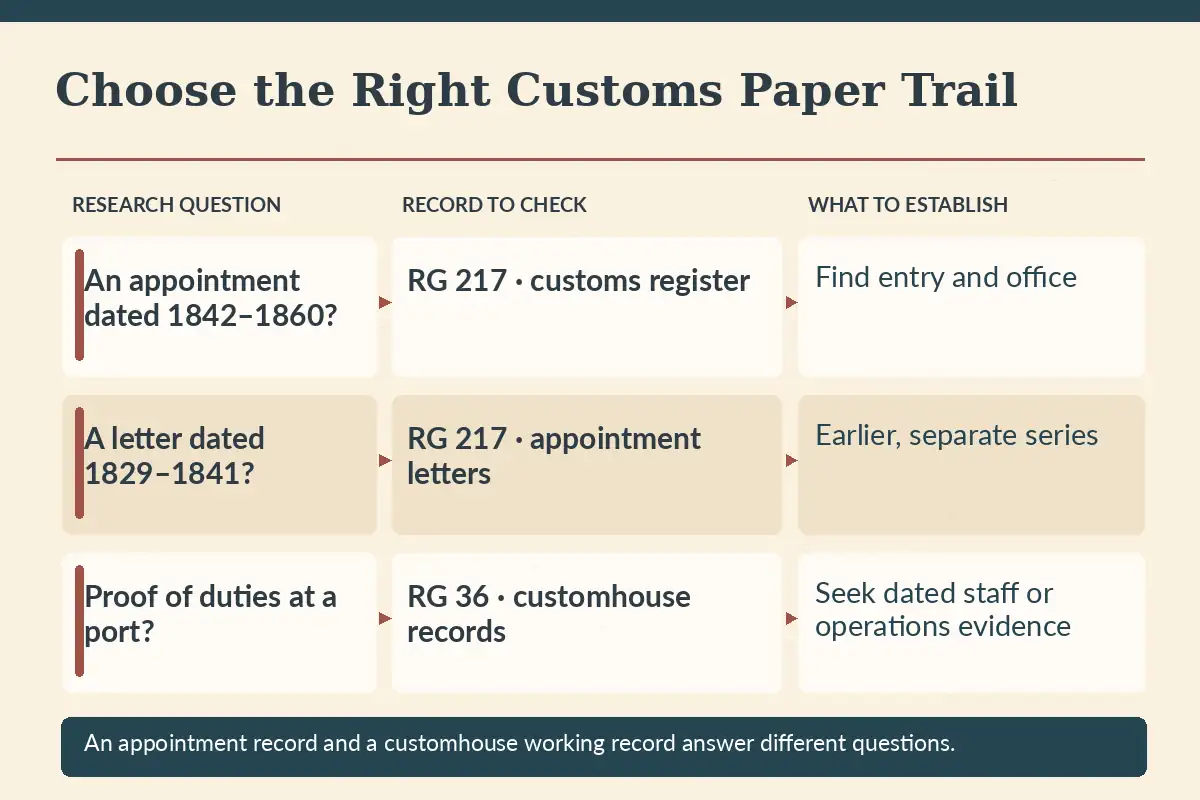
A register of customs appointments dated 1842–1860 survives among the Customs Division records of the Accounting Officers of the Treasury, Record Group 217. It can guide a researcher toward a historical federal appointment, but a register entry does not automatically prove that the officer took up duty, worked at one port for years or retired there. Those later claims need their own dated evidence. Even the adjacent appointment letters in the NARA Guide belong to a different period, 1829–1841, and should not be treated as identical copies of the register.
Customs officers frequently appear in family stories as collectors, inspectors, clerks or other port officials, but a title in a descendant’s account may be imprecise. The appointment record is a useful starting point because it can provide an official administrative context. To build a career narrative, compare it with records created by the working customhouse, now described by NARA in Record Group 36, and with reliable local identity evidence. The important distinction is between a recorded governmental action and a documented span of actual service.
Begin With the Treasury Accounting Division
NARA RG 217 section 217.3.2 lists Customs Division correspondence, appointment letters from 1829–1841 and the 1842–1860 register. Cite the longer name “Records of the Accounting Officers of the Department of the Treasury” in your request, because RG 217 is not simply the later U.S. Customs Service record group. An archivist may need the series title and date range to distinguish this register from local port staff books or payrolls.
Search the National Archives Catalog with the record group and “register of customs appointments,” then ask what arrangement or indexes exist for the physical volume. A group description is not a promise of a searchable name database or a scan of every entry. If you obtain a page, document its column labels, volume title, page number, date and any cross-references. A register can use shorthand intelligible only when compared with surrounding entries.
Write down the historical job title rather than replacing it with a broader modern label. A collector, surveyor of customs, inspector or clerk may have had distinct duties; do not infer which title appears in a document without reading it. If a notation is abbreviated, keep the literal form in your transcript and mark the expanded interpretation as provisional until verified.
Treat an Appointment as One Dated Event
The register can document a recorded appointment action within its date span, subject to what the original entry states. It does not by itself tell you whether the person accepted the position, took an oath, received a commission or actually drew a salary. Keep those outcomes as separate research questions. A family tree that converts the appointment date into a full career start date may be asserting more than the document supports.
Check whether the register contains a district, port, replacement officer or legal designation, but do not assume such fields are present until you have inspected the page. An entry could be copied later or arranged by administrative rather than event date. Transcribe unusual punctuation and amendments: a marginal note may reflect a later action, not part of the original appointment. Avoid building an exact chronology from one unclear date.
If the family story describes a position before 1842, the appointment letters of 1829–1841 form a distinct route within RG 217. Do not search that earlier period in the later register and treat no hit as evidence the ancestor was never appointed. The two date ranges meet but are not guaranteed to form a seamless register of every federal customs appointment.
Check the Port Through Customs Service Records
The National Archives assigns U.S. Customs Service administrative and customhouse records to RG 36. After identifying the historically correct port or district, search that record group for local correspondence, staff documentation, official actions or other appropriate series. A federal appointment registered by Treasury headquarters and a dated entry created at a particular customhouse are independent clues when they refer to the same person and office.
Do not assume that every customhouse saved payrolls for every year or that RG 36 holdings follow one national arrangement. The guide covers many ports and periods, and access may depend on the particular geographic custodian. Include the port, approximate dates, name variants and position in a research request. An official with the same surname in a neighboring district could be a different person or a transfer requiring proof.
Use the local record to answer a narrow question: was this person named in working correspondence, a salary-related document or another record at a specified date? That evidence may extend the timeline. It should not be stretched into continuous service from appointment until the next surviving reference. A transfer, interruption or a second appointment remains a separate event to document.

Distinguish Namesakes and Changing Port Boundaries
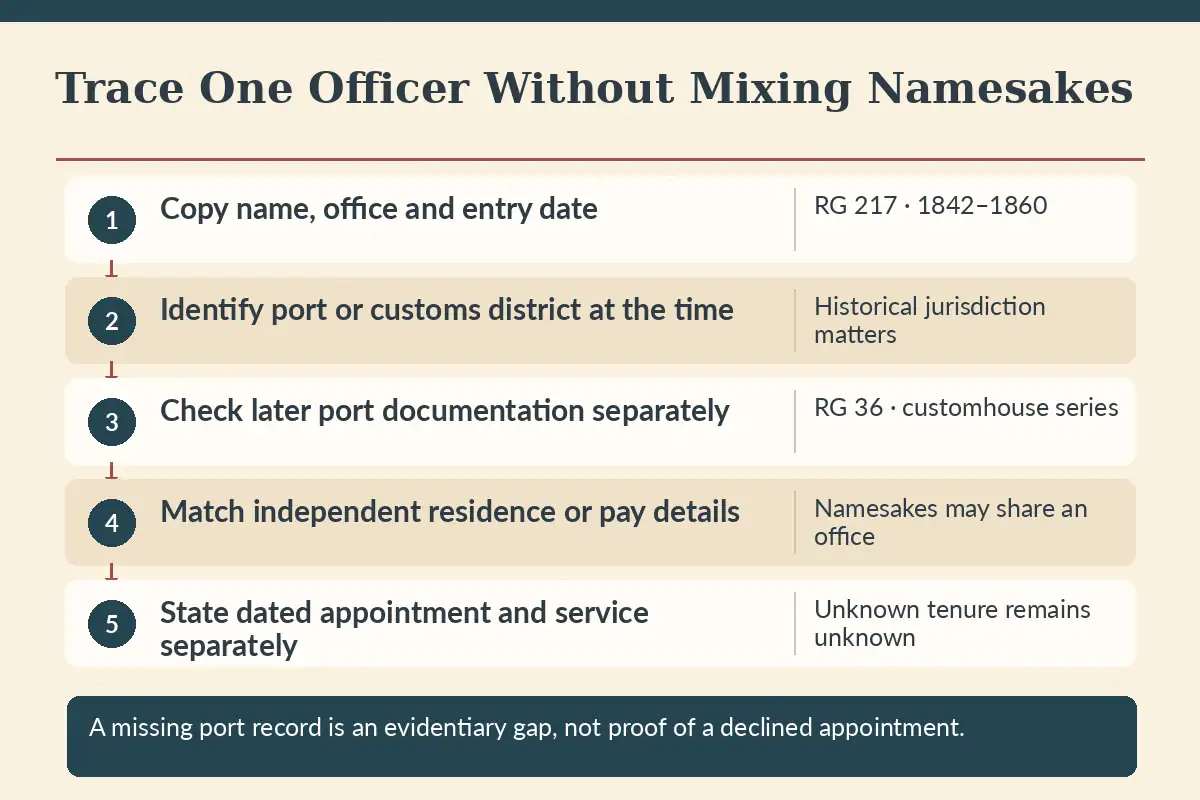
Customs districts and ports did not always correspond to present-day city boundaries. Record the jurisdiction named in the historical document and compare it against contemporary maps or official descriptions. A designation associated with a district may not locate the officer’s home at the main port. Conversely, a person living in a nearby town might have held the office without residing in the customs building.
Build a comparison table using full name or initials, position, appointment date, port, independent residence and evidence of pay or service. Test candidates against census records, directories, local newspapers and estate records, remembering that these sources have their own date and reporting limitations. A name in a directory is evidence about a listing, not a federal appointment.
When two candidates share a surname, reject accidental matches with the same discipline used to accept a match. Compare age, household, occupation and location for contradictions. Keep a reasoned note whenever an entry cannot yet be assigned to your ancestor. The cost of saying “unresolved” is small compared with publishing a long but fabricated official career.
Cite the Register and the Job Separately
A reliable summary could read: “An RG 217 customs appointment register records a named appointment in a stated year. Later service at the proposed port has not yet been confirmed.” If you find RG 36 correspondence or a dated pay record, make it a separate sentence and citation. This structure keeps an administrative act from becoming unsupported proof of continuous employment.
In your final citation include the archive, RG 217, Customs Division, the register’s title and dates, volume or page, and any original reference number. Maintain a second citation for each customhouse record used as corroboration. Your research log should also record incomplete searches, spelling variants and unavailable volumes, because a gap in the archival trail is not evidence that the appointment was refused or the individual never served.
More Records and Archives Guides
How We Research This Historical Record Group
We verified the two distinct RG 217 Customs Division series and their dates directly against NARA section 217.3.2. RG 36 confirms the separate record group for customs working administration and customhouses. The distinction between Treasury appointment tracking and local service evidence is the article’s core source test; these guides do not certify a particular named officer’s full career.
Begin with NARA RG 217, then compare RG 36 Customs Service records and Catalog searching guidance. Our affiliate disclosure is available; no paid record provider is required.
The NARA Guide lists the Customs Division register for 1842–1860.
No. NARA lists the earlier appointment letters as a separate RG 217 series.
Not by itself. Seek dated evidence from the relevant customhouse or payroll series.
NARA describes local customhouse and other Customs Service records under RG 36.
No. Establish residence from appropriate contemporary personal and local sources.