
A Revolutionary War Claim Is Not a Service Record
The National Archives holds Treasury accounting records for Revolutionary War claims long after the war itself. In Record Group 217, the Second Auditor’s records include audit reports dated 1828–1835, vouchers for payments dated 1829–1834, and other registers linked to settlements. Their late dates are not the dates of the veteran’s wartime actions. The records concern later claim administration and payment, not necessarily enlistment, a regiment, a battle, or an approved pension.
A family note reading “paid for Revolutionary service in 1832” is a lead, not a complete identification. First ask what kind of payment or claim it was and which person received it. The claimant, agent, heir, and original service member may occupy different roles. Only the actual record can show which names and capacities are present. Avoid assuming that a surname on a Treasury voucher is the name of the person who fought.
Route the Research by Audit, Claim, or Payment
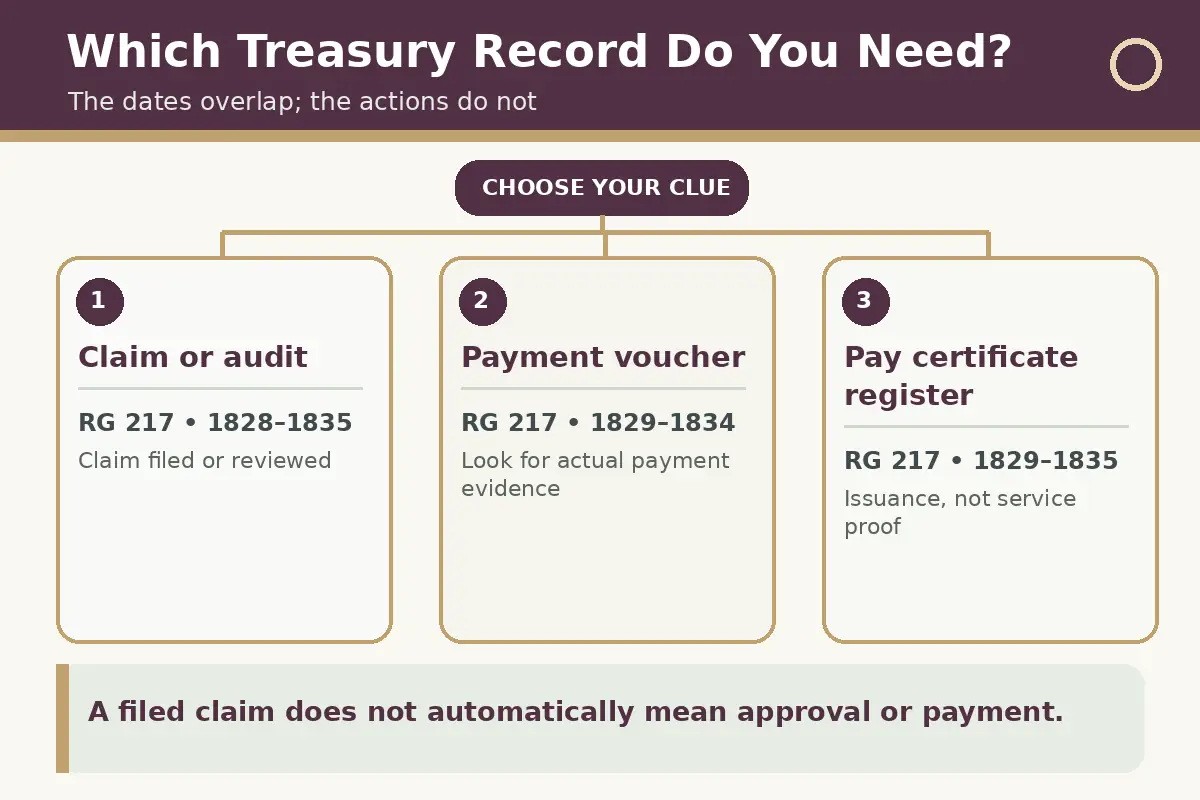
NARA’s section 217.7.3 names several related but distinct record types: audit reports on Revolutionary War claims, 1828–35, with a register; settled accounts for Revolutionary War claims, 1828–31; vouchers for payments of claims, 1829–34, with a register for 1831–34; claims filed by Revolutionary War veterans, 1828–35; and registers of pay certificates issued in settlement, 1829–35. These spans overlap, but they are not one continuous case file.
Start with the document your family actually has. A voucher implies an accounting action; a claim alleges entitlement; an audit describes review; a certificate register may trace issuance. Search the title and series appropriate to that action. Do not infer a payment from a filed claim, or a proven claim from a mere index entry. The original source’s wording determines how far the conclusion can go.
Pay Attention to the Narrow Voucher Dates
A critical fact is that the vouchers NARA identifies run from 1829 to 1834, while the related audit and claim materials have slightly different spans. A claim dated 1835 may belong in the claims or audit descriptions but is outside the published voucher span. A family tradition dated 1818 may need an entirely different accounting record. Treat these ranges as navigation aids rather than claims that every calendar year contains a complete series.
A register can help locate an account or payment, but it is not necessarily a transcript of every voucher. Keep a register reference, claim reference, original voucher reference, and any cross-number separately until you see how the office arranged them. If you cannot establish a link, state that the records are potential matches rather than a reconstructed administrative sequence.
Distinguish the Claimant From the Veteran
A Treasury claim may involve a veteran, a successor, a payee, a representative, or an account settled for another person. The guide does not promise that every voucher identifies those roles. When you obtain an actual page, transcribe the name and any explicit terms such as attorney, executor, or payee rather than translating all names into “soldier.” Compare ages, residence, family relationships, and signatures with independent contemporaneous records.
Where the same common name appears in several Revolutionary-era sources, use an identity grid. Put every record date, county, known relatives, unit only if independently documented, and the specific person-role in separate columns. A payment with a compatible surname is not sufficient to unite two men living in different states. Absence of a unit on a financial record does not show that the service never happened; it only means that record has not proved it.

Keep RG 217 Separate From M804 Pension Files
NARA directs researchers of Revolutionary War service and pensions to separate military service and pension or bounty-land materials, including the M804 pension and bounty-land application files in Record Group 15. That guide has a different evidentiary purpose from the Treasury payment-voucher holdings in RG 217. The same historical person might appear in more than one record system, but finding one does not prove the others exist or are about the same individual.
Use pension testimony to test service or family assertions where appropriate, while checking its own date, witnesses, and limitations. Use the Treasury materials to document a particular claim, review, or payment. If a later pension abstract names a soldier but a Treasury voucher names an executor, do not merge them without a documented connection. Explicitly write “pension application” and “Treasury payment claim” in your notes.
Follow an Audit Without Inventing Approval
An audit report describes an administrative examination and may support a decision if the wording says so. A filed claim, especially one noted in a register, does not automatically imply that the auditor found it valid. Likewise, a payment voucher must be read for what it documents; a draft, authorization, and completed disbursement can be different stages, depending on the record’s actual labels.
Copy the headings and handwritten notations exactly. If the page mentions an amount, identify the currency unit and whether it is claimed, allowed, or recorded as paid. Do not sum amounts across documents without checking for duplicate entries or adjustments. For genealogy, the crucial question is often not the amount but who the office acknowledged and in what legal capacity at a dated moment.
Search the Accounting Series by Office and Date
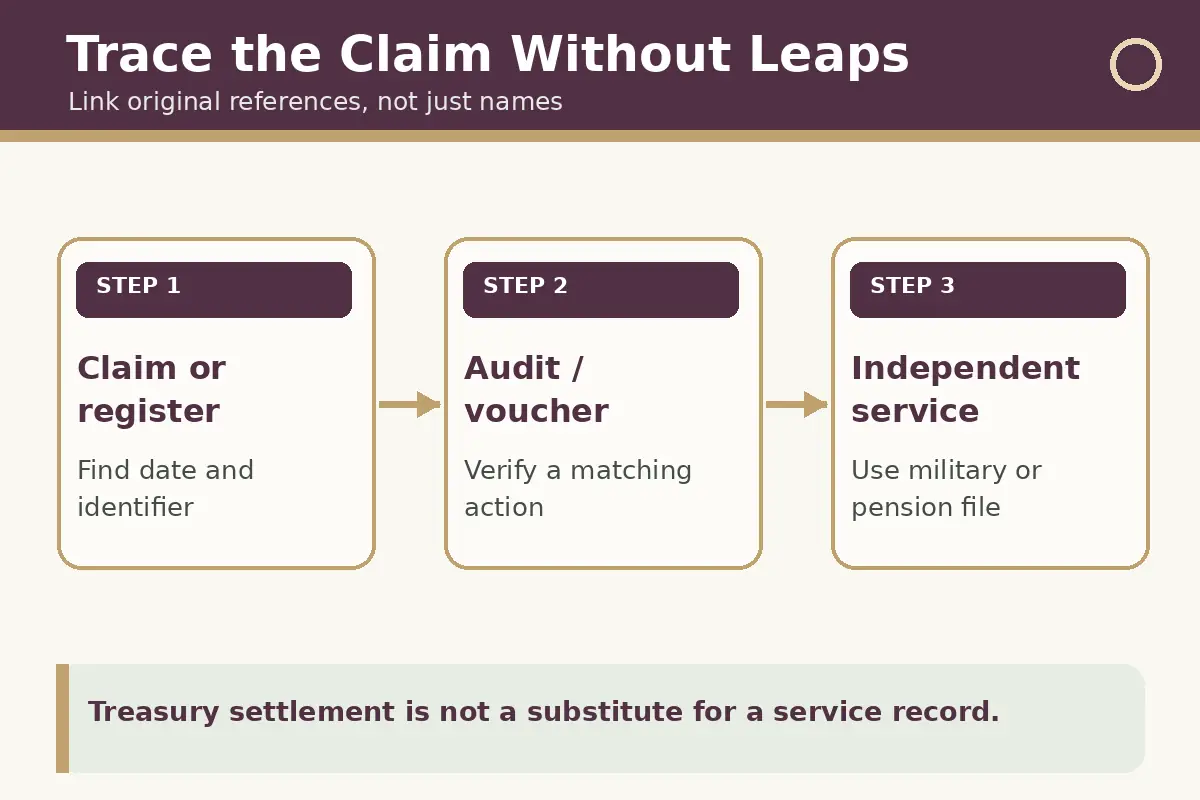
Begin with the NARA RG 217 description for section 217.7.3, the Paymaster, Ordnance, and Medical Division of the Second Auditor. Search for the exact records type, the relevant 1828–1835 period, and any known reference number in the National Archives Catalog. A record-group description may be searchable even if the vouchers themselves have no indexed personal names or public scans.
In a reference request, ask about registers, surviving voucher arrangement, and whether claimant-name searches are possible. Identify whether you need a claim, audit, certificate register, or voucher. Do not request “all Revolutionary War files” without a defined purpose. If the original volume is not online, a useful archival citation and finding aid may be the next concrete result rather than a digital image.
Build a Defensible Claim-to-Payment Timeline
Construct a ledger with one line per original item: record title, date, claimant or payee as written, action recorded, amount only if stated, register number, and repository citation. Connect two lines only where the office cross-references them or independent identifiers make the link credible. If a certificate was issued, describe the issuance; if a voucher is actually marked paid, say what the mark shows. Avoid calling every accounting document a pension payment.
A final summary may establish that a certain person filed a claim in 1831 and that a linked voucher records payment in 1832, if the originals support those facts. It does not, without additional service evidence, establish that person’s regiment, battles, exact relationship to a deceased veteran, or total lifetime entitlement. State unresolved names, ambiguous handwriting, and missing administrative stages openly.
More Records and Archives Guides
How We Research Treasury War Claims
We use NARA RG 217’s stated series and dates as the documentary backbone, then consult the NARA Revolutionary War research guide to separate financial claims from military and pension evidence. No claimant is assigned a unit or family role without a source that states it or a transparent corroboration argument.
The affiliate disclosure documents our editorial policies. A reliable research packet preserves images and exact transcriptions of the claim, audit, register, and voucher, showing the evidence for any connection rather than hiding the connection inside a narrative.
No. They are later Treasury accounting and claim records; the payment-voucher series described by NARA dates to 1829–1834.
No. NARA lists related claim and audit records through 1835, but the voucher series described here ends in 1834.
Not on its own. Test service against separate military or pension evidence such as the relevant NARA service and RG 15 files.
A representative is possible, but do not assume a role. Read the original record for its actual names and capacity statements.
Use NARA RG 217 section 217.7.3 to identify the correct claim or payment series, then ask for finding aids and compare dates and independent identifiers.