
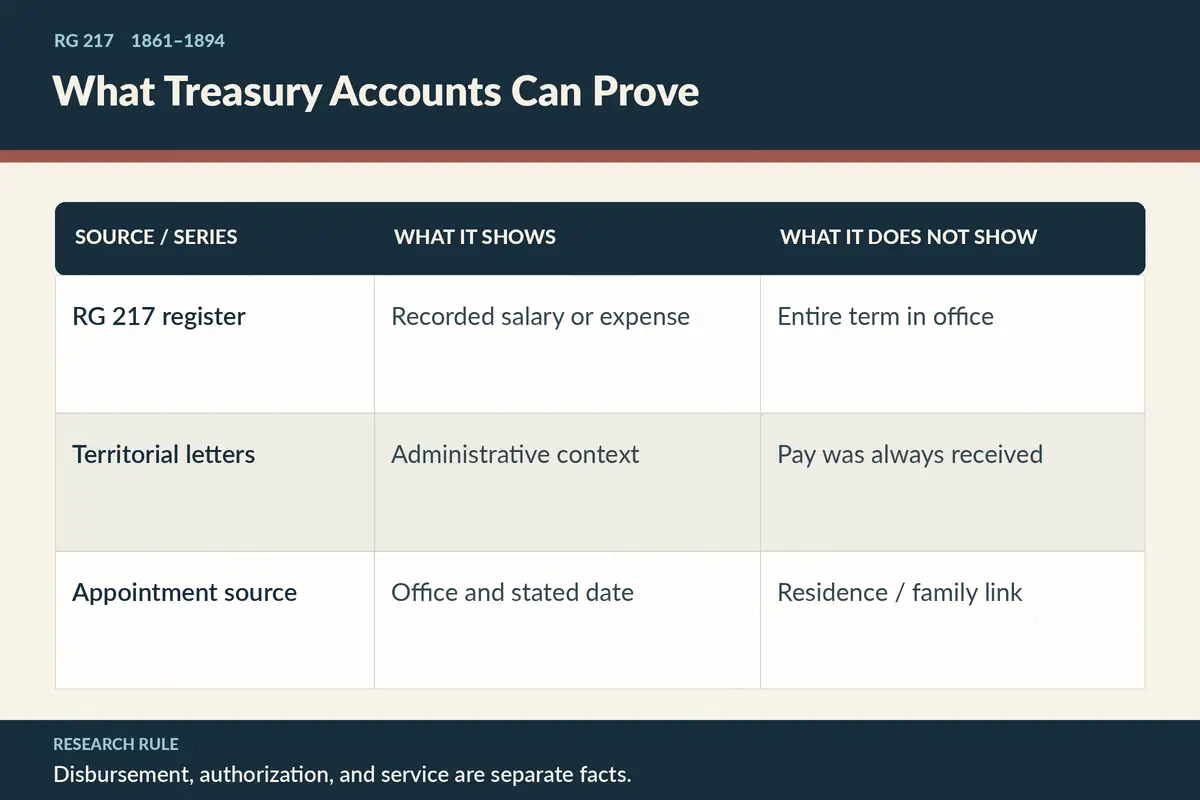
A salary account is a financial record, not a ready-made biography of a territorial officeholder. The National Archives lists registers of accounts for salaries and expenses of territorial officials, 1861–1894, in Record Group 217, within Treasury accounting records. These books can point toward a person, territory, office or period of public expense. They do not necessarily establish the official’s full term, actual day-to-day duties, residence or family relationships.
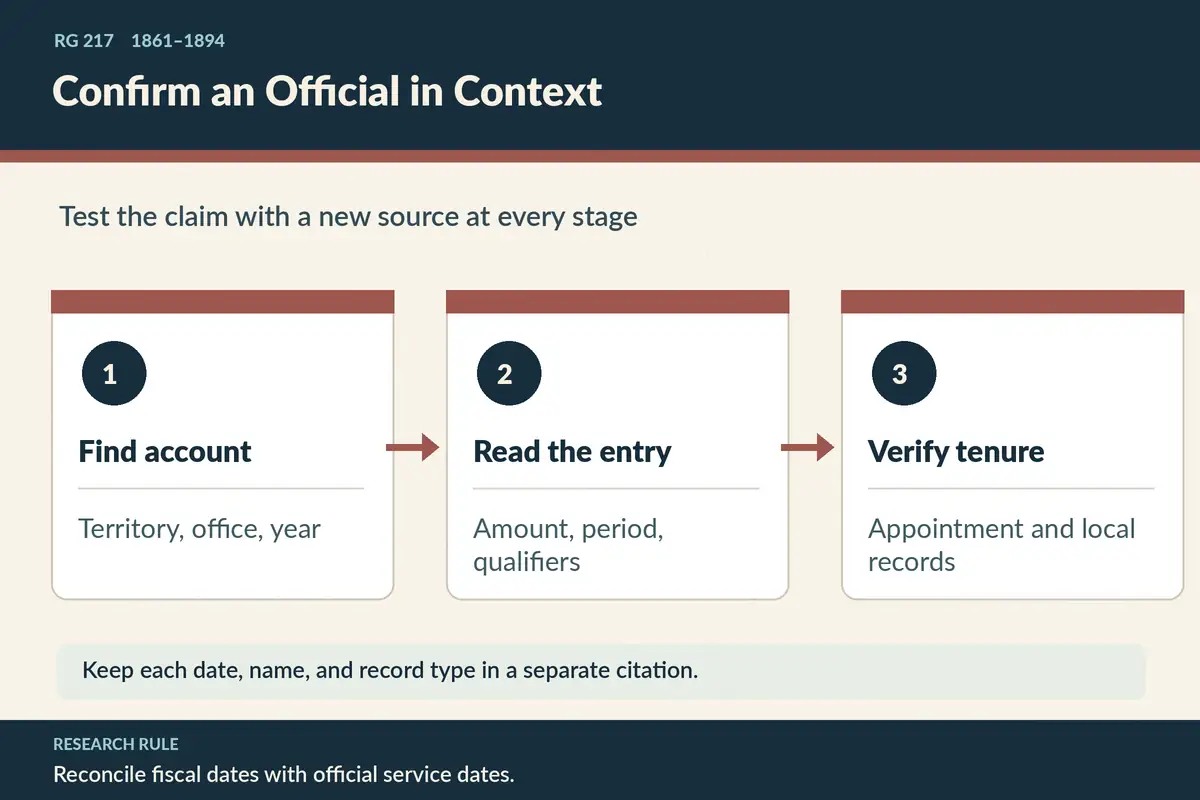
The useful research question is narrower than “Did my ancestor govern a territory?” It asks whether a particular named entry belongs to the person you are researching, what kind of amount or expense it records, and whether a different source documents appointment or service. Treat the account date and the period covered by the account as distinct where the document permits. A later settlement may refer to an earlier period without proving continuous officeholding throughout.
Start in the Division of Territorial Accounts
Section 217.3.9 of the RG 217 guide identifies registers for 1861–1894 as well as related letters sent on territorial expenses dated 1854–1894 and letters received dated 1835–1891. This tells researchers where to begin, but does not promise a complete name index or digitized entries. Search by the division’s title, relevant territory and fiscal document type, then ask whether volume-level descriptions can be consulted.
Identify the historical territory and office precisely. A modern state name may conceal a change in territorial boundaries or the creation of a new jurisdiction. A title such as secretary, marshal or surveyor can belong to different agencies. Do not substitute modern state-government structures for the federal territorial administration described in a nineteenth-century account. Record the exact office wording on the page before interpreting it as a particular appointment.

Read Salary and Expense Entries Separately
A register may combine amounts with administrative categories, but its columns must be interpreted from the actual volume. Copy name, office, territory, accounting period, amount, folio and any cross-reference exactly as given. If the heading says a sum was charged, allowed, or settled, retain that verb; it may have a narrower accounting meaning than “paid to the individual.” Where a page is illegible or a total is ambiguous, preserve the uncertainty rather than calculating a guessed salary.
Expense items may concern travel, supplies, an office’s running costs or other territorial spending, and the person in an entry may be an official, contractor or payee. Do not assume the account contains every paycheck or all the money an official received. An amount recorded against one year could summarize earlier expenses. A register date is evidence of an accounting action, not automatically of the official’s presence at a particular place on that day.
Establish Appointment and Actual Tenure
If the research claim is that a person held an office, look beyond RG 217 for appointment documents, commission registers, territorial government records, official correspondence, and dated directories or newspapers. A nomination, authorization and actual assumption of duties may occur on different dates. The fiscal register may support the relationship of a name to an office, but an appointment document is stronger evidence for formal status. Service ending also requires its own record.
Compare periods carefully. A predecessor could have an account settled after a successor took office, or an official might be reimbursed for travel after leaving the territory. Do not read administrative overlap as concurrent officeholding without an explanation. Keep a three-column timeline: effective appointment, documented activity, and accounting period. If the same name appears in several territorial records, confirm whether it is one official or different namesakes.
Check Namesakes and Geographic Boundaries
Territorial records require particular care when surnames repeat across generations or a family moved between jurisdictions. Match the recorded office and date with a separately verified age, residence, correspondence address or identifiable family relationship. A shared surname and territory is insufficient. Avoid inferring that the official’s spouse or children lived in the territorial capital; an officer could travel, maintain another household or be paid without continuous presence in that location.
Plot the historical jurisdiction for the entry date rather than assuming present-day county borders. If a document names a city, confirm whether it refers to the seat of an agency, place of payment or residence. These meanings may be different. Transcribe historical spelling and titles before normalizing them in explanatory prose. If sources disagree on dates or office descriptions, expose the conflict instead of silently taking the one that best supports a family tradition.
A two-date ledger is especially useful here. In its first date column enter the date written on a Treasury entry; in its second enter the salary or expense period, but only when the document expressly provides one. Add the reported office and territory without changing the historical labels. Compare these entries against a commission date or documented oath from a different source. If a financial item concerns an earlier period, describe it as a retrospective settlement instead of proof that the official was present at the accounting location on the later date. This small distinction prevents fiscal bookkeeping from becoming an invented travel diary or an exaggerated term in office.
Produce a Verifiable Fiscal Citation
A complete citation should identify NARA, RG 217, Division of Territorial Accounts, the exact register series, volume or folio and entry, dates, and catalog or repository details actually confirmed. Do not invent the amount or a clerk’s notation from a general records-guide summary. When a copy is cropped to a single line, retain the original page header and adjacent totals so the meaning of a figure is not lost.
Phrase conclusions to match what has been observed. For example, a register might show an account for a named territorial official in a given period; a separate commission could verify the appointment; a later local directory could support residence. Each proposition needs its own citation. If only the series description is available, the responsible result is an actionable plan for finding a volume, not a fabricated person-level finding.
How We Research the Records and Check Boundaries of Evidence
We used RG 217’s Division of Territorial Accounts description and NARA’s Catalog search guidance. Our approach treats ledger entry, administrative decision, formal appointment, actual service and residence as distinct claims, not a single implied biography. See the affiliate disclosure for editorial context.
More Records and Archives Guides
Frequently Asked Questions About the Records
The NARA guide lists 1861–1894.
No. Compare the actual entry with appointment and tenure documents.
No. Inspect column labels and accounting terminology in the original volume.
Only if a particular entry supplies one; the series description does not promise addresses.
Related territorial correspondence, appointment documents, local directories and contemporary official records.