
A sailor’s name on a Civil War prize list suggests a potential place in a naval prize-money record, not a confirmed payment. The National Archives describes several different Treasury record types under RG 217, Office of the Fourth Auditor: prize lists for 1862–1865, indexes extending through 1873, persons omitted from lists for 1862–1873, certificates of settlement for 1863–1884, and registers of claims paid for 1875–1903. The dates are not interchangeable, and a later payment entry cannot be inferred from an earlier list.
The crucial source is NARA RG 217, section 217.9.5. The Fourth Auditor handled naval accounting, and its Record and Prize Division preserved materials from several stages of claims administration. A genealogist should ask four different questions: was this sailor on a specified prize list, was a claim considered, was it settled, and was it paid? Each question can require a different record.
Begin With the Exact Prize List and Index
Start with a vessel, capture or suspected event date, then search for a matching prize list entry and any contemporary index. The NARA guide dates prize lists to 1862–1865, with indexes covering 1862–1873. Indexing can extend beyond the dates of the underlying lists, so an index date is not the date of the naval engagement. Transcribe vessel names exactly, including spelling variants, and retain the archival reference for the list or account rather than citing a general statement about Civil War prizes.

A name that appears in a prize list may reflect an administrative understanding of eligibility. Do not assume the person was present at every related engagement or that the list is a formal service roll. Compare the list with ship muster or pay records for the relevant period. If two men share initials, the combination of rank, vessel, service dates and subsequent claim documentation matters more than a surname alone. Treat uncertain spelling and missing middle names explicitly.
Understand Omission Lists Before Reporting Absence
NARA separately lists persons omitted from prize lists for 1862–1873. These records offer an important correction path when an expected name is missing, but an omission record is not automatically proof that the person received compensation or even that the claim was approved. Document exactly whether the omission concerns a specific list, a later correction or another administrative stage. The date of the omission record should be reported separately from the underlying naval service.
Do not conclude “he received no prize money” just because an online list omits a surname. The historical records include different vessels, administrative sequences and periods. A person might be listed under a rank or an altered spelling, or a later claim may have been handled outside the searched document. Conversely, finding the person on an omissions list does not guarantee that the correction was eventually accepted. The reliable wording identifies the item searched and its coverage.
Distinguish a Settlement From Disbursement
The Record and Prize Division includes certificates of settlement of prize claims dated 1863–1884 and registers of prize claims paid dated 1875–1903. These are separate evidentiary categories. A certificate may show administrative determination; a payment register is stronger evidence that an amount was recorded as paid. Check whether the named recipient is the claimant, an heir, an attorney or another payee before adding the money to a personal biography.
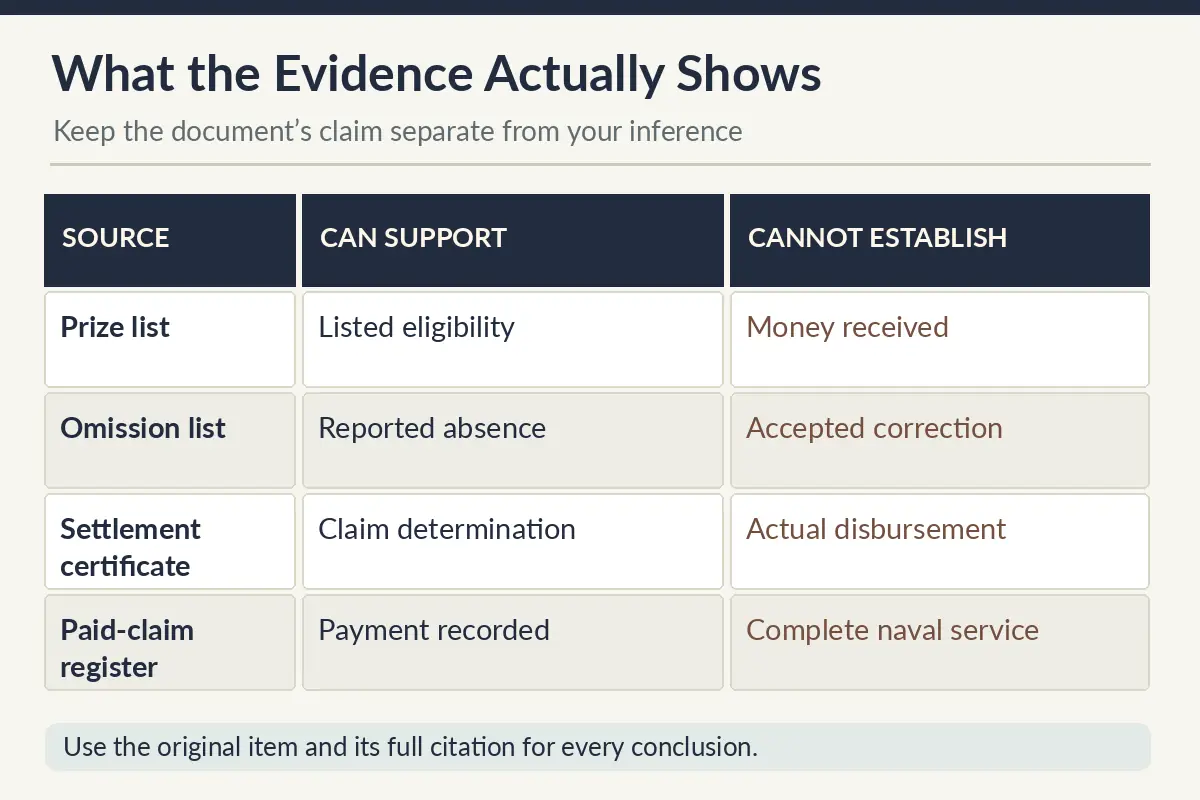
The non-overlapping ends of these series matter. There may be settlements for which a researcher does not find a payment entry in the later registers, and not every payment necessarily corresponds to a surviving certificate accessible through the same name search. Search by claim or settlement identifier if available. Never draw one unbroken arrow from prize list to settlement to payment as though every claimant passed through all stages. The evidence path is conditional at each transition.
Corroborate Service With Naval Records
A prize claim may involve an enlisted sailor, officer, estate or beneficiary. Use a service or muster record to connect the named person to a vessel and the relevant time, then return to the prize account. NARA’s Civil War research guide notes that naval personnel do not have the Army-style compiled service records many researchers expect. Search the appropriate naval muster and pay sources instead of treating an Army index as universal.
For example, “Thomas Kelly” in a prize-money index could match several men serving in the Union Navy. A ship name on the claim, a rank in the muster roll and a date consistent with the list help narrow possibilities. A family letter mentioning prize money can support an identification but should not replace the accounting document. Likewise, a payment to a widow or representative needs direct evidence of that relationship; a shared surname alone cannot establish it.
Record the Amount and Recipient Precisely
If an actual account shows a sum, capture the currency, date, exact payee, and whether the amount is a gross award, settlement, deduction or payment. Modernized dollar equivalences often imply more precision than the source supports. A pencil notation or total on a page may belong to a batch of claims rather than one person. Check the column heading and surrounding entries before transcribing a figure into family-history notes.

It is reasonable to describe a person as “listed for a prize claim” when a named entry supports that statement. “Received prize money” needs a reliable payment record or a contemporaneous receipt. “Served on a captured ship” needs still another source; the context of a prize list may concern the capturing vessel, not the captured property. Keep those relationships distinct even if a family tradition compresses them into one colorful story.
How We Research a Naval Prize Claim
Our evidence ledger contains separate columns for eligibility list, omission or correction, settlement certificate, paid-claim register and independent service record. For each item we retain a complete archival reference and record the type of statement actually made. We do not mark a payment column as verified simply because the sailor appears in a list. When a file lacks dates or identifying attributes, we state that limitation instead of assigning it to a plausible relative.
The RG 217 guide establishes the record categories, not the result of any named family’s claim. Recheck the catalog and reading-room request process for the specific item. The site’s affiliate disclosure applies to linked services where relevant. Preserve the precise spelling of vessel and payee, and explain any difference between the original account and a later published index.
More Records and Archives Guides
Frequently Asked Questions About the Records
NARA lists prize lists for 1862–1865, with associated indexes extending through 1873.
No. An actual payment register or receipt is needed to support a payment claim.
Yes. NARA separately describes omission lists for 1862–1873; examine the specific item.
No. Settlement and payment are different administrative steps recorded in different series.
Do not rely on Army-style compiled records for Navy personnel; use relevant naval muster and accounting records.