
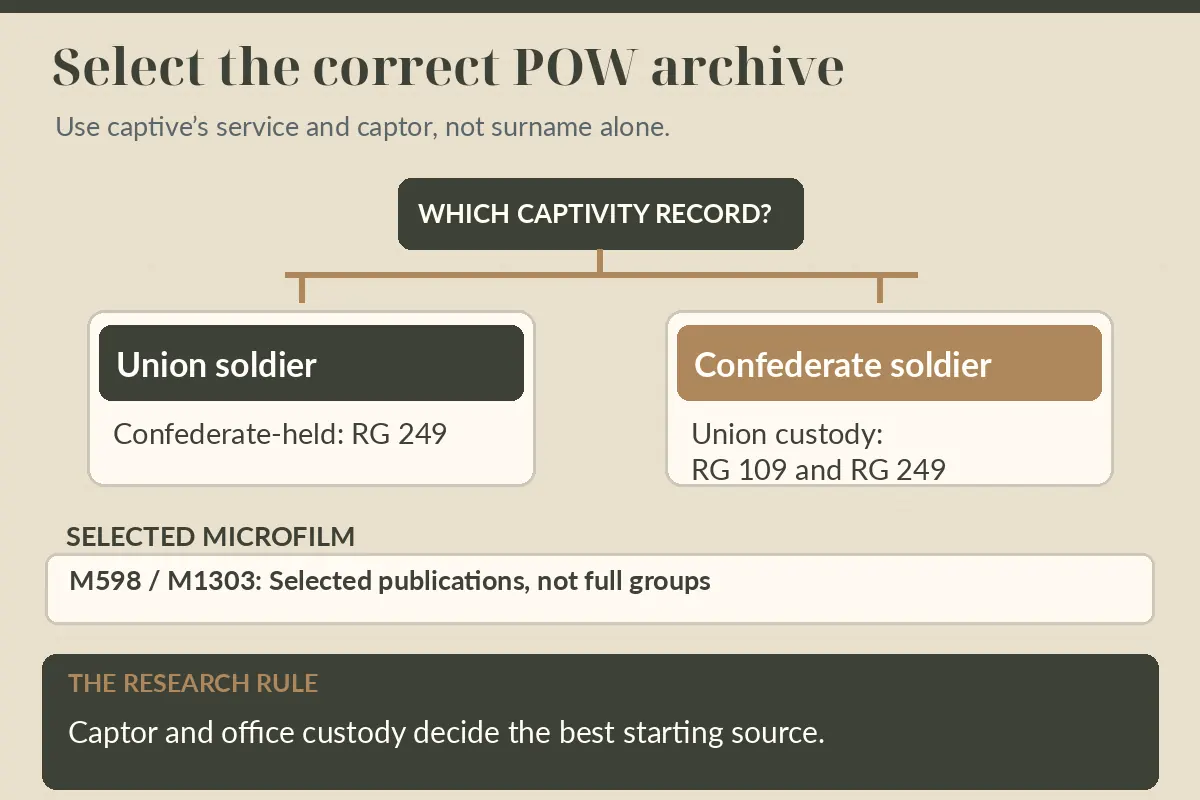
For a Civil War prisoner of war, identify which military authority held the person and the approximate camp and date before choosing an archival record group. NARA’s RG 249 contains extensive records about Union prisoners in Confederate captivity and federal parole-camp administration. RG 109 holds many records of Confederates held in Union prisons, including selected material published as M598; RG 249 also preserves federal administration of Confederate prisoners. The two groups overlap administratively but are not interchangeable surname databases. Start with NARA’s RG 249 guide and RG 109 guide, plus our affiliate disclosure.
Choose the Custodian Before a Prison Name
Before searching, identify the regiment, rank, approximate capture date, side of service, place of capture or known prison from service jackets, pension testimony or family correspondence. Camp names can be repeated, written imprecisely or refer to transfers rather than original confinement. The phrase “at Camp Chase” can identify a Union prison holding Confederates or a federal parole and administrative operation in a different context. Ask whether the item is a list of prisoners held, a release roster, a hospital list, a death register or a bureaucratic exchange register. Each answers a different question.
NARA describes RG 249 as Records of the Commissary General of Prisoners. Its materials include registers, rolls and lists of federal prisoners in Andersonville, Charleston and Richmond, as well as records of parole camps and exchanged prisoners. RG 249 also includes later Prisoner of War Division records with federal prisoner rolls, deaths, hospital entries and records at named Confederate sites. Search by camp and month when the person is not name indexed; a roll may preserve a regiment or status but not a complete personal history. Record the exact subgroup or series title and date band used.
Find Union Captives in RG 249
The historical publication M1303 includes selected Commissary General of Prisoners records relating to federal prisoners at Andersonville. It is a microfilm publication, not synonymous with everything under RG 249. A surviving Andersonville death or burial register can establish that an official recorded a death or interment, but should be compared with later burial and service information when identity or exact date is uncertain. Similarly, a Richmond prison daybook documents an administrative entry rather than all movement before or after that page. Notes about illness or escape require reading surrounding context and distinguishing an observed event from an official report.
Find Confederate Captives in RG 109
RG 109 preserves the War Department Collection of Confederate Records, including records of Confederates in Union prisons. It describes registers and lists of persons received, transferred, escaped, paroled, died, buried, discharged and released. The selected microfilm M598 covers War Department records relating to Confederate prisoners of war, 1861–1865. Do not search M598 expecting the complete RG 249 history of every Union prisoner. If a Confederate soldier is listed in a Union military prison, independently compare service number or unit, rank and capture date to the compiled service record before assigning the prisoner entry to a same-name ancestor.
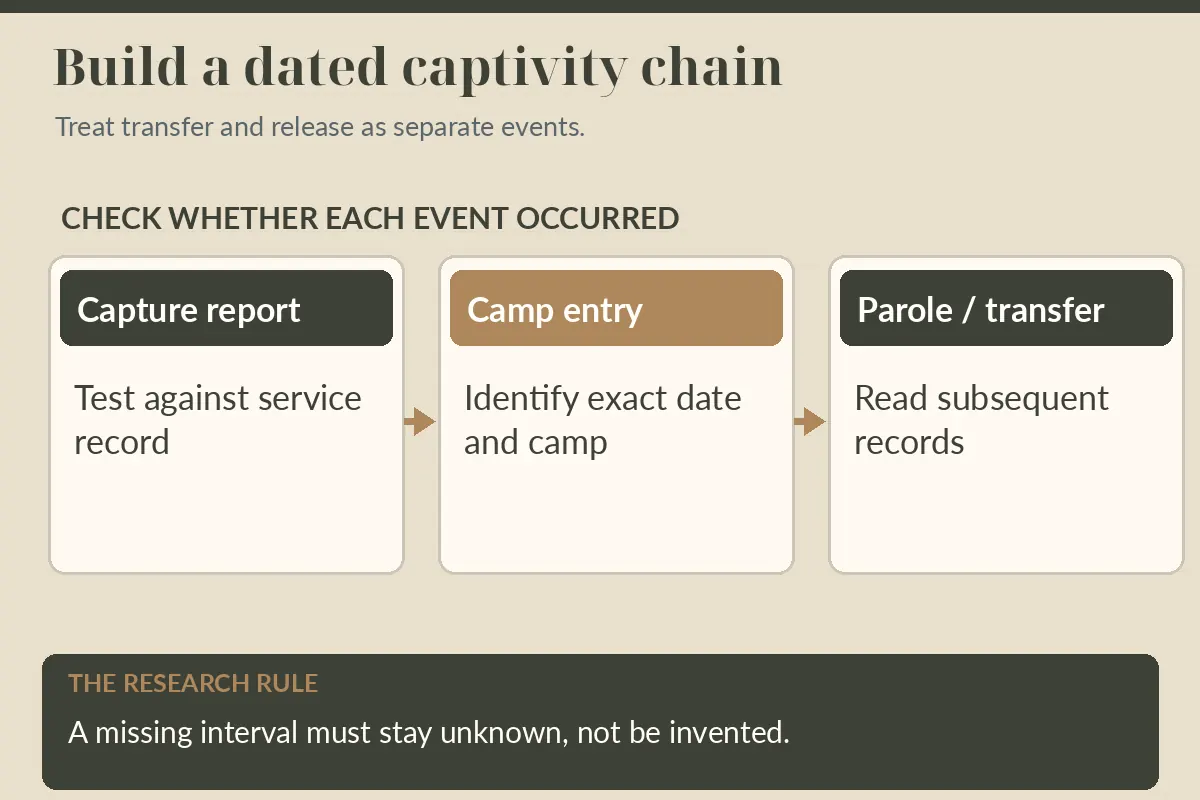
Distinguish capture, receipt at a camp, transfer, parole, exchange, discharge and death. A prisoner could be captured near a battlefield, processed elsewhere and recorded in a third location weeks later. Parole was an administrative condition that did not automatically mean final release from all military obligations, and exchange is a separate process. A roll dated the first day of a month may be a snapshot of persons held rather than the date of every listed individual’s capture. If an officer’s recorded remarks contradict later pension testimony, record both claims and analyze informants, rather than silently replacing one date.
Distinguish Parole From Exchange or Release
RG 249 also holds registers and claims concerning former federal prisoners, including money, lost property and ration commutations; those administrative files should not be mistaken for a complete register of imprisonment. Parole-camp records for Benton Barracks, Camp Chase, Camp Parole and other locations track arrivals and departures after release from Confederate custody. Meanwhile RG 109 includes hospitals, financial registers and correspondence for Confederate detainees under federal custody. The physical camp name alone does not tell you which office created a surviving document. Use the NARA subgroup’s described function and date to locate the right record.
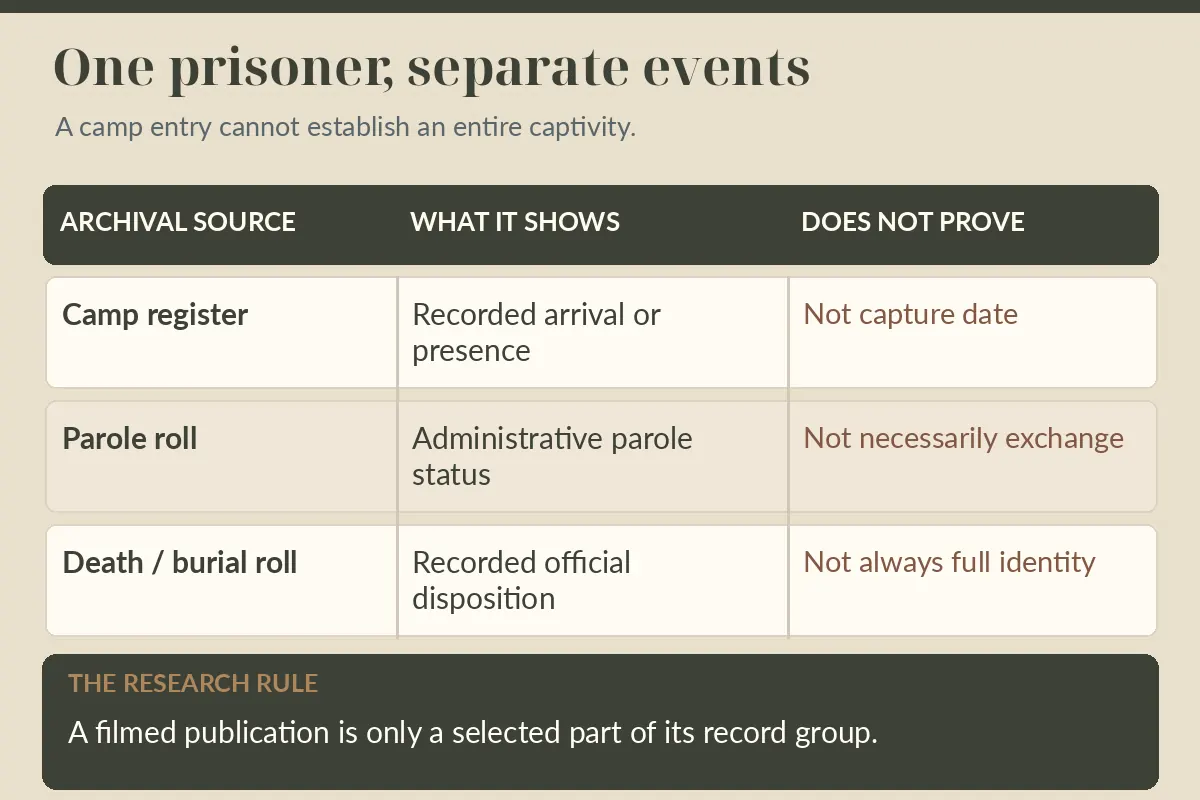
Prison registers may include names, unit details, status, a transfer destination or annotations concerning death or burial. They rarely prove every condition endured, the exact length of captivity or the motives of captors. Records can contain mistaken names, delayed paperwork and officers’ secondhand reports. For an alleged death, seek a death register, cemetery or burial evidence and unit records, allowing for postwar reinterment. For an alleged escape, look for a dated corresponding service or parole entry. Never take the absence of a name from one filmed roll as proof that the person was not captured.
| ARCHIVAL SOURCE | WHAT IT SHOWS | WHAT IT DOES NOT PROVE |
|---|---|---|
| Camp register | Recorded arrival or presence | Not capture date |
| Parole roll | Administrative parole status | Not necessarily exchange |
| Death / burial roll | Recorded official disposition | Not always full identity |
Read Camp Registers and Death Lists Critically
Imagine two fictional soldiers named James Ellis, one serving a Union Illinois regiment and one a Confederate Tennessee regiment. A family document mentions “prison near Richmond.” A name-only search of M598 might produce a Confederate captive but would be a misleading fit for a Union soldier held by the Confederacy. Establish service side and unit independently, then select RG 249 for the federal captive, search Richmond rolls by date, and test any prison entry against service or later pension evidence. If the camp reference lacks a date or unit, keep both hypotheses open until discriminating documents appear.
Create a chronological ledger with “event as recorded,” “date of record,” “custodian,” “person identifiers,” and “independent check.” A prisoner received on July 3 may have been captured in June; do not normalize these to one date. Transfers should name both the departing and receiving institution if either record actually identifies them. A postwar inquiry about a presumed death is different from the underlying death register. When an online index gives a brief event description, open the roll to inspect headings and marginal notes before declaring the exact disposition.
Build a Multi-Event Prisoner Timeline
Cite the National Archives record group, office or subgroup, series title, volume or microfilm publication and roll, camp, recorded date, page and person entry. Add image location and retrieval date. If you reference M598, identify it as a selected RG 109 publication; for M1303 specify the federal prisoner materials it actually contains. Pair a prison entry with unit muster or service-file evidence and preserve conflicting dates in the log. A compelling Civil War story still requires a traceable chain instead of a single unverified list of prisoners bearing a familiar surname.
More Records and Archives Guides
How We Research Civil War Captivity
We use the captivity administrator and person’s service affiliation to choose RG 249 or RG 109, then search the relevant prison and date range rather than treating all filmed lists as one index. We transcribe every arrival, transfer, parole, exchange and disposition separately; an official remark remains a reported event unless corroborated. Our second source is usually the named soldier’s compiled service or pension evidence, with burial records for a claimed death. The outcome is a bounded captivity timeline that preserves gaps instead of inventing continuous imprisonment or a dramatic escape.
RG 249 includes substantial registers and rolls for federal prisoners in Confederate captivity, though other groups may hold related material.
RG 109 includes many War Department records of Confederates in Union custody, with selected material in M598; RG 249 also holds federal camp administration records.
No. It is a selected microfilm publication, not the entire record group.
No. Parole and exchange are distinct military-administrative actions requiring precise records.
No. Coverage, spelling, damaged records and transfers can explain a missing entry.