
To identify a captive in ADM 103, start with the holding depot, nationality and detention date rather than a surname-only hit. These are registers of prisoners in British custody, not a general list of British sailors held overseas. Read our affiliate disclosure.
Find the Holding Place Before the Surname
Begin with the distinction between prisoners taken by Britain and British people taken by an opposing power. The National Archives maintains a guide to prisoners in British hands that points to ADM 103. These registers concern captives kept on prison ships, in depots and in other custody settings.
A broad surname search cannot replace a location-first strategy because no universal named index has been produced for every surviving volume. Assemble a short list of possible holding ports or depots, the war or capture period, the alleged nationality and any ship mentioned in a family account. If none is documented, write those fields as unknown rather than silently assigning a location based on later residence.
Understand Which War and Register Survives
ADM 103 volumes span different eighteenth- and nineteenth-century conflicts; the British record selection guide describes prisoner registers within the broader years 1755–1831. That is a record-series scope, not a guarantee that a person was enumerated in every year. Consult the Discovery catalogue at series or piece level and filter by the earliest and latest documented detention dates.
The Napoleonic-era captives include more than one nationality, while records connected with the War of 1812 must be tested against the appropriate geographical context. The same individual may move from a prison ship to a depot or appear in more than one list. Separate successive custody events instead of interpreting two entries as unrelated namesakes.

Read the Register Heading and Its Columns
Before copying a name, transcribe the volume heading and the original column labels. Depending on the book, entries may describe name, nationality or status, the vessel associated with capture, dates, age, physical appearance, confinement place, and later movement or disposal. The presence of a field in one ADM 103 book does not promise it in another. A description such as “American” reflects a particular clerk and administrative classification rather than a complete nationality history.
Distinguish the date of admission, the date of a transfer and any date of liberation; these events are not interchangeable. Note crossed-out entries, marginal updates, and whether a record appears to be a later copy. An abbreviated index may suppress exactly these qualifications.
Build a Custody Timeline Without Filling Gaps
Write one timeline row per documentary event, with the original spelling and source reference alongside it. If a person appears at a depot in April and a ship register in August, determine whether an actual transfer is recorded or whether the match rests on the surname alone. An entry in a later book might represent recapture, continued detention, a duplicate name, or retrospective accounting.
If a volume carries no outcome column, do not say the captive was released simply because the next page is blank. Compare notices of exchange, parole and repatriation only when they cover the right conflict and person. The chronology should expose gaps so that further research remains possible.
Choose Companion Series for a Missing Entry
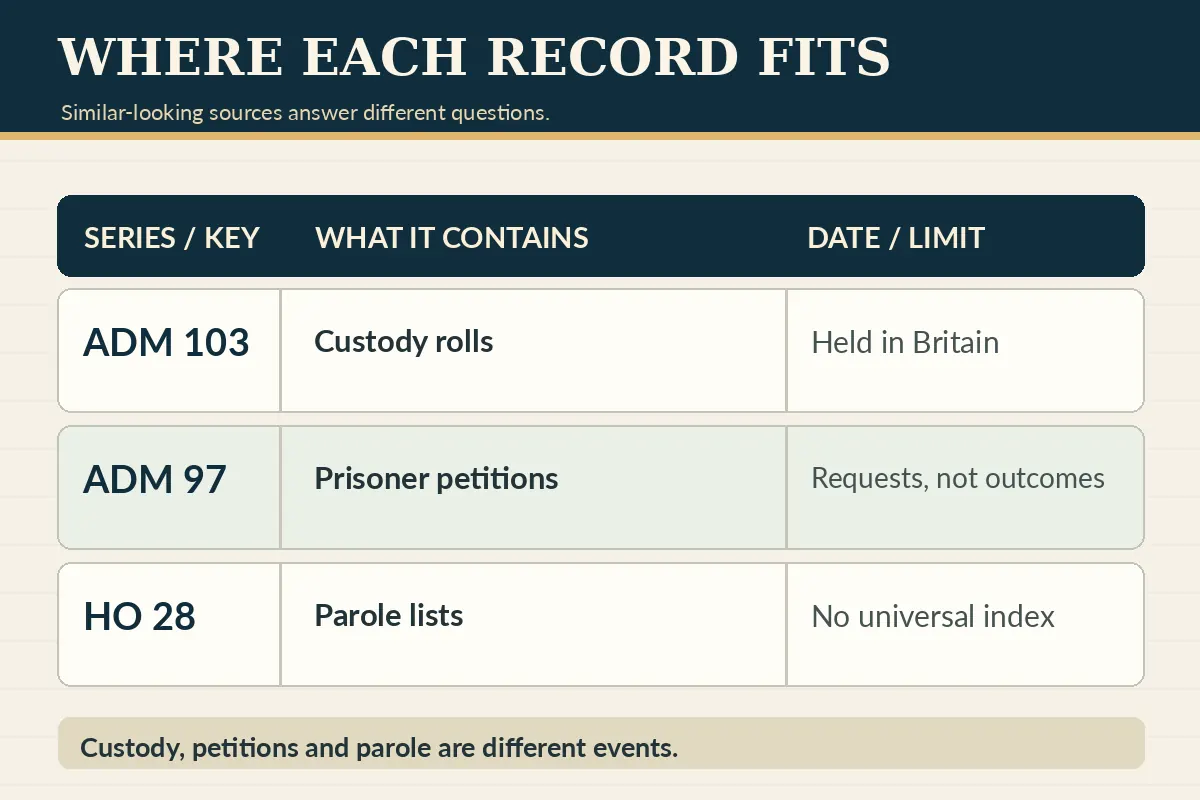
The British-hands guide identifies ADM 97 petitions, ADM 105, and selected exchange records in WO 40 and WO 1 as related pathways. HO 28 contains some lists of enemy prisoners on parole, but is not a universal name index. These sources answer different administrative questions: a petition records a request, an exchange list may document an arrangement, and a prison register records custody.
A request for release does not establish a release; a parole entry does not necessarily indicate unrestricted liberty. Use the listed sources as parallel checks based on what is already known, not as a prescribed sequence in which every prisoner must appear. Record the record-group search terms, date span and negative results.
Test a Possible Identity Across Two People
Consider two fictional men called Jean Martin, one appearing in a Devon depot register and another mentioned aboard a captured ship. Their identical names do not unite their histories. First compare dates, recorded nationality, apparent age, physical description and vessel, then ask whether either entry documents movement between those places. A compatible physical description can strengthen a hypothesis but is not unique personal identification.
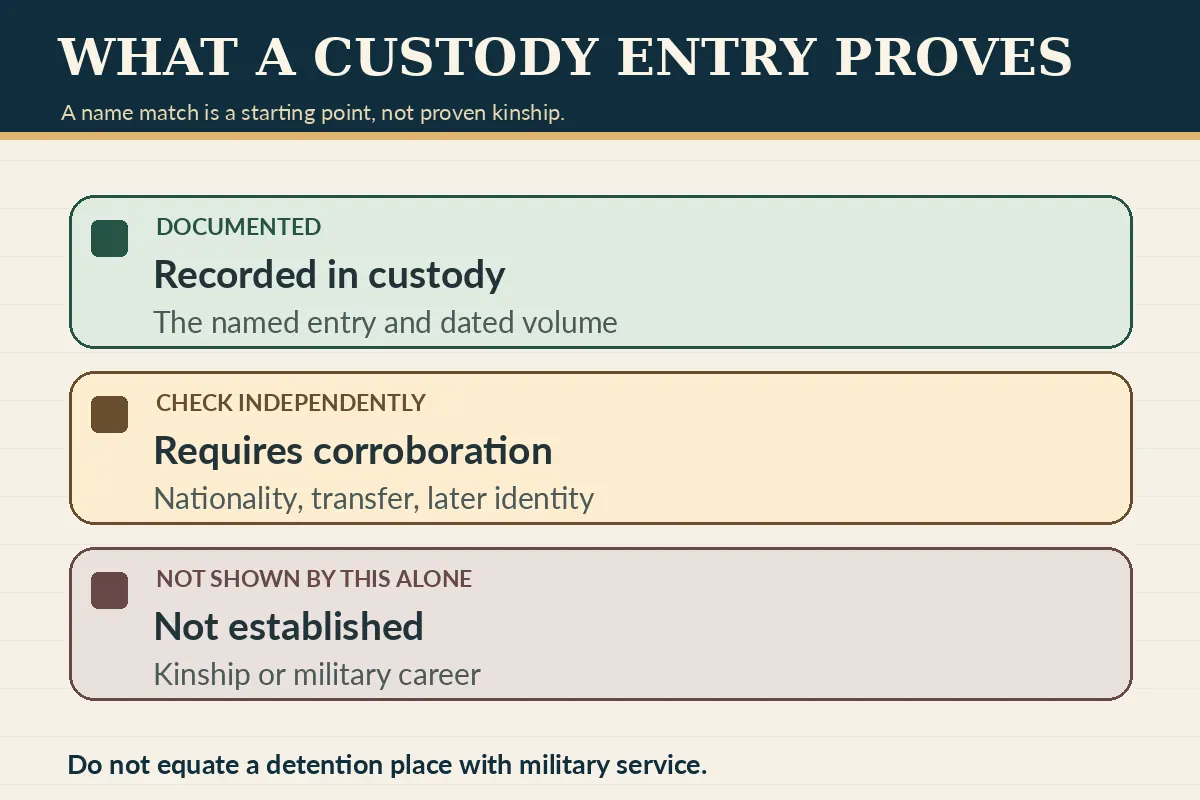
Birth registers, home-port documents and petitions may offer a second independent anchor. If identity cannot be resolved, keep two provisional person profiles and a conflict note. The register proves an entry for a named captive under stated conditions, not marriage, parentage or later immigration.
Plan Access and Write a Reproducible Citation
Search Discovery for the series and relevant locality and date, then inspect the access notice for that individual item. Some selected prisoner-of-war records have partner digitizations, possibly requiring payment; other items may need a visit to Kew or a copy request. Do not imply that a catalogue hit supplies every page as free digital imagery. Cite the exact ADM 103 piece, register title, detention location, page or folio, entry date and the URL or repository used.
Label a transcription derived from an original image differently from a catalogue-only observation. Preserve unusual spellings, because future searches may depend on them. If the first route fails, use the failure log to choose the next holding place rather than declare the prisoner absent.
More Records and Archives Guides
How We Research Custody and Identity Claims
Our method begins with the archival question: who held the person, where, and under what wartime authority? We use the separate guide for British prisoners held abroad when the answer reverses the custody direction. For ADM 103 we record register headings, the piece, names, and literal terminology, then seek a second source that supports an identity claim independently.
We keep three evidence levels: the register’s direct statement, a cross-record identity hypothesis, and a family relationship supported by its own documents. Because survival and indexing vary, a documented negative search never means an entire population was absent. The final research note includes exact pages and unresolved alternatives.
A final check should establish whether a detention name is the same individual appearing in an external record. For example, a place of birth noted in one register might conflict with a later family history, while a ship or capture detail could link a separate petition. Rather than discard inconvenient data, write a side-by-side list of what each clerk personally recorded, what a detained person reported, and what a modern researcher inferred. When a register’s last entry is a transfer notation, follow it only if the destination and next book can be documented. Never read a transfer as a release, or a political prisoner designation as a proven criminal judgment. This controlled method produces a more reliable account than a dramatic narrative based on one record.
No. Registers survive unevenly and no general name index covers every prisoner. Search by locality, nationality and date; an absent name is not proof of non-captivity.
Not as their primary purpose. ADM 103 concerns prisoners in British custody; consult the separate National Archives guidance for British and Commonwealth prisoners held abroad.
Yes, relevant American prisoners may appear in British records. Fix the capture or detention locality and dates first, and check other wartime correspondence where needed.
No. Status, occupation and nationality must be read as recorded and verified elsewhere. A detention location is not equivalent to a naval service posting.
Record the ADM 103 piece, volume heading, page or folio, date, named entry, and the catalogue or access point where you saw it.