
Search the South Australian index to Yatala Labour Prison prisoner registers, then use the volume and register reference to read GRG54/41 itself. The surviving series spans 1854–1931, but the public alphabetical name index described by State Records covers 1854–1921, and the original volumes are subject to a 100-year access rule.
Know the difference between series dates and index dates
State Records of South Australia identifies Yatala Labour Prison’s prisoner register as GRG54/41, running from 1854 to 1931. Its special-list index covers 1854 to 1921 and is organized alphabetically by surname. The prison opened in 1854, yet some entries refer to convictions as early as 1851 because prisoners from Adelaide Gaol were sent to Dry Creek for the new prison’s construction. To go further, our guide “Adelaide Gaol Prisoner Registers, 1848–1912” shows how to find names and verify entries.
These date distinctions are essential to a careful search. Finding no surname in the online index cannot rule out an entry after 1921, an index error, or a different spelling. Equally, a conviction dated 1851 in a later Yatala register does not mean the prison was receiving prisoners in 1851.
Locate the name and retain the volume reference
Begin with the official Yatala index linked from the State Records gaols and prisons guide. Search the surname, known aliases, and spelling variants; note the register or volume number from the hit, any admission or register number and how the name is written. The special-list guidance explains that the index is not the complete original record and that transcription or conversion errors may occur.
Next find the correct digitized unit on FamilySearch when available. State Records lists images for an early unit extending to December 1866 and additional units through December 1904; its special list explains that other volumes may require ordering copies through the archive, possibly for a fee. Verify the actual unit and date range instead of assuming every register page is freely browsable online. Our guide “South Australia Soldier Settlement Records, 1917–1931” shows how to find land files.

Read the entry as a sequence of legal and prison events
The register may record a prisoner’s name and aliases, reception date, origin, conviction date, court, offence, sentence, and eventual discharge. These are separate events. A reception date is not necessarily a trial date; a term of sentence is not proof the full term was served; a discharge notation requires interpretation from the original column and nearby cases.
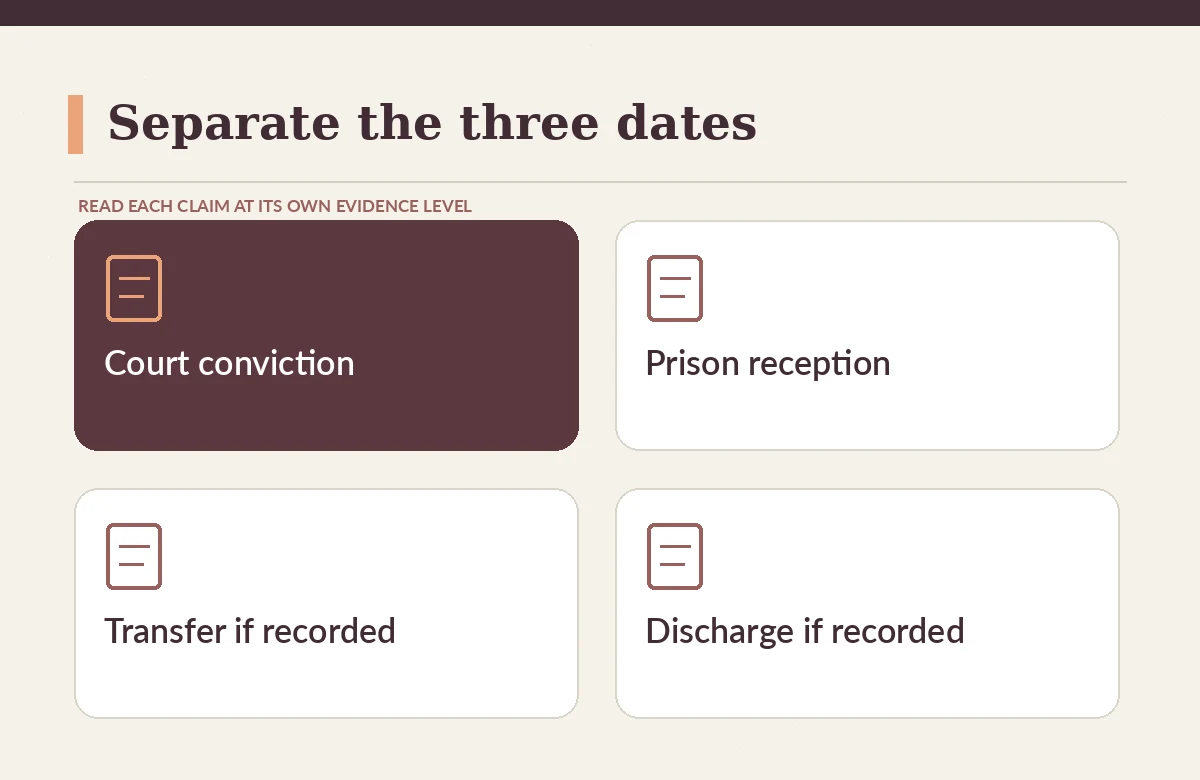
Build a three-date timeline—court action, receipt into the prison, and discharge—and add further transfers or returns where explicitly noted. If one item is missing, leave it blank. For claims about a trial’s findings, seek the relevant court record rather than relying solely on a register summary written for prison administration.
Treat biographical fields as reported information
State Records’ index description lists possible fields including occupation, approximate age, place of origin, arrival in South Australia, ship, employer, contacts, marital status, religion and physical description. Those details can provide rich search clues, but neither the index nor every surviving volume promises to populate every field for every person. Copy headings and wording from the specific entry before turning them into research claims. To go further, our guide “South Australia Destitute Asylum Registers, 1870–1924” shows how to find families.
Use a claimed ship or arrival date to locate original passenger evidence; test a listed “friend” or employer in independent records before assuming kinship. A reported birthplace or age may be inaccurate or secondhand. Record the source and informant uncertainty without using the prison entry as a substitute for civil identity records.
Find the photograph without inventing identity
According to State Records, prisoner photographs are usually included from 1883. “Usually” is not “always”; some entries have none or may be on inaccessible leaves. If a photograph survives, document its register volume, prisoner number, page and date and obey archive reuse and privacy requirements. Do not use visual resemblance as the sole method to identify a family member.
Keep descriptions and images in historical context. Physiognomic language and labels found in colonial justice files can be offensive or misleading today. Quote only what is necessary for a sourced argument; avoid publishing a person’s alleged offence or physical traits simply to make a family profile more dramatic.
Calculate access by the actual record, not the headline year
ArchivesSearch marks the GRG54/41 series partially open and specifies an access determination of open after 100 years. In 2026, records from the later 1920s and 1930s cannot simply be assumed open because the index spans older dates. Confirm the individual unit’s access status with State Records before requesting or sharing it. Our guide “Brisbane Gaol Prison Registers, 1850–1901” adds more detail on this.
The published official index ending in 1921 is a coverage boundary, not a statement that the registers stop there. If you need a post-index admission, use the series catalogue to find a potentially relevant volume and seek repository guidance within the lawful access rules.
| Record or checkpoint | What it supports | What it cannot prove alone |
|---|---|---|
| 1854–1921 alphabetical index | Name and locator to a register | Complete 1854–1931 access |
| Reception or admission date | Entry into prison administration | Date of original conviction |
| Sentence and discharge fields | Recorded legal or prison actions | All events occurred on one day |
| Photograph from 1883 | Possible historical identification clue | Certain kinship from appearance |
Test one name against independent court and family evidence
Suppose an index shows “John Sullivan,” an arrival ship and an occupation, while a family certificate identifies a John Sullivan in Adelaide. Keep the prison candidate separate until place, age, ship, court date or a distinctive identifier converge. A same-name match alone cannot establish that your relative was incarcerated.
Where the conviction is relevant to a biographical claim, find the court proceeding or contemporary report and reconcile it with the prison entry. Distinguish a recorded charge from a court disposition and avoid reading unstated facts into administrative abbreviations. The example is fictional and no specific person is being accused.

Create a citation with index and original layers
For an index hit, cite the State Records special list, the recorded name, GRG54/41 and the reference it provides. For the original register, cite the volume, item, entry or page, prisoner number when present, date and repository, plus the online image locator if used. Note any differences between transcription and original handwriting.
For a missing case, record exactly which surname forms and years you searched, which units are indexed, and any access restriction. Report “not located in the consulted index” instead of “never imprisoned at Yatala,” and do not treat the file as a full account of an individual’s life.
How We Research Yatala Prisoner Registers and Access
This guide was researched using the repository’s published collection descriptions and official finding aids. We compared the specific date spans, item and index identifiers, access directions, and what each type of entry can establish. A catalogue description is not a transcription of every surviving page; verify the individual record against its headings and the archive’s current access conditions before relying on a family conclusion.
The scenarios are illustrative research exercises, not claims about identified historical individuals. We do not insert fictitious names or “sample” historical facts into genuine source transcriptions. Review the citations and any conflicting original evidence before adding a relationship to a public tree.
More Records and Archives Guides
Official Yatala GRG54/41 finding aids and catalogue
State Records SA official Yatala series description and digitized-unit guidance (archives.sa.gov.au).
Official ArchivesSearch GRG54/41 series, date range and 100-year access determination (catalogue.archives.sa.gov.au).
Official special-list guidance on indexed dates, fields, volume reference and image access (archives.sa.gov.au).
Editorial disclosure: This guide contains no paid placement or approved affiliate recommendation. Read the GenHis affiliate disclosure. Archived records can contain offensive historical language, allegations, and information about people or families. Quote accurately, protect living people, and never turn an unverified administrative label into a current medical, legal, or personal judgment.
It is the State Records of South Australia series for the Yatala Labour Prison prisoner registers.
Some people entered the new prison after earlier convictions connected with Adelaide Gaol and Dry Creek work.
No. The official alphabetical special-list index is identified as covering 1854–1921.
No. Photographs usually appear from 1883, but individual records vary.
Not automatically. The series is subject to an open-after-100-years rule; check the unit status.