
South Australia’s soldier settlement research starts with GRG35/320, the record of land held by soldier settlers for 1917–1931. Search the surname index, inspect the relevant register page, and copy the SSS, L&S, DL or A.S. references to reach correspondence and agreements. A recorded allocation is not, on its own, evidence that the settler eventually owned the land.
Start with the soldier settlement register, not a modern title search
State Records of South Australia provides a surname index to GRG35/320, Record of land held by soldier settlers, 1917–1931. It focuses on soldiers returning after the First World War. The underlying registers contain information such as the settler’s name, section and Hundred, acreage, allocation or settlement date, valuation, docket numbers, payment amounts and how the holding was classified.
Before searching, gather a service or discharge record, a likely surname variation, and any South Australian locality associated with the veteran. Do not assume that a person who served in the war necessarily took up settlement land, or that an early allotment remained in the same family for decades. The register tracks one scheme rather than every possible veteran landholding.
Move from alphabetical index to correct page image
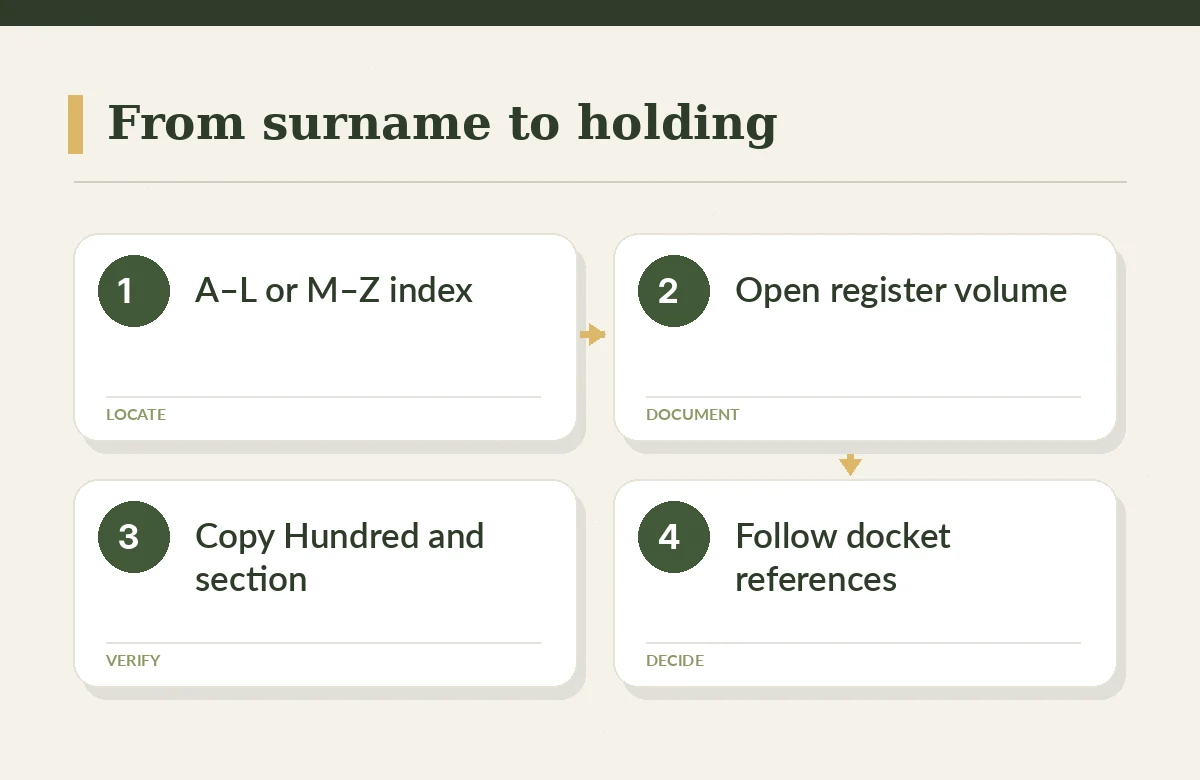
Find the settler in the GRG35/320 A–Z special list and copy the indicated volume and page. State Records explains that Volume 1 holds surnames A–L and Volume 2 M–Z. Open the relevant digitized page from the archive’s official soldier settlement guide or consult it in the Research Centre. A list entry is a navigational pointer, not the entire evidence of tenure.
Compare the page heading, adjacent notations and each date column. Where names have been cross-referenced because a parcel was held by more than one person, keep the relationship between entries explicit. Multiple recorded landholders need not be biological relatives; leases, business arrangements and administrative changes may explain their connection.
Decode SSS, L&S, DL and A.S. docket numbers
The register’s abbreviations are valuable file locators. State Records routes L&S or DL to GRG35/104 Lands and Survey correspondence, SSS to GRG35/176 Superintendent of Soldier Settlement correspondence, and A.S. to GRS/3507 registers of agreements concerning acquired land. Preserve punctuation and docket numbers exactly, including codes recorded in the remarks column.
A single person may have more than one reference. File them as separate research tasks, because a lease agreement, relief request, payment ledger or land-office letter can address different questions. Contact the archive or its Research Centre for the corresponding item if it is not online; the docket number often provides a better starting point than a broad surname search.
Understand the schemes and custody changes
The state scheme began during the First World War; the Department of Agriculture handled it from 1915 to 1919, and responsibility shifted to Lands and Survey in March 1919. As a result, the same settler’s administrative trail may pass between offices. Some Superintendent of Soldier Settlements records were lost in a 1924 office fire, a critical explanation for gaps that no amount of searching can repair.
Other related records include agreements and irrigation perpetual leases. State Records notes that some land transactions remained active in the custody of government land agencies. A missing digitized item may represent an undigitized record, a custody distinction, an access restriction or historical destruction. State which of these is actually documented before interpreting absence.

Separate allocation, payment, lease and ownership
GRG35/320 can show a reported section, acreage, date and valuation, but the legal meaning depends on the tenure described and what happened afterward. A notation of allotment does not prove freehold title; an agreement schedule may show payment obligations or advances rather than completion. For a present property-history claim, trace later title changes and cadastral maps in the correct land registration system.
Treat addresses and Hundred names as historical geography. A Hundred is an administrative land division, not necessarily the name of the farm or nearby town. Use the section number, period map, and register references together. Two people with the same surname in one Hundred may occupy different parcels and should not be merged from locality alone.
Find a veteran without confusing a namesake
Consider a fictional returned soldier “William Harris,” whose regiment and home district are known. The index points to a William Harris in a Hundred where a relative later lived. Record that as a candidate and compare the original register page, dates and scheme correspondence with the soldier’s service identifiers and independently documented postwar address.
If the dates do not line up or the correspondence names a different household, stop rather than forcing a connection. Conversely, a matching docket in an agreement register and a later property transfer could support a continuous land history. The verification rests on a chain of original references, not on one surname in the public index.
| Record or checkpoint | What it supports | What it cannot prove alone |
|---|---|---|
| GRG35/320 | Settler, Hundred, section, date, docket | Final freehold ownership |
| SSS → GRG35/176 | Superintendent correspondence | Complete file despite 1924 losses |
| L&S / DL → GRG35/104 | Lands and Survey letters | Agreement fully discharged |
| A.S. → GRS/3507 | Settlement agreement references | Continuing residence |
Record financial information without inventing personal history
Advance and payment columns describe a financial relationship with the settlement scheme; they do not reveal an individual’s character, success as a farmer, or the reason for difficulties. A request for relief may have a documented cause, but do not substitute modern speculation about a person’s health, finances or wartime experience.
State Records warns that some files include sensitive financial data and may have restrictions of up to 60 years. Check the item-level availability. Some later administrative documents may concern living people or descendants, so share only necessary historic details and respect repository conditions.

Cite the complete land-to-docket route
A reproducible reference should give GRG35/320, the recorded name, volume, page, date, land section and Hundred, and any docket codes. When an SSS, L&S, DL, or A.S. file is consulted, cite that case file separately with its own series and number. Note whether you read the image directly or only a transcription.
For a negative search, record spelling variants, both index volumes if relevant, and any destroyed or restricted series that would be necessary to answer your question. Report the limited search accurately: a failed GRG35/320 surname lookup cannot prove that a veteran never applied for land.
How We Research South Australia Soldier Settlement Dockets
This guide was researched using the repository’s published collection descriptions and official finding aids. We compared the specific date spans, item and index identifiers, access directions, and what each type of entry can establish. A catalogue description is not a transcription of every surviving page; verify the individual record against its headings and the archive’s current access conditions before relying on a family conclusion.
The scenarios are illustrative research exercises, not claims about identified historical individuals. We do not insert fictitious names or “sample” historical facts into genuine source transcriptions. Review the citations and any conflicting original evidence before adding a relationship to a public tree.
More Records and Archives Guides
State Records soldier settlement sources and indexes
State Records of South Australia series scope, government handovers, record gaps, access and docket code routes (archives.sa.gov.au).
Official GRG35/320 special list and instructions for volume, page and docket lookup (archives.sa.gov.au).
State Records SA broader land, government and archival access context (archives.sa.gov.au).
Editorial disclosure: This guide contains no paid placement or approved affiliate recommendation. Read the GenHis affiliate disclosure. Archived records can contain offensive historical language, allegations, and information about people or families. Quote accurately, protect living people, and never turn an unverified administrative label into a current medical, legal, or personal judgment.
The official soldier settler register is indexed for 1917–1931.
Volume 1 covers A–L surnames and Volume 2 covers M–Z, according to the official special list.
It points to Superintendent of Soldier Settlement correspondence, particularly GRG35/176.
No. State Records notes a 1924 fire destroyed some Superintendent of Soldier Settlements material.
No. Follow lease, payment, agreement and later title evidence before making that claim.