
Understand What the Soldiers’ Effects Ledger Measures
If a British soldier died while serving, normal pension-based service files may not have been retained. The National Archives identifies a distinct source: soldiers’ effects ledgers in WO 25/3475–3501 for 1862–1881. These records document money owed and paid in connection with a soldier’s death. Despite their title, the ledgers do not list the soldier’s actual possessions such as uniforms, photographs or watches. Searching them as probate inventories would misread the purpose of the series.
The official guide says typical ledger details include the soldier’s name, regimental number, date and sometimes place of death, next of kin and sums paid. Treat those as possible fields, not a guarantee that every surviving entry is equally detailed. The question “Who received money after this soldier died?” is distinct from “Who inherited all his property?” or “Who lived in his household?” An administrative payment is one element of a family-history investigation, not a complete pedigree.
Begin with an estimated death year and a likely regiment or service number. Before assuming that an entry with the right surname is your ancestor, compare date, unit and number against independent military information. A payment applicant or named next of kin may not be the only relative. A “next of kin” designation in an Army payment process must not automatically become a spouse or a proven parent-child relationship in your family tree.
Use the Index Pieces Before the Payment Ledger
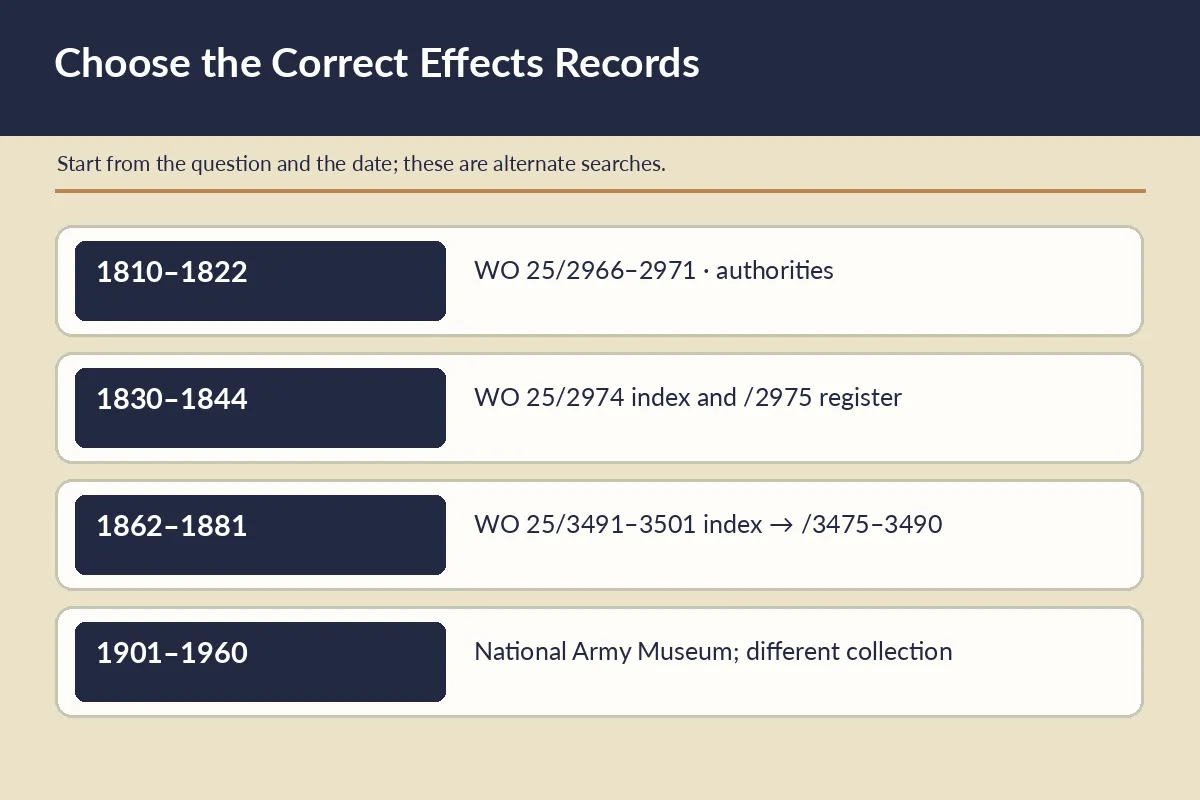
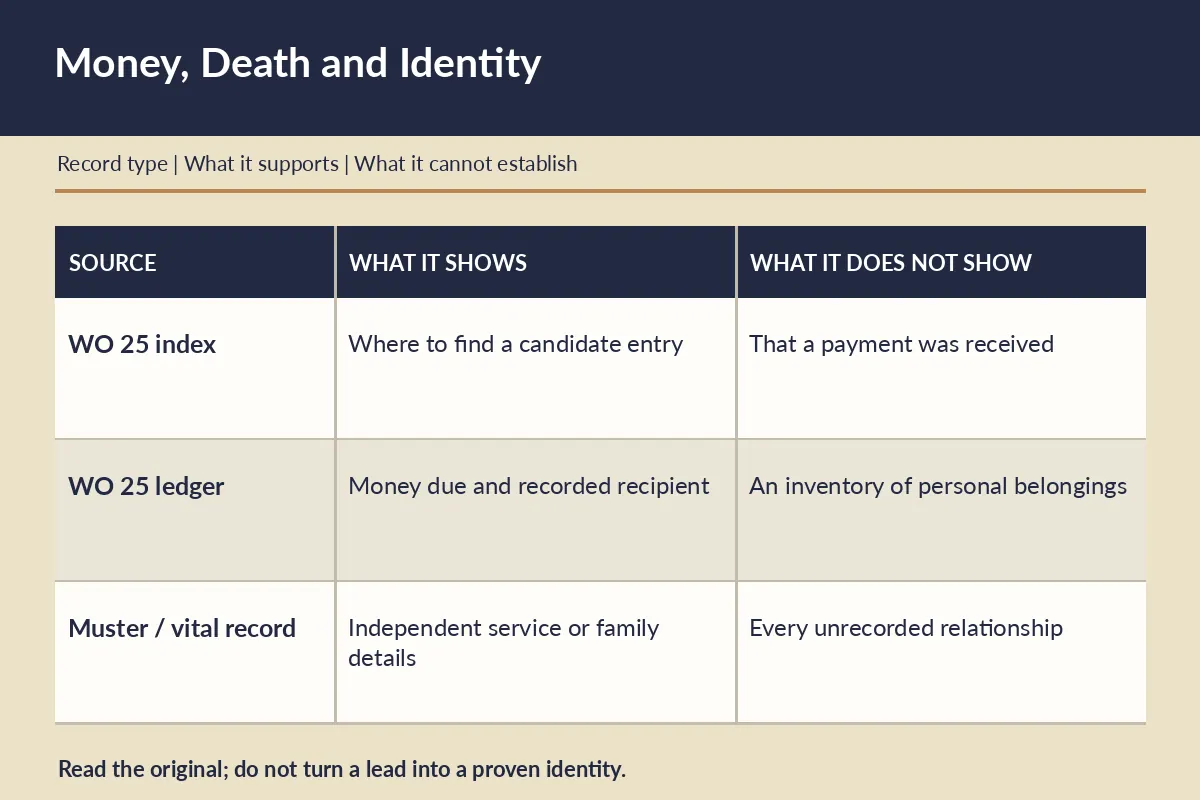
The National Archives expressly distinguishes two sets inside WO 25/3475–3501: WO 25/3475–3490 are the ledgers, and WO 25/3491–3501 are indexes to those ledgers. Those are not equivalent documents. Start with the appropriate index where it helps locate a candidate and carry its reference into the ledger entry itself. A surname in an index is a pointer to evidence, not the full payment account.
Retain the page, entry, regiment and any amount as written. An index may help narrow multiple candidates with the same name, but it is the ledger that must be examined for the actual transaction and recipient. A researcher who quotes only an index and then describes payment details is claiming more than the consulted source supports. Use a two-stage citation: first where the name was found, then the exact ledger piece and entry.
Coverage is specifically 1862–1881 for these ledgers. For another death period, do not stretch these piece numbers into a fictitious universal archive. The same official guide points to earlier authorities for effects in WO 25/2966–2971 for 1810–1822, an 1830 index in WO 25/2974, and a register in WO 25/2975 for 1830–1844. These are different classes of source with different likely detail.
Read the Payment and the Relationship Separately
A ledger may identify the person applying for money, an amount or the date of payment. A named applicant is not automatically the person’s legal heir in every sense or the soldier’s sole close relative. If a family story says a woman received the money because she was the widow, check the actual relationship notation, and then verify a marriage independently. Financial administration and kinship proof answer different questions.
Distinguish “sum owed,” “sum ordered,” and “sum shown as paid” when the original headings permit that distinction. An accounting reference may document an authorization without proving who physically received funds. Do not translate a sum into a personal salary or pension unless a separate record defines it that way. Copy monetary units, dates, names and any notes exactly, including deletions and corrections, since an amended entry can change the meaning.
An effects entry may supply a death date that is useful for locating a separate death or burial record, but it should not automatically override a contemporaneous service return or civil certificate. Different documents can report death, official notification and accounting processing at different times. Your research log should preserve those dates in separate columns. If they disagree, inspect the provenance of each record before forming a single timeline.
Route Cases Outside the 1862–1881 Window
For deaths before the WO 25 ledger window, read the records that match the time and the actual administrative process. The 1810–1822 authorities to deal with effects may give the regiment, period of death, agent and applicant’s address. That differs from the 1862–1881 payment ledgers. A record of an agent’s authorization does not prove the ultimate receipt of money without further evidence.
The National Archives also points to soldiers’ effects records for April 1901–March 1960 held by the National Army Museum; the 1901–1929 portion is available through Ancestry, while the later portion requires contacting the museum. These are a different holding and access path, not a continuation to be ordered as WO 25/3475–3501. Preserve the repository and series distinction so a reader does not waste time ordering the wrong collection.
If no effects record is located, do not infer that a soldier never died in service, had no family or left no money. Some registers are incomplete and names may be indexed inconsistently. Search alternative surname spellings and compare the regiment and date. Related unit records or independent certificates may clarify the event even when the financial entry cannot be found.

Corroborate a Soldier Without Inventing a Family Link
Imagine a hypothetical ledger entry for “Private John Lewis” in 1874 with a payment to “M. Lewis.” This is an illustrative placeholder, not a quoted historical record. Before assigning this to a family, locate a unit muster or other soldier-level record with his regimental number and plausible dates. Find independent evidence of his death and establish who M. Lewis was. An initial alone cannot prove that the recipient was the spouse named in a later family tree.
Write an evidence ledger with separate rows for soldier identity, death, sum due, sum paid, recipient’s name, relationship and next source. In each row indicate whether the ledger actually states the fact or whether it is an inference awaiting proof. If the date or number conflicts with another soldier of the same name, keep both candidates open. One payment entry is too narrow a source to support a complete military career or the entire household.
A safe conclusion might say “A WO 25 ledger reports a payment associated with a soldier of this name and number.” A stronger conclusion about a named ancestor requires a matching regimental record and family link. Include the repository, exact piece, page or entry, and date in the citation, with a clear statement of what has not yet been shown. A concise unresolved question often guides better research than a premature genealogical claim.
More Records and Archives Guides
How We Research and Cite These Records
This guide uses the National Archives research guidance for the principal series, date ranges and retrieval workflow. The second archival guide supplies comparative context and cautions about record type or personal interpretation. We distinguish a finding aid from an original record, a dated institutional statement from an individual event, and a plausible identity from a proved one. We have not examined any particular family’s archival file or claimed that an illustrative example identifies a real ancestor.
For a reusable citation, record the institution, full series and piece number, item or folio if available, original document date, creator, database or catalog consulted and access date. Quote uncertain names exactly and keep a separate transcription of the document from your conclusion. An online summary may be narrower than the original and a register can point to a document that requires reading-room consultation; verify access options with the repository before ordering copies.
Before following a commercial research recommendation, review our affiliate disclosure. No paid partner or purchase is necessary for the reasoning in this guide. The next practical action is to test one named question against the specific original source, preserve the result whether positive or negative, and identify the independent record needed to confirm the conclusion.
No. The 1862–1881 ledgers primarily describe money owed to soldiers who died in service, not personal items.
WO 25/3491–3501 are indexes to the ledgers in WO 25/3475–3490.
Not necessarily. Confirm relationship language in the source and corroborate with independent family records.
The National Army Museum holds a series for April 1901–March 1960; the 1901–1929 part is available on Ancestry.
Use earlier records such as WO 25/2975 for 1830–1844 instead of the 1862–1881 ledgers.