
WO 25/3956 contains recommendations for appointments of staff nurses to Queen Alexandra’s Imperial Military Nursing Service (QAIMNS), covering 1903–1926 in The National Archives’ guide. Such a recommendation may preserve valuable personal and training clues—date of birth, father’s occupation, education, nursing experience, references and the appointment given—but it should not be read as a complete record of every wartime hospital posting. The essential distinction is between applying or being recommended, receiving an appointment, and actually serving at a named establishment. The archive explicitly separates this series from wartime medical treatment sheets, pension registers and medal cards. This article builds a traceable nursing-career evidence chain.
Identify the Correct Nursing Organization
Start by recording the exact nursing service in a family letter, medal index, hospital notice, or contemporary press report. QAIMNS, Territorial Force Nursing Service, Voluntary Aid Detachment and local civilian hospital roles were not interchangeable. The National Archives’ British Army nurses research guide lists appointment recommendations for QAIMNS staff nurses in WO 25/3956, but the wider nursing records include other organizations and service periods. A woman described only as a ‘war nurse’ may require several searches. Avoid assigning a specific corps because her family remembered a khaki or white uniform.
Write a dated affiliation note containing the name as recorded, hospital or unit if known, approximate age and evidence for the organization. Do not presume that a recommendation for a QAIMNS post meant the woman served overseas or at a casualty clearing station. A nursing candidate could have training in one city and service elsewhere. If no applicant is located in this series, check surname variants and the actual organization before using absence as negative evidence. Keep training credentials distinct from military status.
Read the Recommendation’s Original Fields
The National Archives explicitly lists the possible particulars in WO 25/3956: date of birth; father’s occupation; single or widowed status; education; hospitals and dates of nursing training; later professional experience; matron’s reference; and an appointment given. These fields make the record an unusually useful career clue, but not every item should be assumed complete or correct. Transcribe the source’s questions, answers and signatures separately. Distinguish a candidate’s declaration from a matron’s evaluation and an official appointment notation.
A named referee, hospital matron or father can direct the next genealogical search. However, a father’s stated occupation is a reported fact and does not establish the correct birth registration of a woman with a common name. Dates of training may reflect an asserted period of study rather than an employment contract. Likewise a reference saying a candidate was suitable for a role does not certify that she accepted it. If an ‘appointment given’ entry appears, copy its exact wording and date, then corroborate any later movement from another original source.
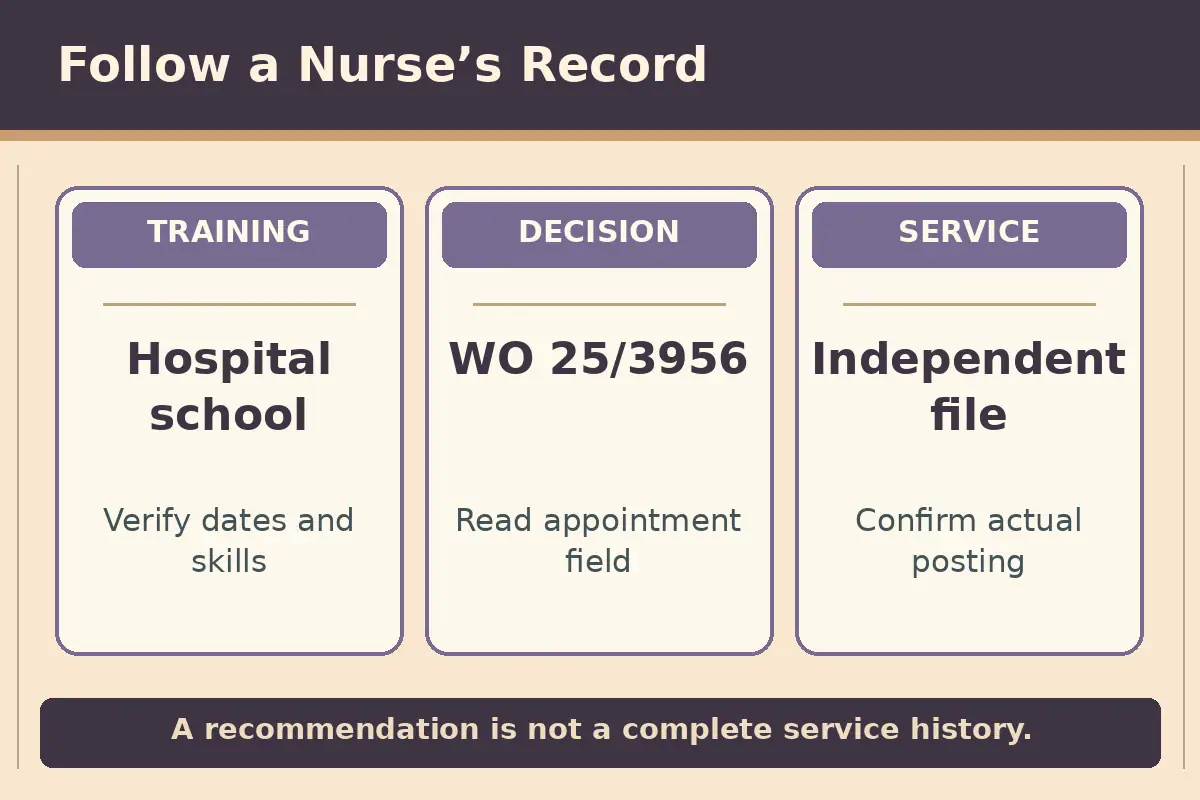
Separate Training, Appointment and Service
Build three evidence columns: TRAINING (institution, dates, qualification), APPOINTMENT (office decision and date) and SERVICE (actual postings or hospital records). The National Archives organizes nursing sources by their administrative purpose. WO 25/3956 concerns appointments, while parts of WO 25/3955 hold earlier seniority or service material and WO 23 provides some later retirement and pension-related entries. No single one of those categories supplies a universal end-to-end biography. Examine whether another surviving original explicitly lists service dates rather than supplying them from an obituary.
A nurse might hold several civilian posts before entering an army service. Do not treat all hospitals on her training form as wartime military stations. When a recommendation describes education and references, capture those as clues to archives in the relevant cities. Read the job title used at the time: staff nurse, sister or matron can have distinct administrative meanings. A unit-level hospital history may establish where an institution operated but not that the candidate was present every day of its deployment.
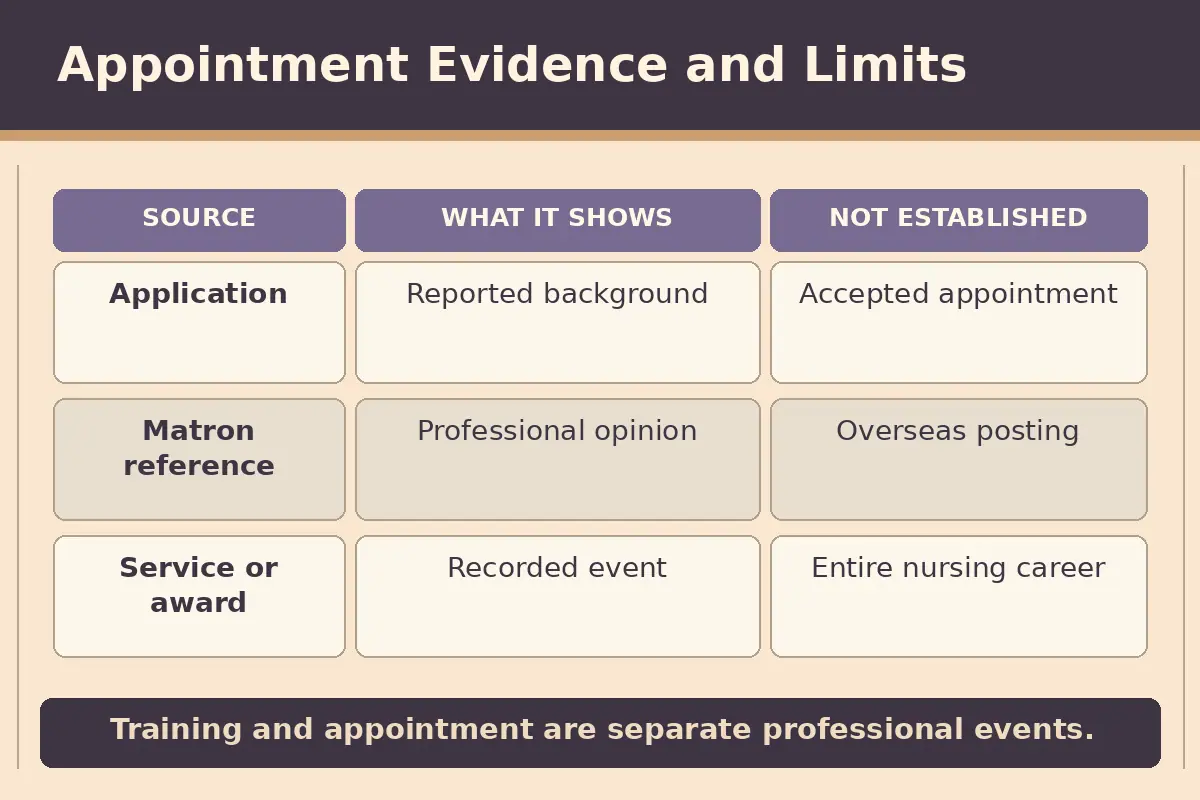
Use Independent Medical and Award Records Carefully
Selected First World War medical sheets for women’s services, including nurses and Voluntary Aid Detachment workers, are in MH 106/2207–2211 according to The National Archives. This is a different purpose from appointment paperwork, and its survival is selective. A treatment entry might confirm a date or rank but should not be treated as a full career log. The nursing guide also identifies Royal Red Cross awards in WO 145; an honor or medal entry can show that an award was made, but awards were not given to all who served.
For pension or later career questions, the archive directs researchers to PMG 34 and PMG 42 for specified QAIMNS records and to other nursing-related registers. Match the same woman’s name, birth date where available, rank and actual appointments across independent records. A common name in an award roll is not enough for identity. Many wartime women worked without appearing in the same series as regular trained military nurses. Make a separate list of untested sources rather than combining incompatible record descriptions into a single imaginary personal dossier.
Account for Access and Historical Terminology
The National Archives describes WO 25/3956 as not available online in its guide, so a Discovery reference may identify a document that still requires a Kew visit or permitted reproduction request. Verify each piece’s current availability before implying a downloadable image exists. Include the exact original reference and part, year, page, candidate’s name and form title in a citation. When the catalogue provides only a short description, do not silently fill in personal facts from the description of possible fields.
Historic forms may use marital-status or profession terms unfamiliar today. Transcribe them as written, and clarify the period vocabulary without exaggerating what it proves about family life. The name of a hospital may have changed, merged or moved; search its historical institution rather than only the modern building. If an application lacks a signature or a dated appointment, label the missing evidence rather than deducing acceptance. A sensible conclusion can be ‘recommended, later service unverified’ until a second record confirms the next step.

More Records and Archives Guides
How We Research an Army Nurse’s Career
We first establish the nursing organization, then inspect WO 25/3956 for any actual recommendation. Every identified candidate is analyzed through the fields supplied on the original form, with a clear distinction between personal declaration, reference and official appointment. A second stage tests service through appropriate records, not a speculative assignment to a famous hospital. When name evidence conflicts, we retain alternative candidates and search independent civil registrations or local nursing school archives rather than choosing the best-looking online tree.
The National Archives’ British Army nurses guide identifies the dates, fields and access arrangements for WO 25/3956 and related series. Its Army soldiers guide provides useful context for distinguishing Army personnel series from women’s nursing records, but is not a nurse identity index. We document every original, unresolved posting and gap in coverage. The GenHis affiliate disclosure explains links; no subscription service is a substitute for checking a source.
No. It is specifically a set of QAIMNS staff nurse appointment recommendations, not all nursing organizations.
Depending on the item, it may show birth date, father’s occupation, training, references and an appointment.
No. A recommendation concerns suitability and experience; separate posting evidence is needed.
The TNA research guide describes the set as not available online; check current piece access at the archive.
No. Medals and awards can support specific entitlements but are not complete career histories.