
State Papers Domestic for Charles II can reveal petitions, official letters, warrants, licences and contemporary government reports that mention individuals otherwise difficult to trace. For 1660–1685, the central correspondence is largely in SP 29, while many warrants and related case papers from 1660–1688 are in SP 30. These are not name-indexed family registers. The National Archives warns that Discovery normally searches these papers by date; the productive route starts in the published Calendar of State Papers Domestic, identifies the calendar’s original reference system, and then checks the actual archival document. A person’s name in an abstract can mean applicant, correspondent, target of investigation, or someone simply mentioned—none automatically proves family connection or a favorable official decision.
Start with the Calendar, Not a Blind Name Search
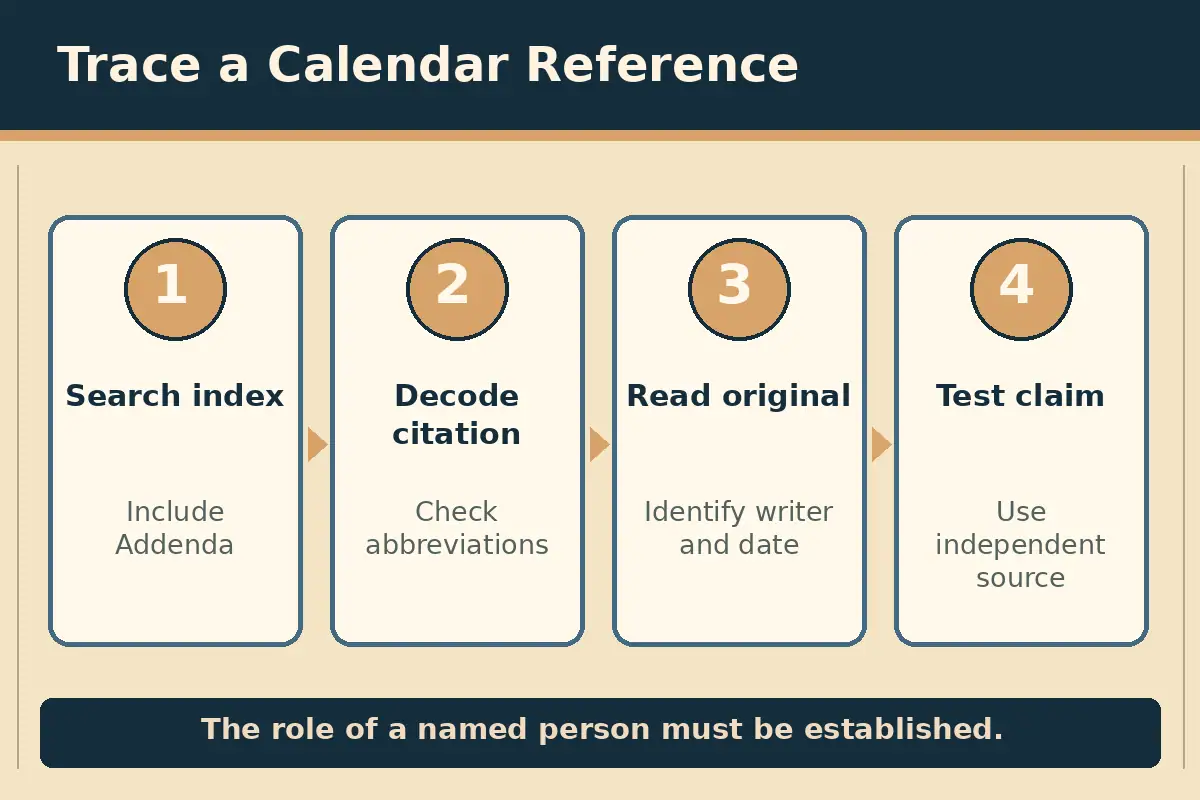
The National Archives explains that state papers for 1660–1714 are searchable in Discovery mainly by date; person or place keywords are more useful in the published calendars. For Charles II, the Calendar of State Papers Domestic runs through a multivolume printed edition with a separate final Addenda volume for 1660–1685. Choose a dated place, event or individual and search the calendar’s index, then identify the volume, page, entry date and the actual language of the abstract. A calendar is an editorial summary, not the author’s original manuscript.
Where available, State Papers Online provides digitized calendars and many images, generally by institutional subscription or onsite access at Kew. British History Online may carry calendars behind a paid service. The printed calendars remain important, particularly their back-of-volume indexes and reference keys. Record the access route separately from the citation so a later reader can use another library. If a surname occurs only as a cross-reference in the index, read the whole dated abstract before attributing its action to your ancestor.
Distinguish SP 29 Letters from SP 30 Cases
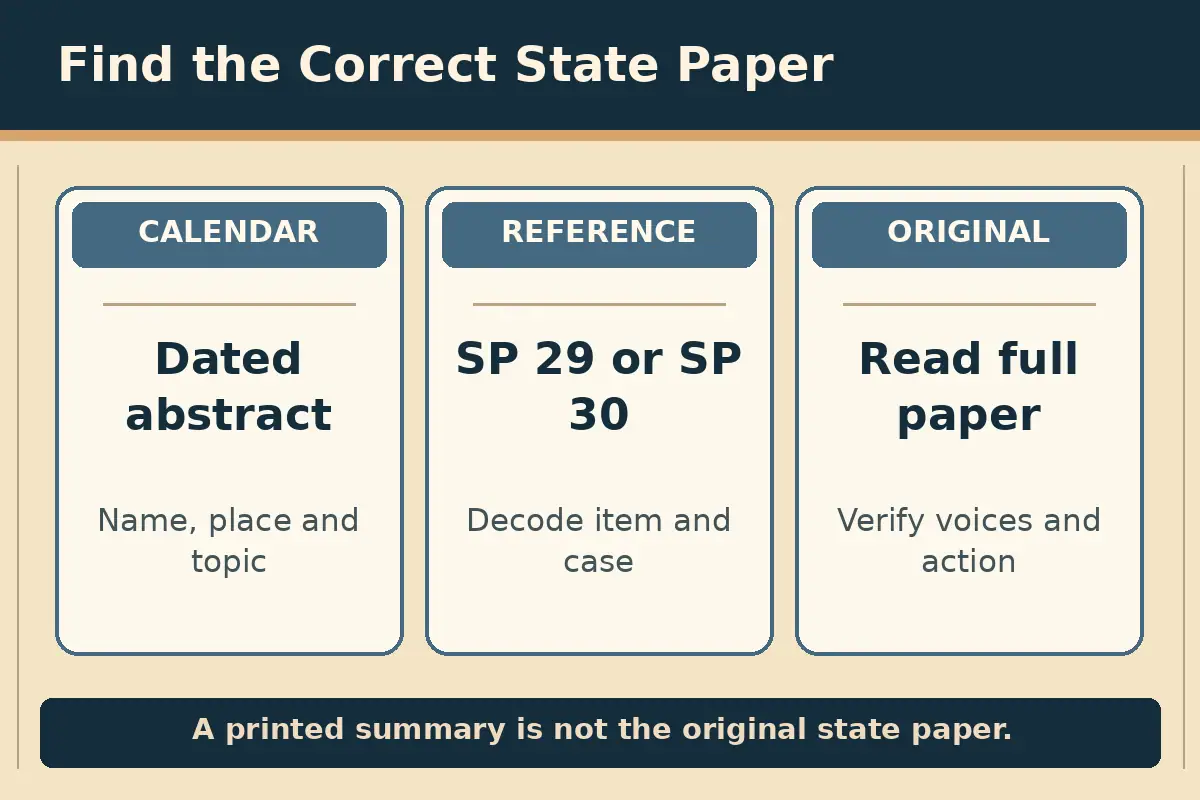
The archive’s Restoration guide identifies SP 29 as containing much of Charles II’s domestic state correspondence, while SP 30 includes many warrants, commissions, licences, pardons and related documents. The same person’s affair might generate a request, a report and a formal action, but the presence of one does not mean the others survive. Begin by noting whether the calendar entry is numbered, refers to a case, or cites an entirely different record office. Do not assume every calendar entry points to a SP 29 page.
For Charles II calendars, the archival guide explains that numbered entries ordinarily belong to the main SP 29 letters and papers, even when an editorial bracket says ‘Adm paper.’ From 1667, volume references to SP 29 often appear in square brackets at the end of the extract. An entry labelled ‘Case’ can point toward SP 30. Keep the abbreviation exactly as printed, and consult the key at the front of the calendar for exceptions and older cataloguing practices before building a modern series/piece reference.
Convert Volume, Item, and Abbreviations Correctly
Write a structured crosswalk with CALENDAR VOLUME, ENTRY DATE, EDITORIAL NUMBER, PRINTED REFERENCE, MODERN SERIES and ORIGINAL ITEM. Use an exact quoted name from the index but do not cite merely its page reference as though it were the archival manuscript. A printed reference may use Roman numerals or an old volume sequence, and the conversion depends on the particular calendar. The National Archives’ broader State Papers guides demonstrate how a volume and item number can be converted and then checked on the original paper.
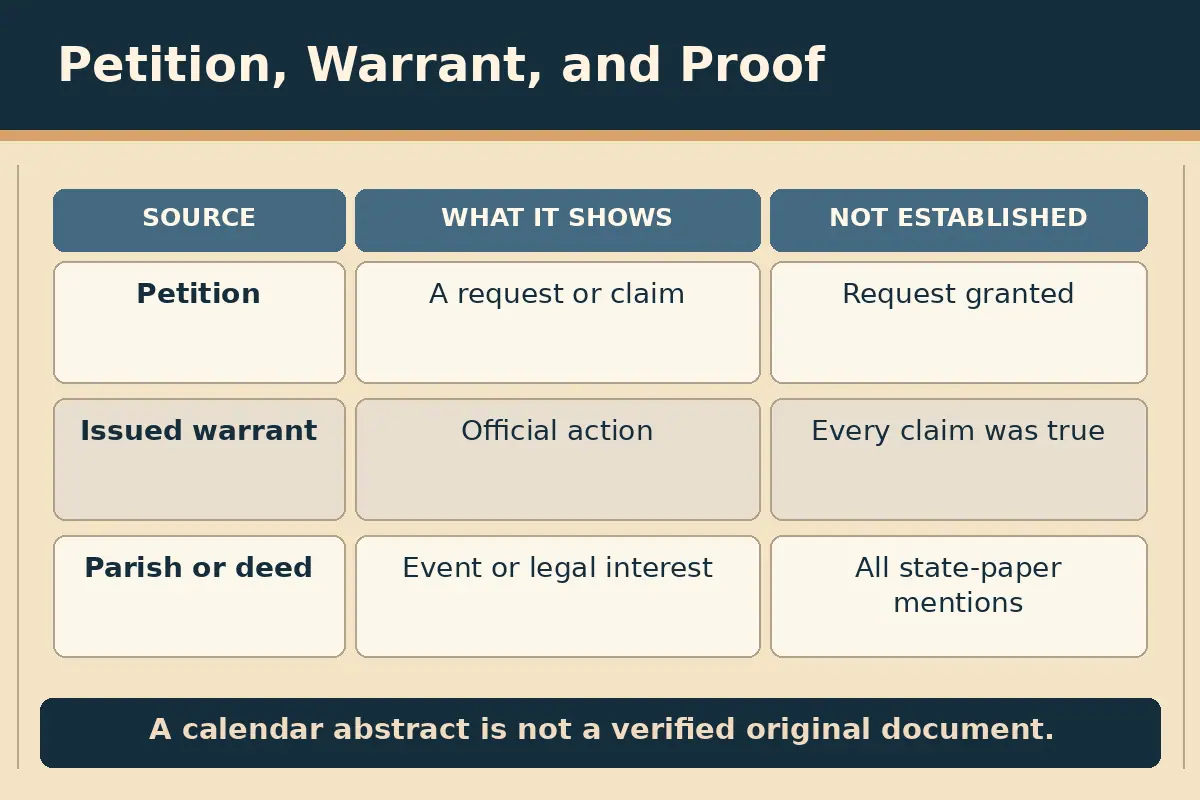
If a calendar summarizes a royal pardon, identify whether it represents a petition asking for pardon, a proposed warrant, an issued instrument or a notice of an action already taken. Those are different legal events. An abstract may also omit qualifiers, other named correspondents and attachments. Locate the actual SP 29 or SP 30 piece in Discovery or the relevant State Papers Online image, then copy the modern reference exactly. Do not manufacture an item number when the finding aid gives only a date or subject heading.
Read the Original Document and Its Voice
An official-looking document can preserve allegations made by interested parties. Classify the writer, signer, petitioner, recipient and subject of each item. A request for release, a complaint against a neighbor, a report of disturbance and the government’s order may appear side by side. A petitioner may claim to be a loyal servant, a relative or an estate owner; that wording is evidence of a statement made, not automatically proof it was true. A subsequent signed order may prove administrative action but not every allegation motivating it.
Transcribe original names and place spelling as seen, noting uncertain readings. Compare the document’s creation date with later docketing or filing dates where those appear. Where witnesses or sureties are named, document their precise role before implying kinship. The series can provide unusually rich context for post-Civil-War resettlement, security concerns, religious matters and Crown business, but must be linked to independent land deeds, parish registers or court records before family conclusions become secure. Maintain a separate ‘not shown’ field in the evidence log.
Follow Addenda and Other Archival Custodians
Do not stop after finding nothing in the main Charles II calendar volumes. The National Archives specifically advises checking the final Addenda volume covering 1660–1685, and warns that the calendars also refer to Colonial Office material, Admiralty files, foreign state papers, Treasury sources and other archives. Copy each printed abbreviation and consult the edition’s reference key. A document mentioned in the calendar may now belong to a distinct series, so its current archival home cannot be guessed from the calendar title alone.
If a calendar entry describes events in the colonies or aboard a naval vessel, trace the actual archival reference rather than forcing an SP 29 citation. For a family identity claim, also examine dated parish events or property transactions in the appropriate historical county. A negative calendar search is weak evidence if surnames vary or the index omits an individual’s appearance in the full text. Note dates and pages searched, the calendar edition, and any major gaps before interpreting silence as an absence from government affairs.
More Records and Archives Guides
How We Research a Restoration-Era Mention
We begin with a single proposed person, place or dated event, then search the Charles II calendar and its addenda as finding aids. Each hit is converted into an original SP 29, SP 30 or other custodian reference according to the printed key. We inspect the entire available document, label the roles of writers, subjects and recipients, and distinguish petitions from issued decisions. The result is a claim-level evidence record rather than a family tree built from isolated name mentions.
The National Archives’ Restoration State Papers guide explains the calendar and series codes, while its early modern political history guide clarifies the broader system of state paper custody. Neither establishes the identity or legal position of a named ancestor without an original item and independent corroboration. We flag uncertain abbreviations, missing pages and roles. See our affiliate disclosure; paid calendar access does not replace source criticism.
Not automatically. Read whether it summarizes an application, proposed warrant or issued decision and inspect the original document.
Discovery usually indexes these records by date, while published calendars offer person and subject indexes.
No. Cases can point to SP 30, and some entries concern entirely different archival series.
It contains additional descriptions for 1660–1685 that may not appear in the main chronological sequence.
No. Identify the documentary role, then test kinship through independent original sources.