
Begin With the Reign, Not a Surname Match
SP 14 holds State Papers Domestic for the reign of James I, 1603–1625, among the central government’s early Stuart documents. It contains far more than a list of persons: correspondence, petitions, commissions, reports and other papers address business passing through government offices. A named individual could be a petitioner, writer, witness, official, or subject of allegations. Begin with the year, place and type of claim you are testing, not a tempting surname in a printed calendar.
The National Archives State Papers Domestic guide assigns James I to SP 14, while Elizabeth I is primarily SP 12 and Charles I SP 16. This reign gate matters when a family story spans 1603 or 1625. The printed calendar may contain addenda or material outside the obvious date; compare its heading and reference with the manuscript rather than treating every nearby entry as SP 14.
Government papers are highly selective evidence of government attention, not a population register. Many residents never appear, and correspondence may have been kept privately by officeholders. The archive also warns that papers associated with officials may survive in other manuscript repositories. A missing name is therefore not evidence that someone did not reside in a locality.
Convert Calendar Volumes Into Archive References
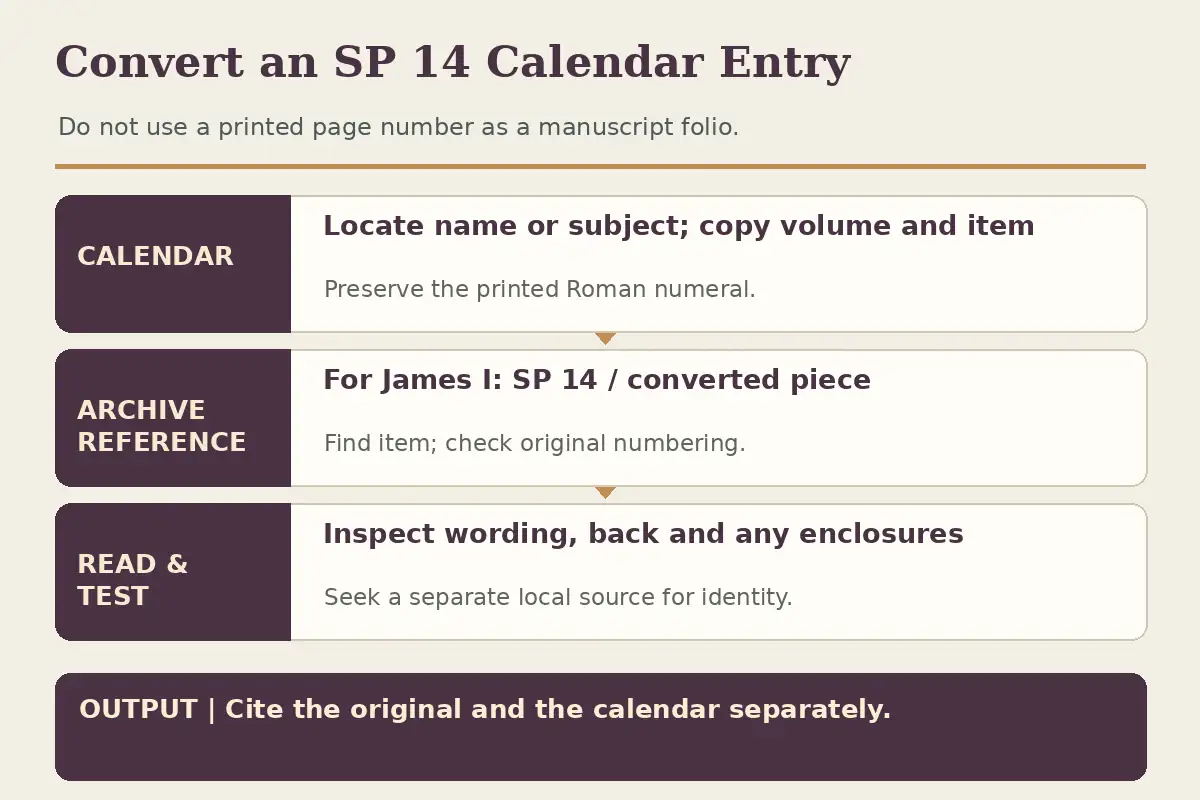
The printed Calendars of State Papers Domestic arrange documents in dated summaries and provide indexes. Find a possible entry, copy the calendar volume title and page, and note its internal volume heading. The National Archives explains that a Roman-numeral “Vol.” heading corresponds to the piece number in the relevant SP series. Convert the numeral carefully and retain the original numeral beside the resulting Arabic number.
For instance, a purely illustrative calendar heading “Vol. CX” means piece 110; if the calendar and date place it under James I, the corresponding series and piece would be SP 14/110, subject to checking the actual catalogue and item. This is a demonstration of the conversion rule, not a claim that a particular ancestor appears there. Never fabricate an item number from page order or use the calendar’s printed page as an archival folio.
The calendar entry also has an item number, and the original file may contain more than one numbering system. Record CALENDAR PAGE, VOL. HEADING, ITEM NUMBER, SP REFERENCE, and MANUSCRIPT MARK separately. If the number you expect is absent from the image, check for handwritten numbering and accompanying pages before rejecting the document. Treat an uncertain crosswalk as unresolved, not as a verified citation.

Read the Original Letter or Petition Carefully
A calendar can compress a lengthy source into a few sentences. It may normalize names, omit qualifications, or summarize an allegation as its subject. Open the document where accessible, or request the original through the catalogue. The archive notes that State Papers Online is a subscription service with free onsite availability at Kew; access to an image must not be assumed for every online search result.
Read the document’s front and reverse, any endorsements and enclosures, and as much context as the piece allows. Early Stuart handwriting includes secretary and italic styles, and dates may omit years. A clerk’s docket may identify an author or topic even when the body is damaged. Mark the source’s own words separately from calendar editorial additions and from your interpretation.
If a petition accuses a neighbour of theft or states a claimed descent, write “the petitioner alleged” until you locate independent supporting records. A royal instruction may show an order was issued, not that the requested remedy took place. An official’s endorsement can be a clue to processing or receipt without proving a later action. This step is essential to genealogical honesty.

Connect a Government Mention to Local Evidence
A person appearing in SP 14 should be connected to parish, estate, court or other local evidence appropriate to the period. Compare distinctive forenames, occupation or title, office, household associations, land names and chronology. A geographical description such as “of London” can identify an affiliation rather than a precise place of birth or a residential address.
The archive’s militia guide notes that SP 14 can include muster-related material for the reign of James I. A muster or commission still may represent a county or administrative event rather than proof of one person’s active military service. If a name appears in a list, inspect the list’s heading and purpose before assigning a rank, unit or battlefield story.
Preserve spelling variants rather than silently modernizing the source. A clerk’s Latin or secretary-hand rendering of a name may differ from contemporary parish spelling. If two people share a name, build a dates-and-associates grid rather than collapsing them. The next step is to seek an independent record with a discriminating feature, not to repeat the same calendar abstract as a second citation.
Cite the Manuscript and the Calendar Separately
A reproducible citation identifies SP 14, piece and item or folio as observed, document date, original archive and the actual viewing format. Give the printed calendar its own citation including edition, page and heading. A calendar is a finding aid and derivative description; the manuscript is an original document. They may agree, but citing both makes the chain transparent.
When you cannot access the original, quote only the modest claim actually supported by the calendar and flag the document for follow-up. A useful final entry states “calendar suggests a letter concerning X; original unexamined” rather than building a full family relationship from one line. That discipline turns SP 14 into evidence with an honest audit trail, even if a spectacular family story remains unproven.
More Records and Archives Guides
How We Research the Archival Evidence
Our method begins with the repository’s description of each series, its date limits and its known gaps. We compare record purpose with the question under investigation and distinguish direct statements in an original document from the cataloguer’s summary, a family tradition, and inference. The examples and record-class distinctions in this guide derive from the official sources listed below; they are guidance for finding and evaluating a document, not proof that any particular family member appears in it.
Official references checked on October 29, 2026: state papers domestic 1547 1649. immigration. militia. We recommend recording retrieval dates and consulting the original image or physical document when possible. See our affiliate disclosure for site-wide relationship information; no paid relationship is implied by these archive links.
No. Match the person across independently dated records using place, role, age when available, associates and documented relationships. A name hit is only a research lead.
A catalogue or printed calendar can locate a record and supply context, but summaries may omit wording and qualifications. Inspect the original before making a strong personal claim.
No. A series may have coverage limits, losses, poor indexing or alternative filing. Record the years, references and spellings actually searched before describing a gap.
Keep the complete archival series and piece, item or folio where available, document date, repository, image or physical access route and the exact claim supported.
Write a precise hypothesis and find an independent record of the relevant person, place or event. Keep unverified relationships and movements clearly labeled as unproven.